Back to News
News AlertWorld Money
Bangkok Blueprint: IMF and World Bank Tackle Digital Fraud
T
Author
Tushar Shrivas
Published
October 14, 2026
Reading Time
6 MIN READ
Spread the Word
The IMF and World Bank launch the Bangkok Blueprint to help countries combat digital financial fraud, strengthen consumer protection and improve financial resilience.
IMF World Bank Bangkok 2026, digital financial fraud framework, cyber-enabled fraud, financial resilience, Bank of Thailand, AI fraud detection
IMF and World Bank Launch a New Framework Against Digital Fraud
The International Monetary Fund (IMF) and World Bank Group introduced the Bangkok Blueprint for Fraud-Resilient Financial Services on October 14, 2026, during their Annual Meetings in Bangkok. Developed in coordination with the Bank of Thailand, the framework aims to help policymakers, regulators and financial institutions prevent, detect and respond to the growing threat of cyber-enabled fraud in digital financial services.
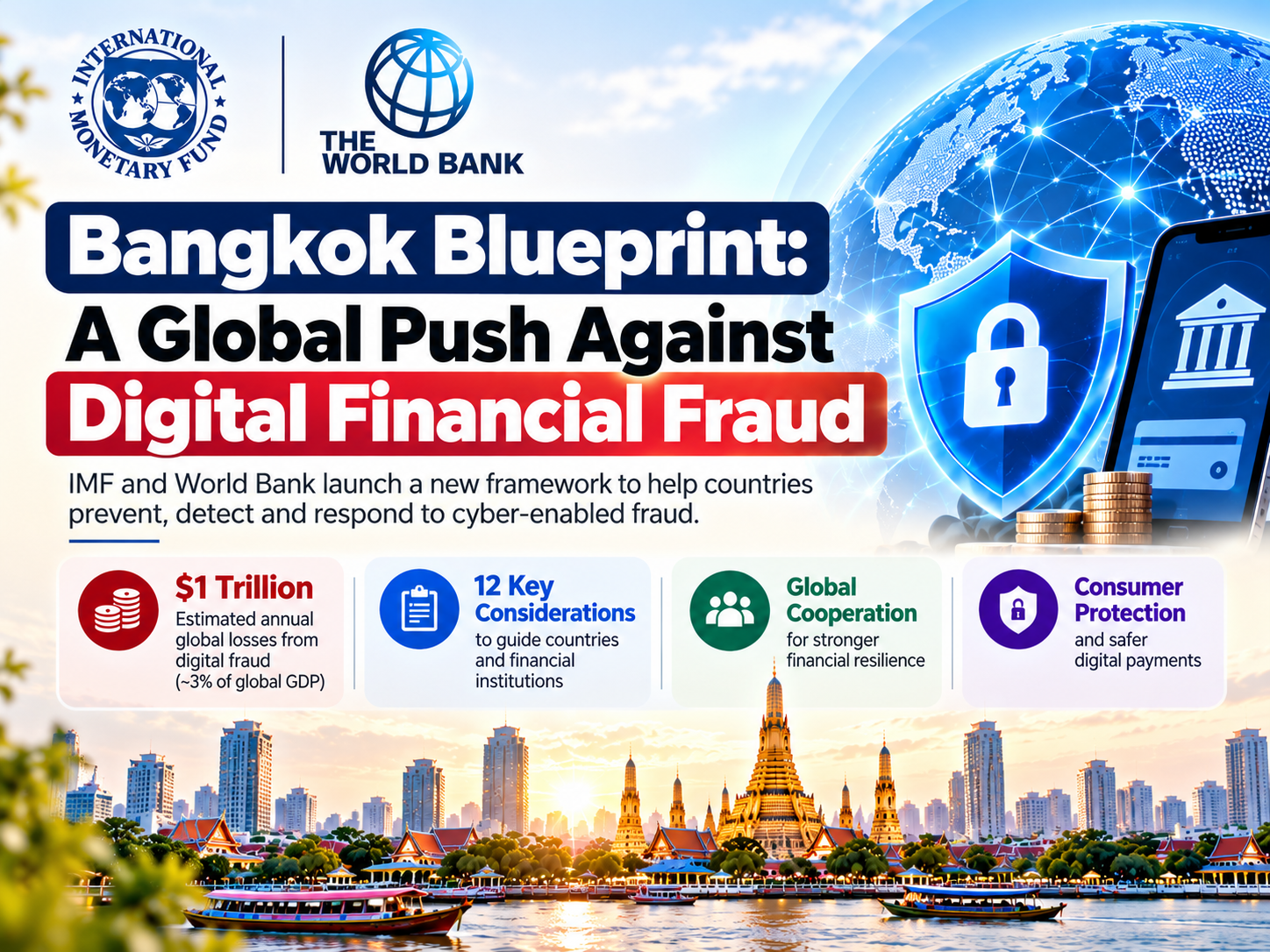
The initiative outlines 12 key considerations designed to guide countries and financial institutions in identifying vulnerabilities and strengthening their defenses. Rather than imposing a single set of rules on every country, the blueprint provides a high-level framework that can be adapted to different financial systems and regulatory environments. Official IMF event announcement
The Scale of the Problem: Digital Fraud's Global Cost
Digital financial fraud has become a serious concern for governments, banks, payment providers and consumers. At the blueprint's launch, Thailand's Finance Minister Ekniti Nitithanprapas cited an estimate that digital fraud and scams cost the global economy approximately $1 trillion annually, equivalent to around 3% of global GDP. This figure should be understood as a reported estimate rather than a precise measurement of every form of digital fraud.
The consequences extend beyond direct financial losses. Fraud can undermine confidence in digital payments, discourage consumers from using formal financial services and create additional costs for financial institutions. These risks are particularly important in countries where digital banking and mobile payments are expanding rapidly. Reuters
Five Key Areas for Strengthening Fraud Resilience
The official blueprint contains 12 key considerations. The following five areas summarize important approaches discussed in this article; they should not be interpreted as a verbatim list of officially designated pillars.
Consumer Protection and Financial Literacy: Consumers need practical guidance on recognizing suspicious messages, fraudulent payment requests, impersonation scams and attempts to steal account credentials. Better awareness can complement technical safeguards, although responsibility for preventing fraud should not fall on consumers alone.
Fraud Prevention, Detection and Response: Financial institutions can strengthen their defenses by monitoring suspicious transactions, improving alert systems and establishing clear procedures for responding to reported fraud. Timely detection can help limit losses and improve the chances of an effective response.
Policy and Legal Foundations: Governments and regulators need appropriate legal frameworks, supervisory powers and reporting mechanisms to address digital financial crime. Clear responsibilities can help institutions respond more consistently when fraud crosses organizational or national boundaries.
Domestic and International Cooperation: Fraud schemes frequently operate across borders, making cooperation among banks, regulators, law-enforcement agencies and technology providers important. Appropriate information-sharing arrangements can help authorities identify patterns and coordinate investigations.
Protection by Design: Security should be considered when digital financial products are developed, rather than added only after problems emerge. Building safeguards into account opening, authentication and payment processes can help reduce vulnerabilities from the beginning. IMF
Why Emerging Markets Need Stronger Fraud Defenses
Emerging markets are rapidly expanding access to digital banking, mobile payments and online financial services. These technologies can improve convenience and financial inclusion, but their benefits depend partly on whether consumers trust the systems they use.
Institutions with limited cybersecurity resources may face challenges in detecting sophisticated scams, coordinating investigations and responding quickly to incidents. An adaptable international framework can help policymakers identify gaps and establish priorities without assuming that every country has the same infrastructure or regulatory capacity.
Thailand's involvement is particularly relevant because the initiative was developed in coordination with the Bank of Thailand. Its participation reflects the importance of collaboration between international financial institutions and national authorities when addressing risks that affect digital financial services.
What the Blueprint Means for Banks and Fintech Companies
Banks, payment networks, remittance providers and fintech platforms may use the Bangkok Blueprint as a reference when reviewing their fraud-prevention strategies. Its focus on cooperation and preventive safeguards is relevant to companies that process transactions across multiple jurisdictions.
Possible areas for institutions to review include transaction monitoring, customer authentication, fraud-reporting procedures, consumer education and coordination with relevant authorities. Implementing stronger systems can involve technology investments, staff training and operational costs, but inadequate protections can also lead to financial losses and damage to customer trust.
Importantly, the blueprint does not automatically create new legal obligations for every financial institution. Binding requirements will depend on the applicable laws and regulations adopted by individual jurisdictions. The framework's practical influence will therefore depend on how regulators and institutions choose to use it.
IMF
The Bottom Line
The IMF and World Bank's Bangkok Blueprint highlights the growing importance of coordinated action against digital financial fraud. By outlining 12 key considerations, the framework gives policymakers and financial institutions a reference for improving prevention, detection, consumer protection and international cooperation.
Its impact will depend on implementation rather than announcement alone. As digital payments and AI-powered technologies continue to evolve, stronger safeguards and effective collaboration will be essential to maintaining trust in financial services.
Frequently Asked Questions
Is the Bangkok Blueprint legally binding?
No. It is a high-level framework intended to guide policymakers, regulators and financial institutions. Any binding obligations depend on the laws and regulations adopted by individual jurisdictions.
What does the Bangkok Blueprint cover?
It sets out 12 key considerations to help stakeholders identify vulnerabilities and design approaches to prevent, detect and address cyber-enabled fraud in financial services.
How much does digital fraud cost globally?
Thailand's finance minister cited an estimate of approximately $1 trillion annually, or around 3% of global GDP. This should be treated as a reported estimate, not a precise measurement of every type of fraud.
Who developed the Bangkok Blueprint?
The IMF and World Bank Group developed it in coordination with the Bank of Thailand.
How does artificial intelligence affect financial fraud?
AI can help criminals produce more convincing scams and automate certain fraudulent activities. Financial institutions can also use AI-assisted monitoring to flag suspicious transactions, provided these systems are appropriately supervised.
Will the blueprint increase compliance costs for fintech companies?
It may encourage institutions to review and improve their fraud-prevention systems, potentially requiring additional investment. However, the blueprint itself does not automatically impose new compliance requirements.

Tushar Shrivas
B.Tech CS@ Shri Balaji Institute of Technology & Management
I write at Metaplugs — breaking down the latest in tech, economics, and business into simple, impactful stories for everyday readers. Passionate about software testing and global finance.