Back to News
News AlertWorld Money
IMF October 2026 Outlook: 3.1% Growth Holds, but the Buffers Are Thin
V
Author
Vicky Galfat
Published
October 15, 2026
Reading Time
4 MIN READ
Spread the Word
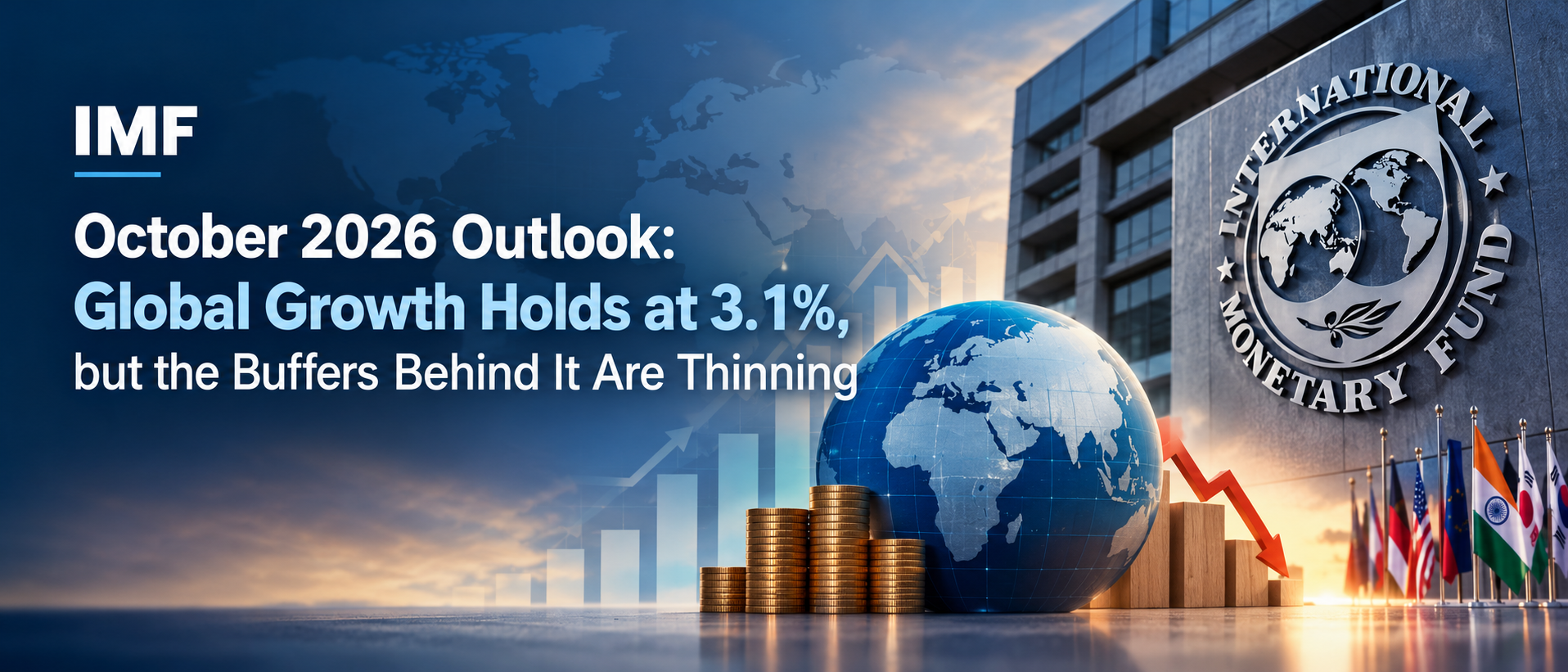
IMF holds 2026 global growth at 3.1% and sees inflation at 4.7%, but warns energy, AI and debt buffers are thinning. India is forecast at 7.0%.
IMF World Economic Outlook October 2026, global growth forecast 2026, global inflation 4.7%, India GDP forecast 7.0%, Resilience Under Strain Urgent Choices, Asia growth AI supply chain, IMF fiscal policy warning, targeted support price controls, South Korea growth AI exports.
IMF October 2026 Outlook: Global Growth Holds at 3.1%, but the Buffers Behind It Are Thinning
The International Monetary Fund left its 2026 global growth forecast unchanged at 3.1% in its October World Economic Outlook, titled "Resilience Under Strain, Urgent Choices." The headline looks calm. The report's message is not: the buffers that kept the world economy growing through a Middle East war and an energy shock are wearing thin. Reuter
The Headline Numbers
The IMF projects global growth of 3.1% in 2026, the same as in April, and 3.4% in 2027, a moderate upward revision. Global headline inflation is expected to rise to 4.7% in 2026, mainly because of higher energy and food prices, before easing to 4.1% in 2027. The Fund says risks to the outlook are tilted to the downside, although stronger AI investment and faster productivity gains could lift growth. Upstox
Three Props Under Strain
The IMF identifies three areas where resilience is stretched, according to reporting on the launch. Adjustments to the energy market are close to exhausted. Growth leans heavily on a concentrated AI investment boom, and a correction in AI valuations is flagged as a risk. And fiscal space is shrinking: public debt is high in many economies, buffers were spent absorbing earlier shocks, and higher financing costs expose the vulnerability.
The Fund also sketches a downside scenario in which higher commodity prices and worries about public finances lead markets to reassess government borrowing risk. In that case, 2027 growth would be materially lower than the baseline and inflation significantly higher. NaN News
Asia Has Two Different Engines
Asia is where growth is strongest, but the IMF's explanation differs by country, and this is where the usual summary goes wrong. Economies tightly woven into the AI supply chain, including South Korea, Singapore, Vietnam and Malaysia, received significant upward revisions. India's story is different. The IMF raised its forecast to 7.0% for fiscal 2026-27, up 0.6 percentage points from July, and 7.4% on a calendar-year basis, but it credits domestic demand and services, not AI hardware exports.
India is not insulated. The IMF projects Indian consumer price inflation of 5.0% in 2026, up from 2.0% in 2025, and does not suggest the country escapes the global energy shock. Elsewhere in the region, China's growth is forecast to slow to 4.5% in 2026 and 4.0% in 2027, with higher oil prices and structural headwinds weighing on activity. Emerging and developing Asia is forecast to grow 5.1% in 2026. Across the Middle East and Central Asia, the IMF expects a 0.3% contraction this year. Asianet Newsable
Why the IMF Prefers Targeted Support to Price Controls
The report's fiscal advice is specific. A chapter on past cost-of-living crises finds that targeted, temporary transfers are the most effective and cheapest way to protect vulnerable households while keeping fiscal space and letting prices adjust. Measures that suppress prices can cost 3 to 22 times more in fiscal resources, and may stop working when fiscal space is limited or many countries adopt them at once.
That matters because the IMF also says fiscal policy must be restrained to contain demand pressures when inflation risks are high. Any support, it says, should be temporary and aimed at the most vulnerable. Governments that respond to fuel and food prices with broad subsidies or price caps are choosing the more expensive route at a time when borrowing costs are higher.
The IMF's framing is that countries must move from coping to rebuilding. The difficulty is that the three props it flags may weaken together. If energy relief runs out, AI valuations fall and borrowing costs stay high, the economies that grew fastest this year, from Korea's chip exporters to India's domestic services sector, would be tested in different ways. The report cannot say which gives way first, only that its baseline of 3.1% is an outcome of resilience that has not yet been tested all at once.

Vicky Galfat
University of Mumbai/BCA
Learning, building, and exploring the world of technology one project at a time.