Back to News
News AlertWorld Unicorn
Base Power's $13B Valuation: Home Batteries as Data Center Capacity
V
Author
Vicky Galfat
Published
October 21, 2026
Reading Time
4 MIN READ
Spread the Word
Base Power's $13B valuation tripled in 10 months on home batteries sold as grid capacity. Compare it with Mistral and Etched's AI capacity bets.
Base Power valuation, Base Power Series D, distributed energy storage, virtual power plant, data center power constraints, Base Core battery, Zach Dell, AI energy infrastructure, Mistral valuation, Etched valuation.
Base Power valuation, Base Power Series D, distributed energy storage, virtual power plant, data center power constraints, Base Core battery, Zach Dell, AI energy infrastructure, Mistral valuation, Etched valuation.
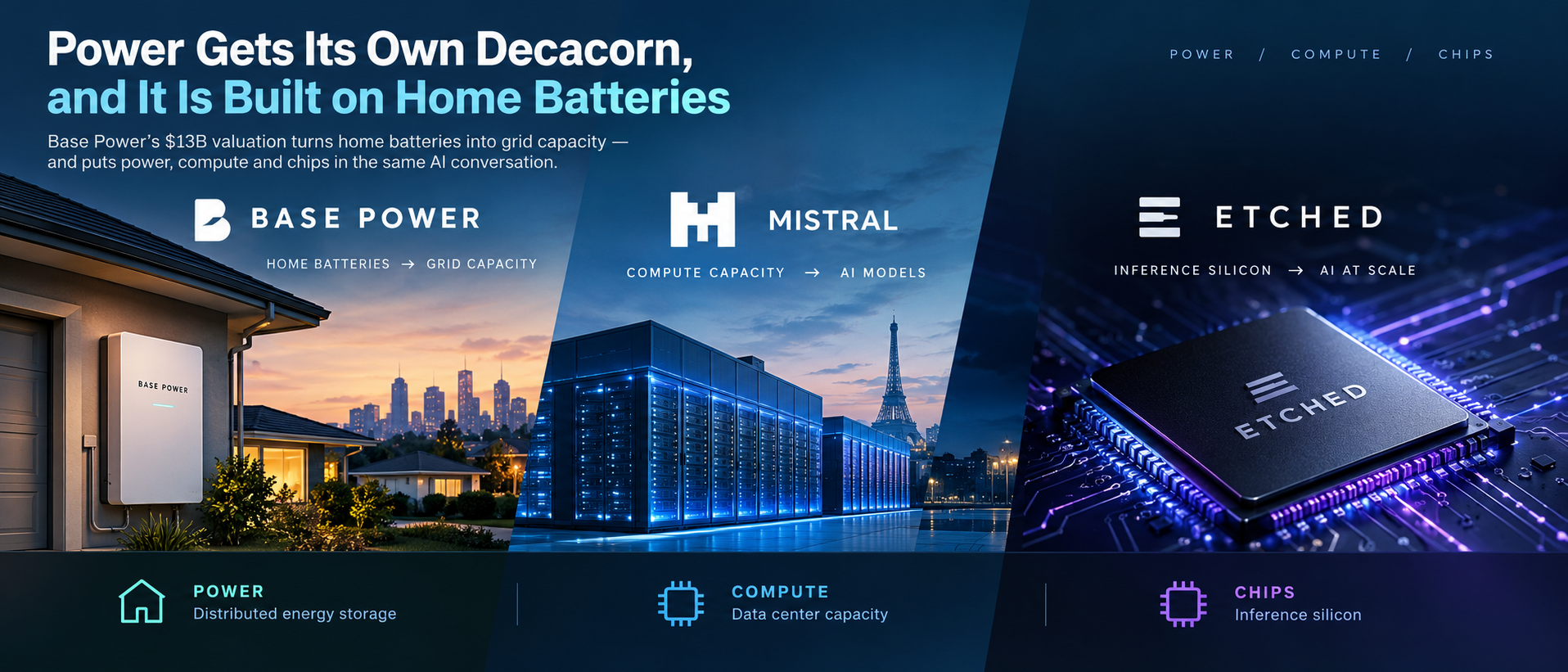
Power Gets Its Own Decacorn, and It Is Built on Home Batteries
Base Power, a 2023 startup that installs batteries in Texas garages, is now valued at $13 billion, more than triple the $4 billion it was worth at its previous round. The pitch is that the fastest way to add grid capacity for AI data centers is not a new power plant but thousands of homes acting as one. It is a useful counterpoint to the two other AI decacorns usually named in the same breath, Mistral and Etched. ESG Today
What Base Power Actually Sells
Base Power announced a $1 billion Series D at a $13 billion post-money valuation in early August, led by Ribbit, Addition, Valor Equity Partners and JPMorganChase's Strategic Investment Group. It has raised more than $2.5 billion since being founded in 2023 by Justin Lopas and Zach Dell, son of Dell Technologies founder Michael Dell. Analytics Insight
The company is not a micro-grid developer. It owns and installs home batteries and sells electricity to the homeowners as a retail provider in Texas, while its software coordinates the fleet as a virtual power plant. It has deployed more than 23,000 systems, roughly 550 megawatt-hours of storage, and launched Base Core alongside the round: a 39.2 or 78.4 kilowatt-hour home battery built at its Austin factory. Wowtale
The Data Center Link: Claimed Versus Signed
The data center story is real but easy to overstate. Investor Salesforce Ventures argues Base can give a hyperscaler a 100-megawatt utility-grade asset in three to six months. Dell has said utilities, data center developers and hyperscalers have approached the company for fast capacity, and Base is pursuing frameworks in which a data center finances distributed batteries whose capacity is delivered to the local utility. The company's utility partnerships already cover more than 200 megawatts.
Salesforce Ventures
What coverage reviewed here does not show is a named, signed long-term supply agreement with a hyperscaler. The evidence so far is utility partnerships and inbound interest. There is also a physical limit: batteries shift energy through the day and relieve peaks, but they do not generate it. That helps with interconnection and peak demand, not with a campus that runs flat out around the clock.
Base plans to lift manufacturing from about 40 megawatts of home batteries a month to 100 megawatts by the end of the year, and it faces competition from Tesla's Powerwall programs, Lunar Energy, Sunrun and sonnen. Latitude Media
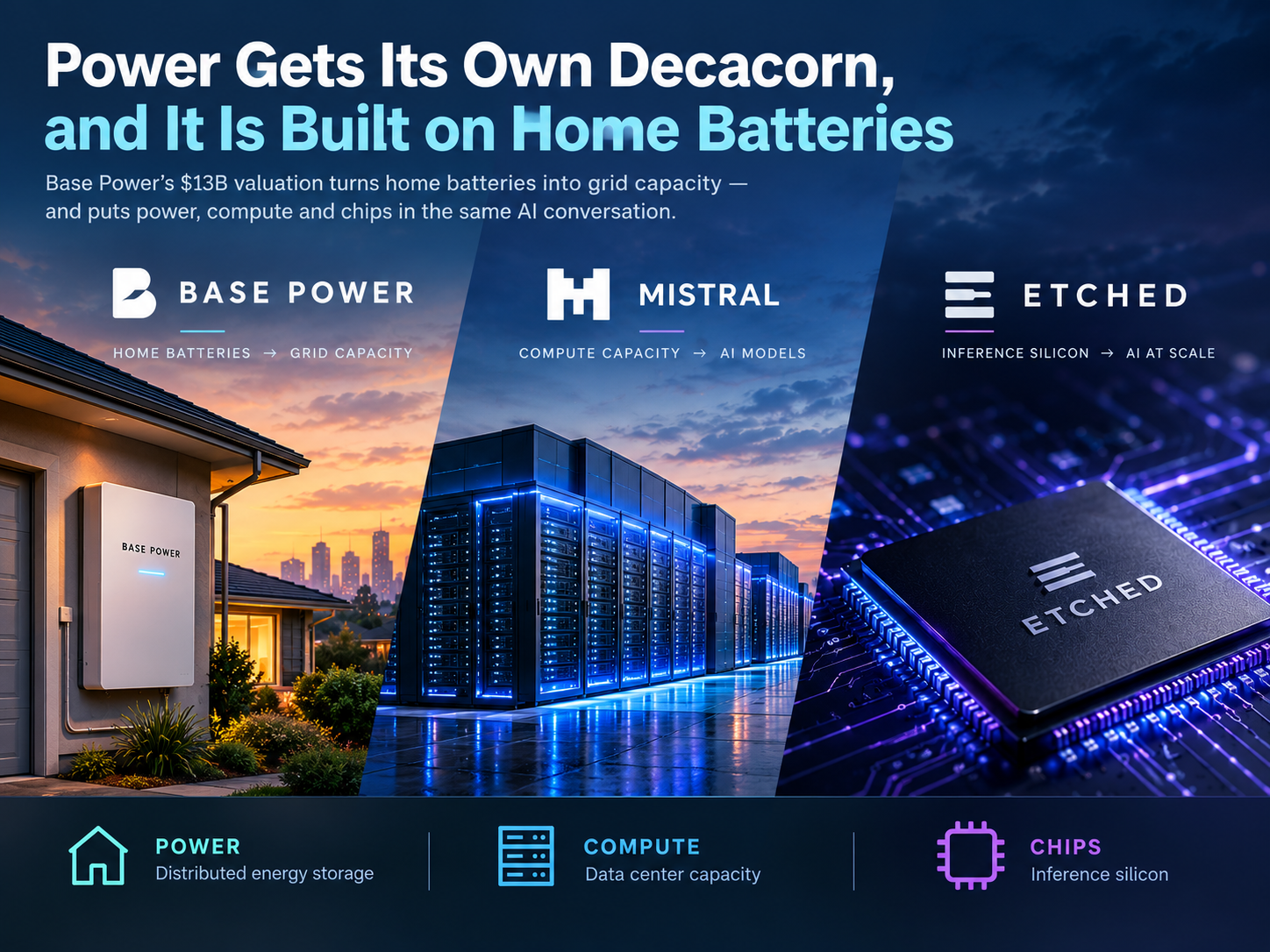
Three Decacorn Step-Ups Side by Side
Set beside the other two, Base's rise is fast but not the fastest.
Base Power went from $4 billion to $13 billion in about ten months. Mistral AI announced a €3 billion Series D on 8 September at a post-money valuation above €21 billion, around $24.4 billion, up from €11.7 billion a year earlier. It is building a 44-megawatt data center site near Paris. Etched, valued at $5 billion in December 2025, raised $700 million at $21 billion on 18 August and was reported on 5 October to be fielding offers of $40 billion to $50 billion. Implicator
Each is a bet on a different scarce input: power for Base, compute capacity for Mistral, and inference silicon for Etched. Which scarcity binds first is contested, since earlier reporting also points to memory supply as a constraint on chipmakers.
Each is a bet on a different scarce input: power for Base, compute capacity for Mistral, and inference silicon for Etched. Which scarcity binds first is contested, since earlier reporting also points to memory supply as a constraint on chipmakers.
Hardware Economics, Not Software Margins
Analysts note that Base's $13 billion rests on hardware with real installation and maintenance costs, not software margins. That makes its valuation a bet on volume and deployment speed. Each home needs a visit, a battery and a customer who stays, which differs from scaling a model or a chip design. Analytics Insight
The Open Question
All three valuations are priced on how quickly scarce capacity can be delivered. Base's test comes next: whether utilities and hyperscalers convert interest into signed contracts at the pace its factory ramps. If they sign slowly, the question is whether a valuation built on speed to capacity can wait for them.

Vicky Galfat
University of Mumbai/BCA
Learning, building, and exploring the world of technology one project at a time.