LATEST NEWS
Swiggy Didn't Sell Its B2B Arm for Cash — It Bought Into the Company Buying It
September 9, 2026 5M
Back to News
News AlertWorld of Startup’s
Blackstone Invests in FUTRONIC to Accelerate Humanoid Robotics Mechanics
V
Author
Vishal Sable
Published
July 21, 2026
Reading Time
3 MIN READ
Spread the Word
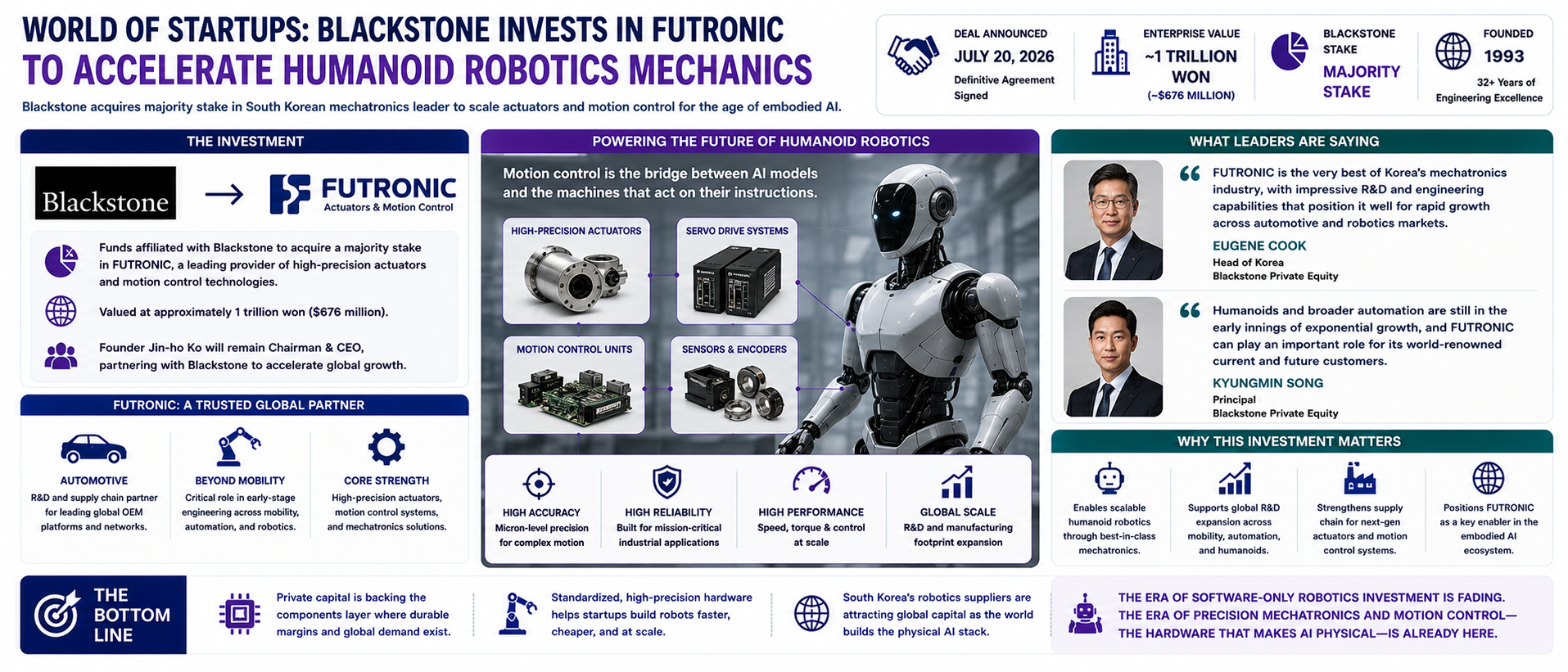
Venture capital and global private equity firms are heavily backing "Embodied AI"—funding the physical mechatronics, sensors, and high-precision actuators needed to run humanoid robots in real-world factories. On July 20, private equity titan Blackstone announced that funds affiliated with the firm have entered into a definitive agreement to make a significant investment in FUTRONIC, a leading South Korean provider of high-precision actuators and motion control technologies. The deal values FUTRONIC at approximately 1 trillion won ($676 million), with Blackstone acquiring a majority stake. Founded in 1993, FUTRONIC has evolved into a trusted R&D and supply chain partner for many of the world's most recognized automotive OEM platforms and their networks. Today, it plays a critical role in early-stage engineering across broader mobility end-markets, including humanoids and general robotics.
The partnership is specifically designed to scale FUTRONIC's global R&D footprint across the mobility, general automation, and humanoid robotics sectors. Founder Jin-ho Ko will remain Chairman and CEO, working with Blackstone to accelerate the company's global growth and end-market expansion. Eugene Cook, Head of Korea for Blackstone Private Equity, called FUTRONIC "the very best of Korea's mechatronics industry," noting its impressive R&D and engineering capabilities that position it well for rapid growth across automotive and robotics markets. Kyungmin Song, Principal at Blackstone Private Equity, framed the investment in the context of the AI era: "Humanoids and broader automation are still in the early innings of exponential growth, and FUTRONIC can play an important role for its world-renowned current and future customers. The convergence of Artificial Intelligence and the physical world is a key investment theme for Blackstone's Private Equity business". Blackstone sees motion control as the bridge between AI models and the machines that act on their instructions, a piece of the humanoid robotics buildout that rarely makes headlines but sits underneath most of it.
Startups building physical automation are benefiting from standardized hardware components. As actuator and sensor manufacturing scales globally, robotics startups can purchase off-the-shelf, high-precision motion systems to build automated warehouse pickers and assistant robots faster and at significantly lower price points. Private equity has flowed steadily into South Korea's robotics suppliers through 2026, on the theory that the components layer of the industry—rather than the finished robots—is where durable margins hide. Blackstone's move lands in the middle of that debate, on the side that says the underlying hardware is worth owning regardless of which robot company ultimately wins. July 2026 marks a decisive shift in how private capital approaches physical AI. The era of software-only robotics investment is fading. The era of precision mechatronics, actuators, and motion control—the essential hardware that makes AI physical—is already here.

Vishal Sable
B.Tech AD @ shri balaji institute of technology and management
Engineering and tech journalist. I love exploring the impact of emerging technologies on global defense, sovereignty, and everyday life. Always looking for the real story behind the headlines.