LATEST NEWS
Swiggy Didn't Sell Its B2B Arm for Cash — It Bought Into the Company Buying It
September 9, 2026 5M
Back to News
News AlertWorld of Startup’s
Capital Floods into "Embodied AI" and Industrial Frameworks
V
Author
Vishal Sable
Published
July 9, 2026
Reading Time
4 MIN READ
Spread the Word
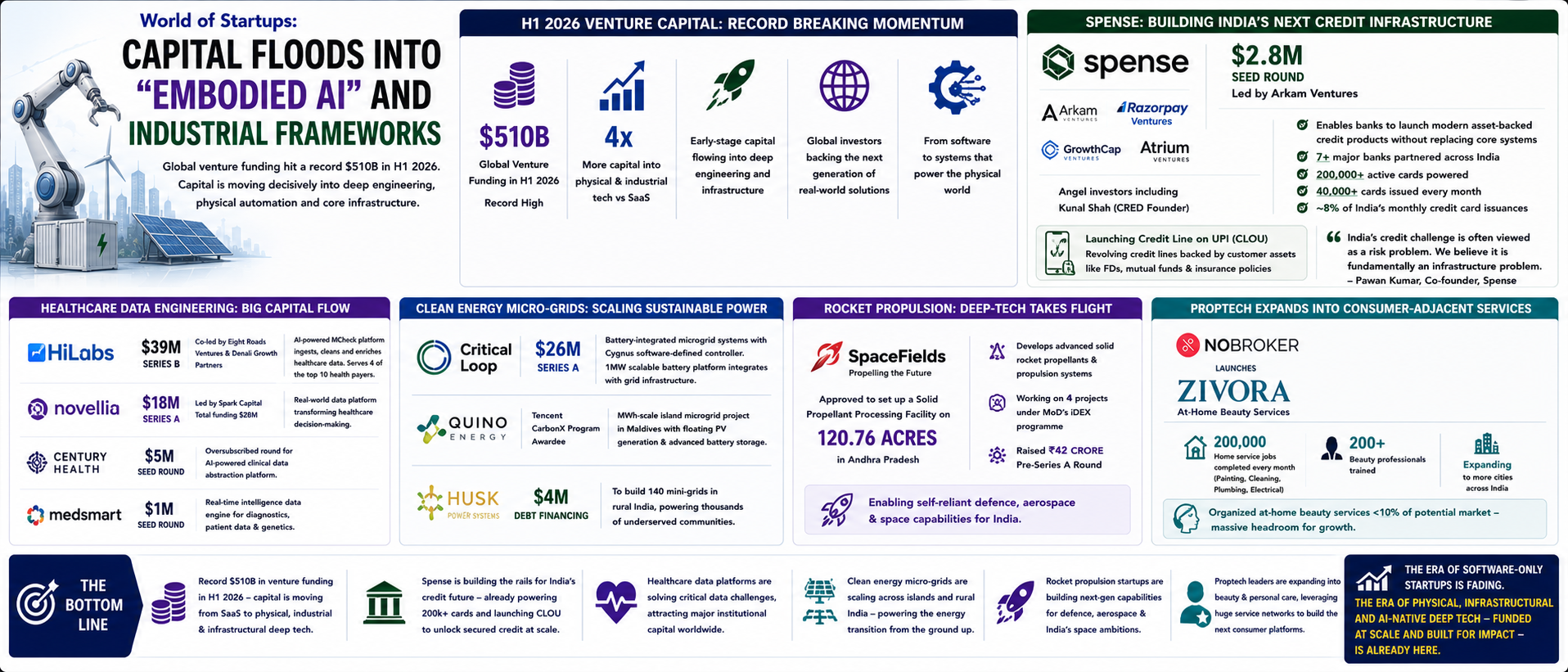
Venture capital is aggressively moving away from standard software-as-a-service (SaaS) frameworks to fund deep engineering, physical automation, and core credit infrastructure. Following a historic first half of the year where global venture funding hit a record $510 billion, early-stage capital is now flowing decisively into physical mechanics—from digital credit rails and healthcare data engineering to clean energy micro-grids and next-generation rocket propellants.
Spense Builds the Infrastructure for India's Next Credit Era
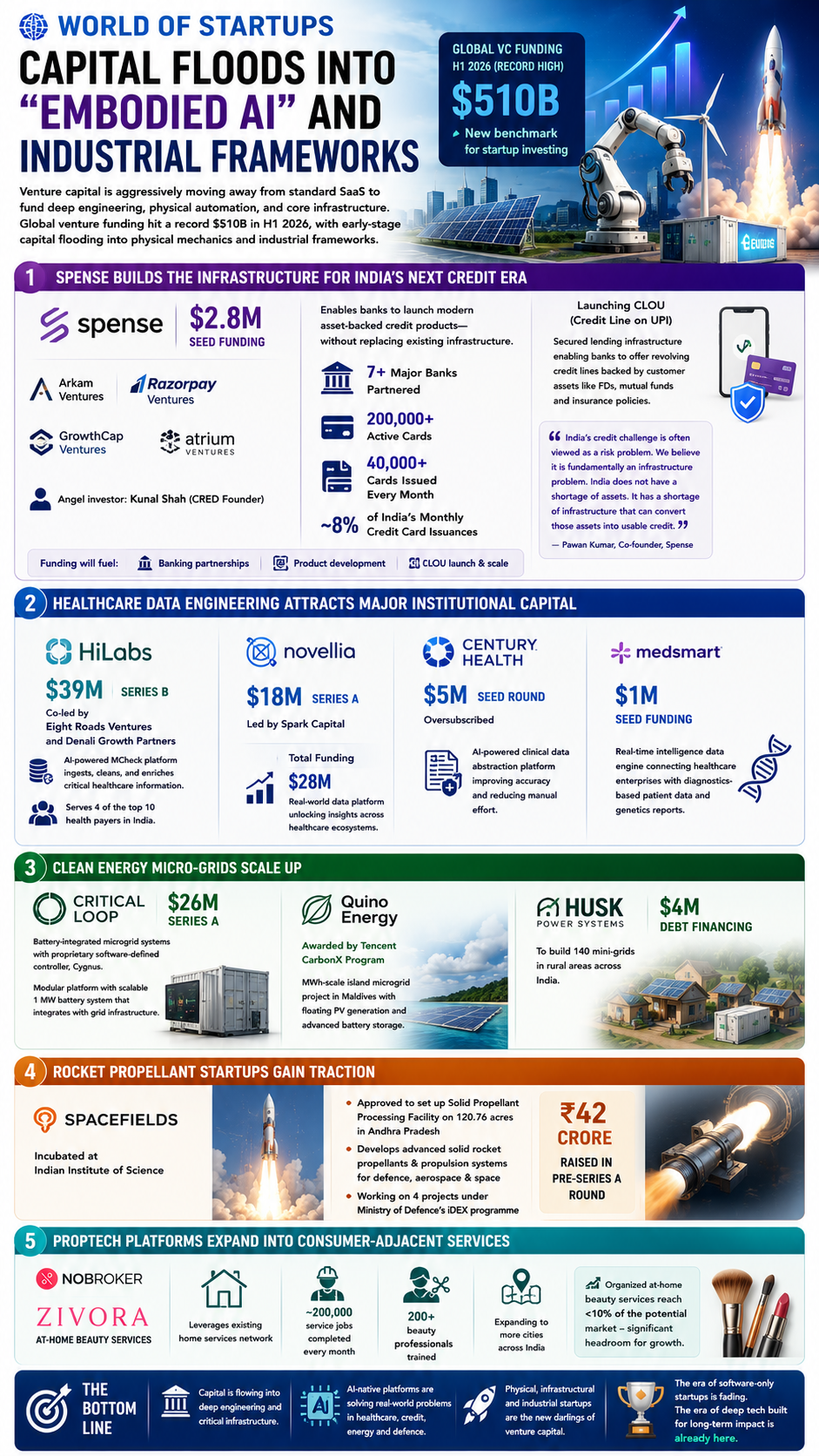
Bengaluru-based fintech infrastructure startup Spense has raised $2.8 million in a seed funding round led by Arkam Ventures, with participation from Razorpay Ventures, GrowthCap Ventures, Atrium Ventures, and angel investors including CRED founder Kunal Shah. The startup enables banks to launch modern asset-backed credit products—including secured credit cards and credit lines—without replacing their existing technology infrastructure. Spense has already partnered with seven major banks across India, powers over 200,000 active cards, and issues more than 40,000 cards every month—accounting for nearly 8% of the country's monthly credit card issuances.
The fresh capital will deepen banking partnerships, accelerate product development, and launch Credit Line on UPI (CLOU), a secured lending infrastructure that enables banks to offer revolving credit lines backed by customer assets such as fixed deposits, mutual funds, and insurance policies. As Spense co-founder Pawan Kumar framed it: "India's credit challenge is often viewed as a risk problem. We believe it is fundamentally an infrastructure problem. India does not have a shortage of assets. It has a shortage of infrastructure that can convert those assets into usable credit".
Healthcare Data Engineering Attracts Major Institutional Capital
Healthcare data engineering is emerging as a major deep-tech investment theme. Health data platform HiLabs raised $39 million in its Series B funding round, co-led by Eight Roads Ventures and Denali Growth Partners. The company's AI-powered MCheck platform ingests, cleans, and enriches critical healthcare information, serving four of the nation's top ten health payers.
Novellia, a New York-based real-world data platform, raised **$18 million** in a Series A led by Spark Capital, bringing its total funding to $28 million. Century Health secured **$5 million** in an oversubscribed seed round for its AI-powered clinical data abstraction platform. Medsmart, a Bangalore-based health-tech startup, raised $1 million to launch its real-time intelligence data engine connecting healthcare enterprises with diagnostics-based patient data and genetics reports.
Clean Energy Micro-Grids Scale Up
Industrial power solutions provider Critical Loop raised $26 million in a Series A funding round for its battery-integrated microgrid systems. The company's solution combines battery energy storage with its proprietary software-defined controller, Cygnus, into a modular platform featuring a scalable 1 MW battery system that integrates with grid infrastructure.
Quino Energy received an award from Tencent's CarbonX Program for a MWh-scale island microgrid project in the Maldives, featuring floating PV generation and advanced battery storage. In India, Husk Power Systems secured $4 million in debt financing to construct 140 mini-grids in rural areas.
Rocket Propellant Startups Gain Traction
SpaceFields, a deep-tech startup incubated at the Indian Institute of Science, received approval to set up a Solid Propellant Processing Facility on 120.76 acres in Andhra Pradesh. The company develops advanced solid rocket propellants and propulsion systems for defence, aerospace, and space applications, and is currently working on four projects under the Ministry of Defence's iDEX programme. The startup recently raised Rs 42 crore in a pre-Series A funding round.
Proptech Platforms Expand into Consumer-Adjacent Services
Startups are successfully shifting into consumer-adjacent operations. Proptech unicorn NoBroker launched Zivora, a dedicated at-home beauty services brand, leveraging its existing home services network that already completes around 200,000 service jobs every month across painting, cleaning, plumbing, and electrical work. The company has trained over 200 beauty professionals and plans to expand to more cities. With organized at-home beauty services reaching less than 10% of the potential market, the category offers significant headroom for growth.
The Bottom Line
July 2026 marks a decisive pivot in startup investing. Capital is flowing into deep engineering—Spense's credit infrastructure, HiLabs' healthcare data platforms, Critical Loop's micro-grids, and SpaceFields' rocket propellants. Proptech leaders are expanding into beauty and personal care, leveraging massive service networks to build consumer-adjacent businesses. The era of software-only startups is fading. The era of physical, infrastructural, and AI-native deep tech—funded at scale and built for long-term impact—is already here.

Vishal Sable
B.Tech AD @ shri balaji institute of technology and management
Engineering and tech journalist. I love exploring the impact of emerging technologies on global defense, sovereignty, and everyday life. Always looking for the real story behind the headlines.