LATEST NEWS
Swiggy Didn't Sell Its B2B Arm for Cash — It Bought Into the Company Buying It
September 9, 2026 5M
Back to News
News AlertWorld of Startup’s
"Connectomics" Startup Flourish Raises $500M from Jeff Bezos to Kill AI Energy Drain
V
Author
Vishal Sable
Published
July 11, 2026
Reading Time
3 MIN READ
Spread the Word
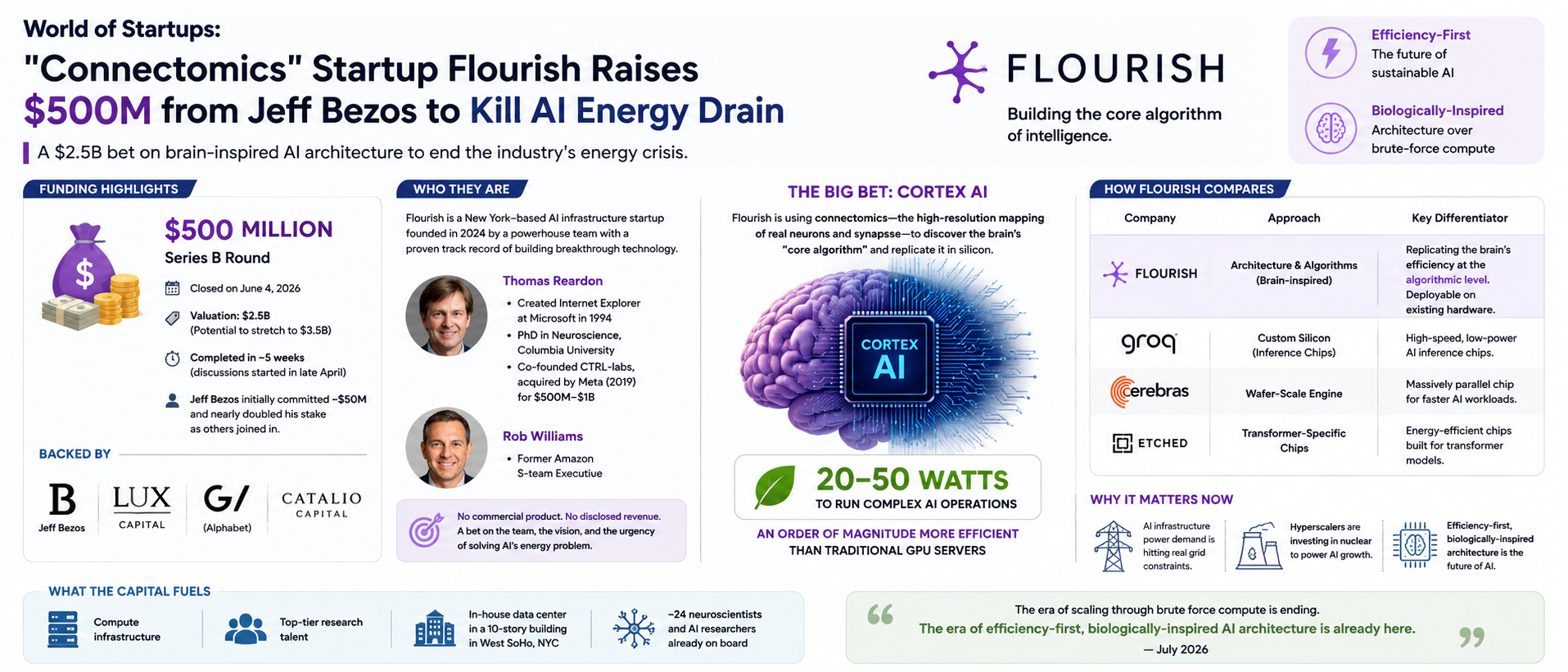
The venture capital market is shifting away from generic software platforms to back deep physical science, alternative hardware, and energy breakthroughs . Data tracking mid-year venture capital trends reveals a massive surge in deep tech, with UK startups alone raising $17 billion in H1 2026, where AI swallowed 74% of the share . Highlighting this trend, New York-based brain-inspired AI infrastructure startup Flourish raised a massive $500 million Series B round at a $2.5 billion valuation (with potential to stretch to $3.5 billion), backed by Jeff Bezos, Lux Capital, GV (Alphabet's venture arm), and Catalio Capital . The round closed on June 4, 2026, and was completed in about five weeks after funding discussions started in late April . Bezos initially committed roughly $50 million but nearly doubled his stake after other high-profile investors piled in .
Flourish, co-founded in 2024 by Thomas Reardon and Rob Williams, has no commercial product and no disclosed revenue, making the $2.5 billion valuation a bet on the founding team's track record and on how urgently the industry needs a different answer to the energy problem . Reardon is the engineer who created Internet Explorer at Microsoft in 1994, then earned a neuroscience PhD at Columbia, and later co-founded CTRL-labs, a neural interface startup Meta acquired in 2019 for between $500 million and $1 billion . Williams is a former Amazon S-team executive . The company is using connectomics—the high-resolution mapping of real neurons and synapses—to find what they call the "core algorithm" of the brain and replicate it in silicon .
Flourish is building Cortex AI, an architectural system that runs complex AI operations on just 20 to 50 watts of energy, completely bypassing the massive energy draw required by standard Nvidia-reliant server stacks . A single server-grade GPU, by comparison, consumes more than 30 times that amount . The company's thesis is that the industry is optimizing at the wrong layer, and that reverse-engineering the brain's actual efficiency mechanisms—rather than loosely mimicking them—is the only credible path to sustainable AI at scale . That architecture-first approach puts Flourish in direct competition with efficiency-focused AI ventures like Groq and Cerebras, which build specialized chips for faster, lower-power AI inference, and Etched, which produces transformer-specific chips that consume less energy than standard GPUs . While those rivals are improving efficiency through custom silicon, Flourish is betting it can do so through algorithms and architecture—making Cortex AI deployable on existing hardware . If they deliver, the energy savings are an order of magnitude. The pitch lands as AI infrastructure power demand bumps into real grid constraints and hyperscalers start building their own nuclear plants . The capital funds compute, research staff, and an in-house data center in a 10-story West SoHo building, with roughly two dozen neuroscientists and AI researchers already hired . July 2026 marks a decisive bet on brain-inspired computing. The era of scaling through brute force compute is ending. The era of efficiency-first, biologically-inspired AI architecture is already here.

Vishal Sable
B.Tech AD @ shri balaji institute of technology and management
Engineering and tech journalist. I love exploring the impact of emerging technologies on global defense, sovereignty, and everyday life. Always looking for the real story behind the headlines.