LATEST NEWS
Swiggy Didn't Sell Its B2B Arm for Cash — It Bought Into the Company Buying It
September 9, 2026 5M
Back to News
News AlertWorld of Startup’s
Cloud Security Protocols Log Stellar 900% Revenue Expansions
V
Author
Vishal Sable
Published
July 17, 2026
Reading Time
4 MIN READ
Spread the Word
Venture capital and corporate enterprises are prioritizing platforms that secure active, real-time cloud data layers over legacy static databases. Mid-year startup accounting books reveal that runtime-powered cloud protection platforms like Upwind are logging an incredible 900% annual revenue expansion, cementing their position as the new standard in enterprise cloud security.
The Latest News
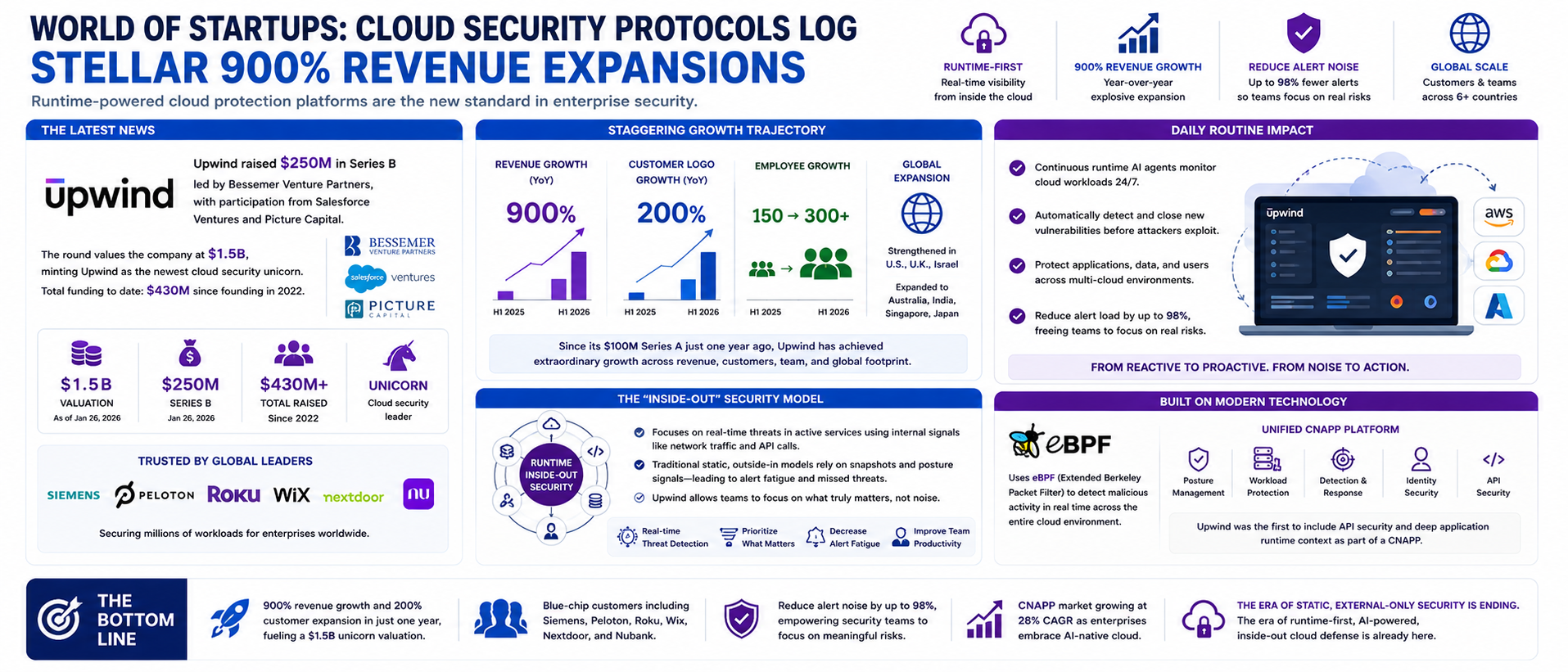
Upwind, a San Francisco-based runtime-first cloud security leader, announced on January 26 that it has raised $250 million in a Series B funding round led by Bessemer Venture Partners, with participation from Salesforce Ventures and Picture Capital. The round values the company at $1.5 billion, officially minting it as the newest cloud security unicorn. The funding brings Upwind's total raised to $430 million since its founding in 2022.
The growth trajectory is staggering. Since its $100 million Series A round just a year ago, Upwind has achieved 900% year-over-year revenue growth and 200% customer logo growth. The company has expanded its workforce from 150 to more than 300 employees and strengthened its presence across the U.S., U.K., and Israel, while also expanding into Australia, India, Singapore, and Japan.
By building automated, real-time security systems across distributed workloads and multi-cloud stacks, Upwind has locked in partnerships with global consumer and financial titans including Siemens, Peloton, Roku, Wix, Nextdoor, and Nubank—the world's largest digital bank. The company reports that its platform secures millions of workloads for enterprises.
The "Inside-Out" Security Model
Upwind's core differentiator is its "runtime" or "inside-out" security model, which prioritizes real-time threats in active services using internal signals such as network traffic and API calls. Traditional security models—relying on static snapshots and posture signals—are struggling to keep pace with dynamic, real-time environments, often overwhelming security teams with alerts that fail to indicate actual threats. Upwind's approach allows security teams to focus on issues that truly matter rather than noise generated by traditional, external-only scans.
The platform uses eBPF (Extended Berkeley Packet Filter) technology to detect malicious activity in cloud environments. It consolidates multiple security functions, including posture management, workload protection, detection and response, and identity security, into a single unified Cloud-Native Application Protection Platform (CNAPP). Upwind was the first to include and identify the importance of API security and deep application runtime context as part of a CNAPP.
CEO and co-founder Amiram Shachar, who previously sold cloud compute brokerage Spot.io to NetApp for $450 million, built Upwind after experiencing firsthand how conventional cloud security tools lacked operational context. "Cloud infrastructure has changed faster than the security models designed to protect it," Shachar said. "The next era of cloud security requires a fundamentally different approach, centered in realtime signals. That's actually the only way to protect the cloud in the new era of AI".
Daily Routine Impact
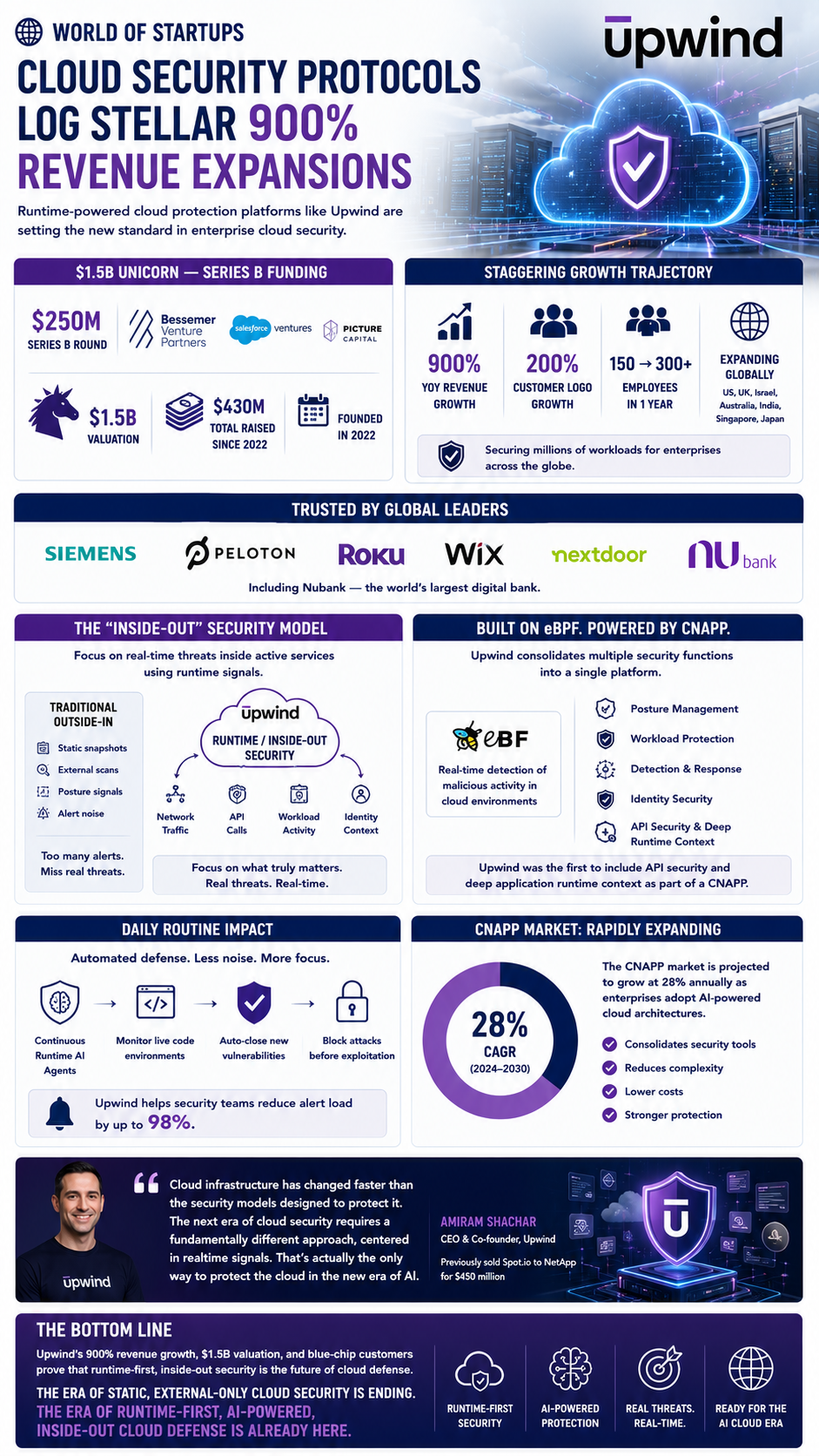
Cybersecurity is transitioning from slow, manual patches to automated defense. In daily enterprise tech operations, cloud-native startups like Upwind are deploying continuous runtime AI agents that monitor operational code environments, automatically closing newly discovered code vulnerabilities before automated external cyber attacks can exploit them. According to the company, Upwind helps security teams reduce their alert load by up to 98%, allowing them to focus on meaningful risks rather than being overwhelmed by false positives.
The shift reflects a broader market trend: Cloud-Native Application Protection Platforms have emerged as a core category for securing modern cloud environments, with the market expected to grow at an annual rate of 28% as enterprises increasingly adopt AI-powered cloud architectures. The CNAPP market consolidates multiple security functions into a single system, eliminating the need for separate tools and reducing the complexity that has historically overwhelmed security teams.
The Bottom Line
July 2026 marks a decisive shift in the cloud security landscape. Upwind's 900% revenue growth, 200% customer expansion, and $1.5 billion unicorn valuation signal that runtime-powered, "inside-out" security platforms are rapidly displacing legacy static approaches. With blue-chip clients including Siemens, Peloton, Roku, and Nubank, and the ability to reduce alert noise by 98%, Upwind has established itself as the new standard for protecting AI-native, real-time cloud applications. The era of static, external-only cloud security is ending. The era of runtime-first, AI-powered, inside-out cloud defense is already here.

Vishal Sable
B.Tech AD @ shri balaji institute of technology and management
Engineering and tech journalist. I love exploring the impact of emerging technologies on global defense, sovereignty, and everyday life. Always looking for the real story behind the headlines.