Back to News
News AlertWorld Defence Tech
Cutting Red Tape & Orbital Tracking
V
Author
Vishal Sable
Published
June 30, 2026
Reading Time
5 MIN READ
Spread the Word
Modern defense technology is undergoing a radical transformation, shifting focus from traditional procurement cycles to rapid trial deployment, regional alliances, and space-based infrastructure. The final weeks of June 2026 have brought significant developments that signal this new era of agile, tech-driven defense.
European Defense Consolidation
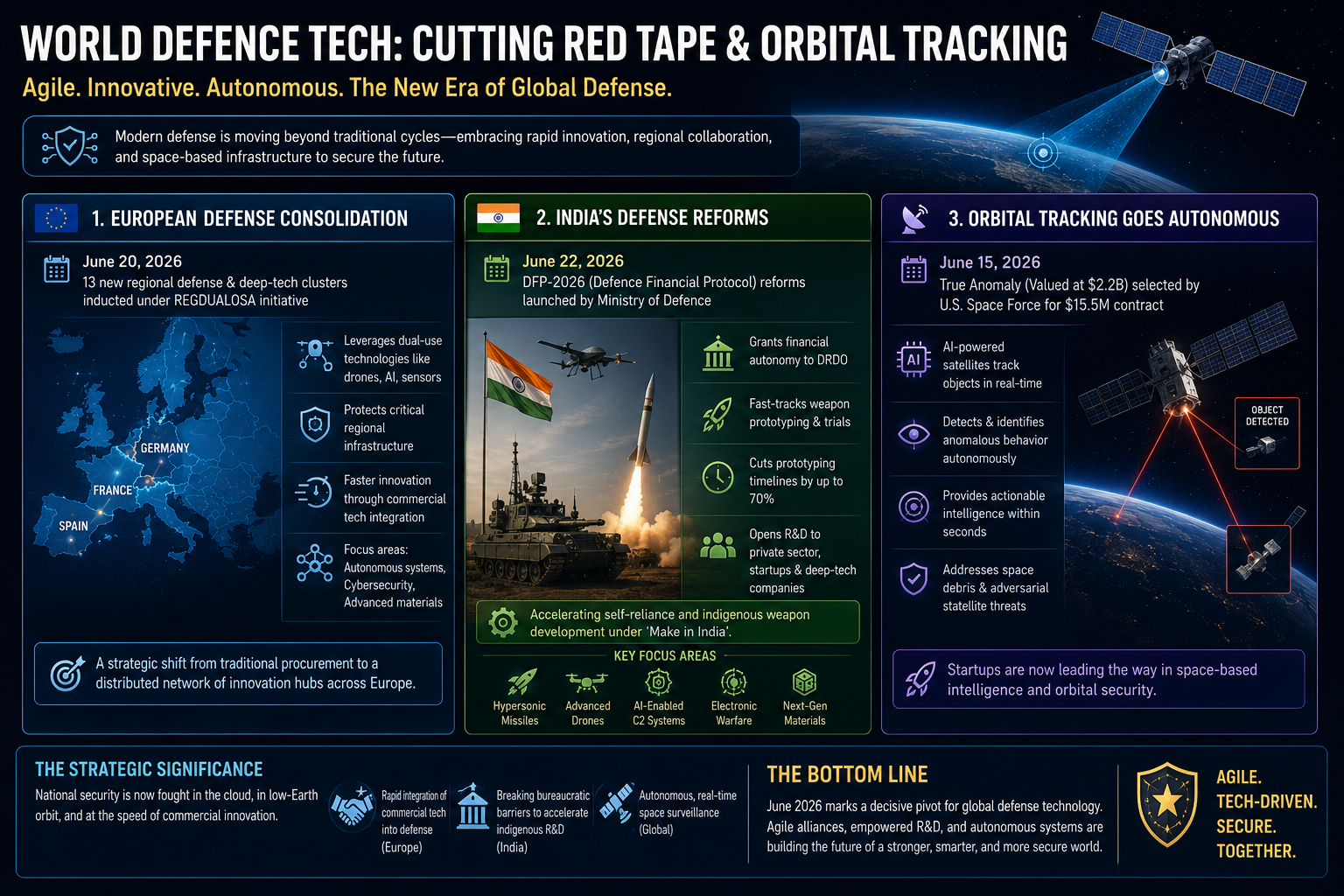
On June 20, the European Defence Economic Network (ENDR) inducted 13 powerful new regional defense and deep-tech clusters across Germany, France, and Spain under the REGDUALOSA initiative. This strategic move aims to legally leverage dual-use commercial technologies—including private drones, AI systems, and advanced sensors—to protect critical regional infrastructure. The initiative represents a significant departure from traditional defense procurement, embracing the speed and innovation of the commercial tech sector. By integrating civilian-developed technologies into military applications, Europe is positioning itself to respond more rapidly to emerging threats while reducing dependence on non-European suppliers. The clusters will focus on areas including autonomous systems, cybersecurity, and advanced materials, creating a distributed network of innovation hubs across the continent.
India's Defense Reforms
On June 22, India's Ministry of Defence launched the DFP-2026 reforms (Defence Financial Protocol), granting unprecedented financial autonomy to the Defence Research and Development Organisation (DRDO). The reforms radically streamline approval processes, enabling the DRDO to fast-track weapon prototyping and initiate immediate trials without the bureaucratic bottlenecks that have historically plagued India's defense R&D. This move aligns with India's broader push for self-reliance in defense manufacturing under the "Make in India" initiative. The reforms are expected to reduce prototyping timelines by up to 70%, allowing India to develop and field indigenous weapon systems more competitively. Key areas of focus include hypersonic missiles, advanced drones, and AI-enabled command-and-control systems. The reforms also encourage greater private sector participation, opening defense R&D to Indian startups and deep-tech companies for the first time.
Orbital Tracking Goes Autonomous
The commercial space defense sector continues its remarkable growth. Deep-tech startup True Anomaly, valued at **$2.2 billion**, is deploying autonomous satellites designed to track orbital objects in real-time. The company's spacecraft use advanced computer vision and AI to detect, track, and characterize objects in low-Earth orbit, addressing growing concerns about space debris and adversarial satellite activity. On June 15, True Anomaly was selected by the U.S. Space Force for a $15.5 million contract to provide on-orbit surveillance capabilities, following a successful demonstration of their autonomous rendezvous and proximity operations technology. The company's platform can automatically identify anomalous behavior—such as a satellite approaching another without authorization—and provide actionable intelligence to ground operators within seconds.
The Strategic Significance
The common thread across these developments is the recognition that national security is now fought in the cloud, in low-Earth orbit, and at the speed of commercial innovation. The European REGDUALOSA initiative enables rapid integration of commercial tech into defense applications. India's DFP-2026 reforms cut through bureaucratic paralysis to accelerate indigenous weapons development. And True Anomaly's autonomous satellites demonstrate that space-based intelligence no longer requires massive government programs—startups are now leading the way.
The Bottom Line
June 2026 marks a decisive pivot for global defense technology. Regional alliances are forming around dual-use innovation, national R&D establishments are being liberated from bureaucratic constraints, and orbital infrastructure is becoming autonomous and commercially viable. The era of slow-moving, government-only defense procurement is ending. The era of agile, tech-integrated, and commercially driven defense is already here.

Vishal Sable
B.Tech AD @ shri balaji institute of technology and management
Engineering and tech journalist. I love exploring the impact of emerging technologies on global defense, sovereignty, and everyday life. Always looking for the real story behind the headlines.