LATEST NEWS
Swiggy Didn't Sell Its B2B Arm for Cash — It Bought Into the Company Buying It
September 9, 2026 5M
Back to News
News AlertWorld of Startup’s
"Deep Tech" AI and New Energy Explode
V
Author
Vishal Sable
Published
July 3, 2026
Reading Time
11 MIN READ
Spread the Word
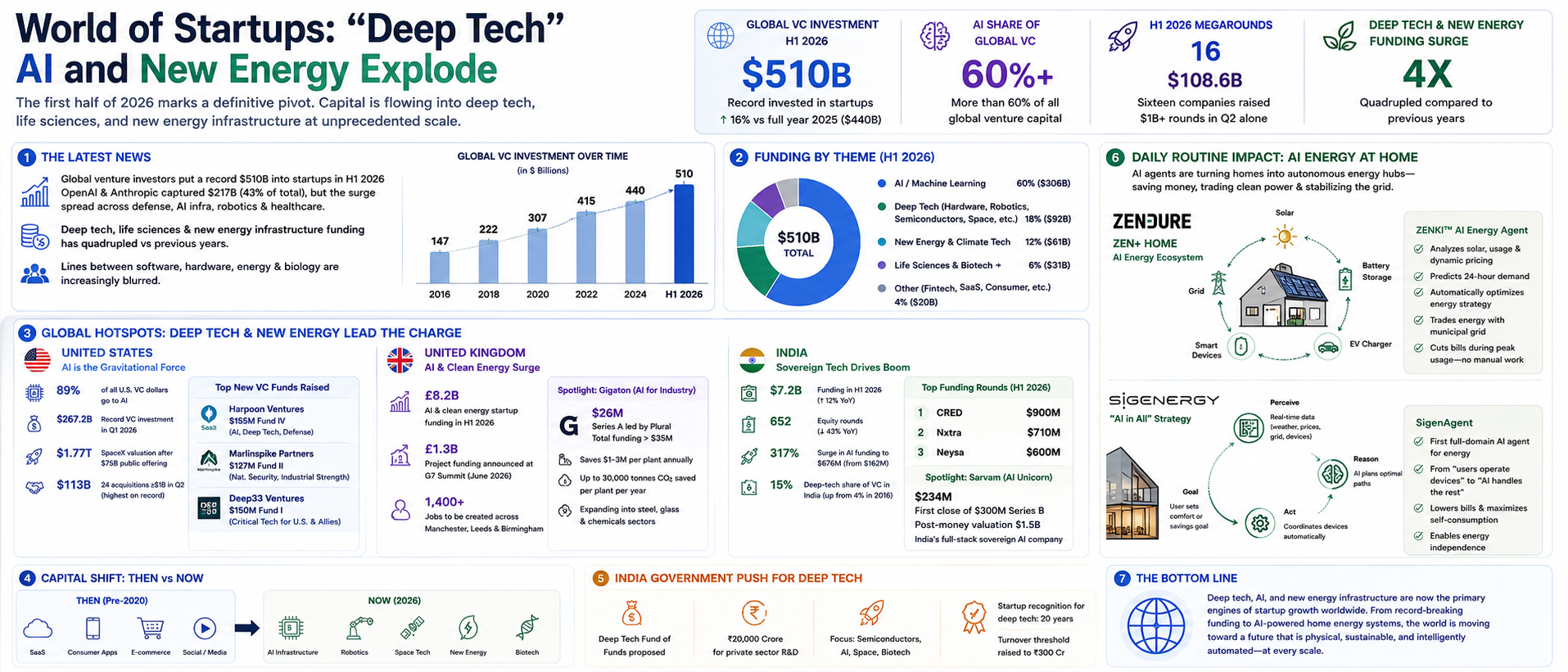
Software-as-a-Service (SaaS) and standard consumer mobile applications are taking a back seat as capital floods into physical mechanics and resource management. The first half of 2026 has delivered definitive proof that the venture capital landscape has fundamentally restructured—with deep tech, life sciences, and new energy infrastructure emerging as the primary beneficiaries of an unprecedented funding surge.
The Latest News
Global venture investors put a record **$510 billion** into startups in the first half of 2026, according to Crunchbase data, topping the $440 billion committed across all of 2025 and beating the prior half-year record of $375 billion from the second half of 2021. OpenAI and Anthropic together accounted for $217 billion—43% of all H1 startup capital—but the surge has spread well beyond the frontier labs. Sixteen companies raised billion-dollar rounds in Q2 for a combined $108.6 billion, with the rest of the megaround cohort clustered in defense, AI infrastructure, robotics, and healthcare. Crunchbase counted the second quarter alone at $205 billion.
Mid-year data confirms that funding into deep tech, life sciences, and new energy infrastructure has quadrupled compared to previous years. At the World Economic Forum, analysts noted that deep tech investment is surging, AI accounts for more than 60% of all global venture capital, and the lines between software, hardware, energy, and biology are increasingly blurred.
The United States: AI as a Gravitational Force
AI now commands 89% of all U.S. VC dollars, making it the dominant, and in many cases the only, category attracting meaningful investment. Q1 2026 alone saw a record high of $267.2 billion in venture investment. Given the level of geopolitical tensions and conflicts, defense tech and space tech continue to be very attractive to VC investors. New funds are emerging to capture this opportunity: Harpoon Ventures closed an oversubscribed $155 million Fund IV to back founders building critical technologies across artificial intelligence, deep tech, and defense. Marlinspike Partners closed an oversubscribed $127 million Fund II to invest in early-stage companies at the intersection of national security and American industrial strength. Deep33 Ventures emerged from stealth with a $150 million deep tech fund focused on critical technologies for U.S. and allied infrastructure.
Exits have returned in force. SpaceX went public at a $1.77 trillion valuation and raised $75 billion in the offering, then confirmed a $60 billion deal for Anysphere, the maker of the AI coding tool Cursor. Twenty-four companies were acquired at prices at or above $1 billion in Q2, totaling $113 billion—the highest quarter on record. Thirty-two companies went public above $1 billion.
The United Kingdom: AI and Clean Energy Surge
In the UK, AI and clean energy startups raised a record £8.2 billion in H1 2026. At the G7 Summit in June, Prime Minister Keir Starmer announced £1.3 billion in project funding for clean energy and AI, including £1 billion from French private equity firm InfraVia for battery storage. The investment is set to create over 1,400 jobs across Manchester, Leeds, and Birmingham.
Gigaton, a London-based AI company developing control software for energy-intensive industries, raised **$26 million** in Series A funding led by Plural, bringing total funding to over $35 million. The UCL and Cambridge spinout—formerly known as Carbon Re—is replacing legacy control software with fully autonomous AI-driven systems across some of the world's most energy-intensive industries. Its technology is already used by several of the world's largest cement producers, including Adani Cement, Heidelberg Materials, and Holcim, delivering annual savings of $1–3 million per plant through reduced energy use and lower emissions. Individual plants are now saving up to 30,000 tonnes of CO₂ per year. The new funding will support a five-fold expansion of the team alongside entry into new sectors including steel, glass, and chemicals.
"Every cement executive I speak to is facing the same challenges: costs they struggle to control, carbon they struggle to reduce, and plants that weren't built for the world they're operating in today," said Josh Vernon, CEO of Gigaton. "The underlying software infrastructure most plants run on today was never built to manage the complexity plants are forced to deal with today".
India: Sovereign Tech Drives Deep-Tech Boom
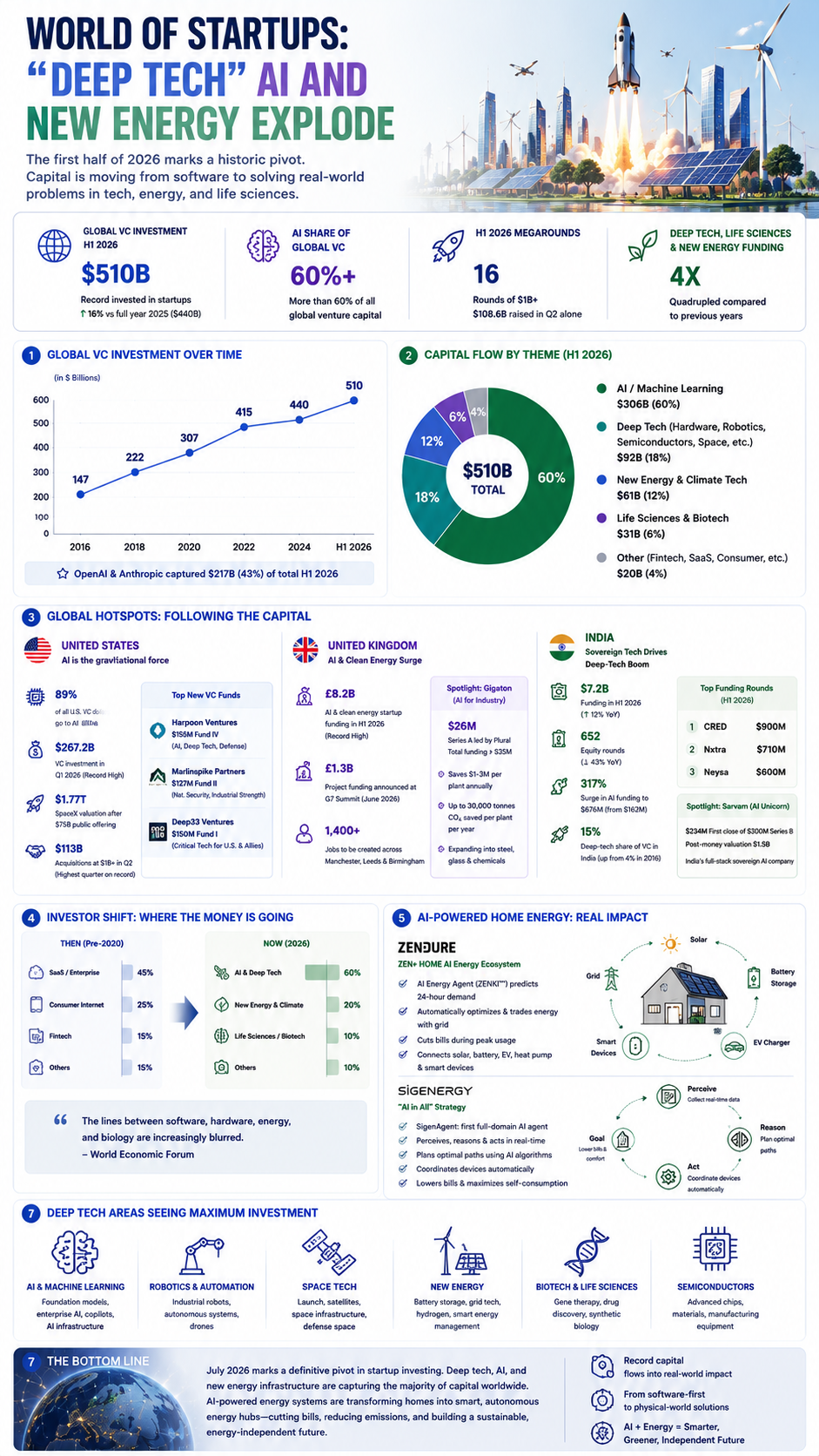
India's startup ecosystem attracted **$7.2 billion** in funding across 652 equity rounds during H1 2026, a 12% increase from $6.4 billion a year earlier. However, the number of funding rounds fell 43% to 652 from 1,149, underscoring a sharp shift in investor preference toward larger, late-stage bets.
AI funding surged 317% year-over-year to $676 million in H1 2026, thanks to initiatives like the IndiaAI Mission and ISM 2.0. The capital infusion in the AI ecosystem zoomed over **4X** from $162 million raised across a mere 30 deals in H1 2025. Deep-tech funding has nearly doubled as a share of India's total venture capital activity, rising from just 4% in 2016 to 15% today.
The top three funding rounds of H1 2026 were CRED at $900 million, Nxtra at $710 million, and Neysa at $600 million—together representing $2.2 billion, or 31% of all capital deployed in the half. Sarvam, India's full-stack sovereign AI company, raised $234 million in the first close of its $300 million Series B at a post-money valuation of $1.5 billion, marking one of the largest funding rounds for an Indian AI startup. The company is now India's newest AI unicorn.
The Indian government has actively supported this shift. The budget proposes a Deep Tech Fund of Funds and allocates ₹20,000 crore for private sector R&D, targeting sectors including semiconductors, AI, space tech, and biotech. DPIIT extended startup recognition for deep tech companies to 20 years and raised the turnover threshold to ₹300 crore.
Daily Routine Impact
Startups are successfully targeting scale through AI-powered energy management. Clean energy startups are integrating predictive AI engines straight into household smart meters, allowing smart homes to trade solar energy with municipal power grids autonomously—saving consumers money during peak usage windows without any manual intervention.
Zendure showcased its ZEN+ HOME AI Energy Ecosystem at Intersolar 2026 in Munich on June 22. At its heart is ZENKI™, Zendure's AI Energy Agent powered by the proprietary ZenPulse time-series model. By analyzing solar generation, household consumption, and dynamic electricity pricing, ZENKI™ predicts 24-hour energy demand and automatically formulates the optimal strategy. The ecosystem's PowerHub platform connects solar generation, battery storage, grid electricity, EV chargers, heat pumps, and smart home devices into a unified energy coordination platform.
Sigenergy unveiled its "AI in All" strategy in June 2026, introducing SigenAgent, the energy industry's first full-domain AI agent. The platform shifts from "users operate devices" to "users set goals, AI handles the rest"—perceiving, reasoning, and acting to help lower bills. SigenAgent can interpret user goals, analyze weather, electricity prices, grid and equipment status in real time, plan optimal paths through intelligent algorithms, and directly coordinate device execution.
The Bottom Line
July 2026 marks a definitive pivot in startup investing. Global venture capital has reached historic highs—$510 billion in six months—with deep tech, AI, and new energy infrastructure capturing the overwhelming majority of funding. The UK's £8.2 billion and India's 4X AI funding surge demonstrate that this trend is truly global. Meanwhile, AI-powered home energy systems from Zendure and Sigenergy are transforming households from passive consumers into active, energy-independent participants—automatically trading solar power with municipal grids, cutting bills, and stabilizing demand without a single manual adjustment. The era of software-only startups is fading. The era of physical, infrastructural, and energy-focused deep tech is here.

Vishal Sable
B.Tech AD @ shri balaji institute of technology and management
Engineering and tech journalist. I love exploring the impact of emerging technologies on global defense, sovereignty, and everyday life. Always looking for the real story behind the headlines.