LATEST NEWS
Swiggy Didn't Sell Its B2B Arm for Cash — It Bought Into the Company Buying It
September 9, 2026 5M
Back to News
News AlertWorld of Startup’s
Deep Tech and Life Sciences Absorb the Venture Flow
V
Author
Vishal Sable
Published
July 15, 2026
Reading Time
4 MIN READ
Spread the Word
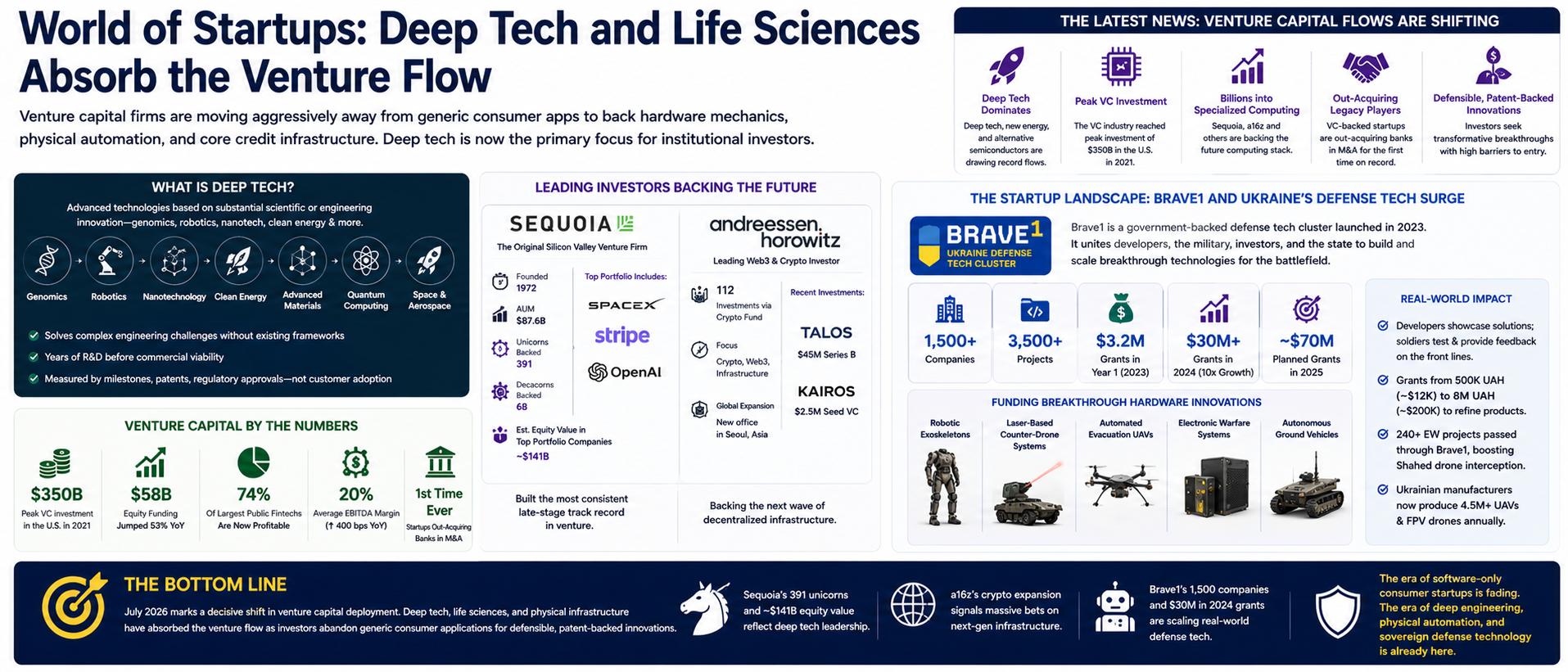
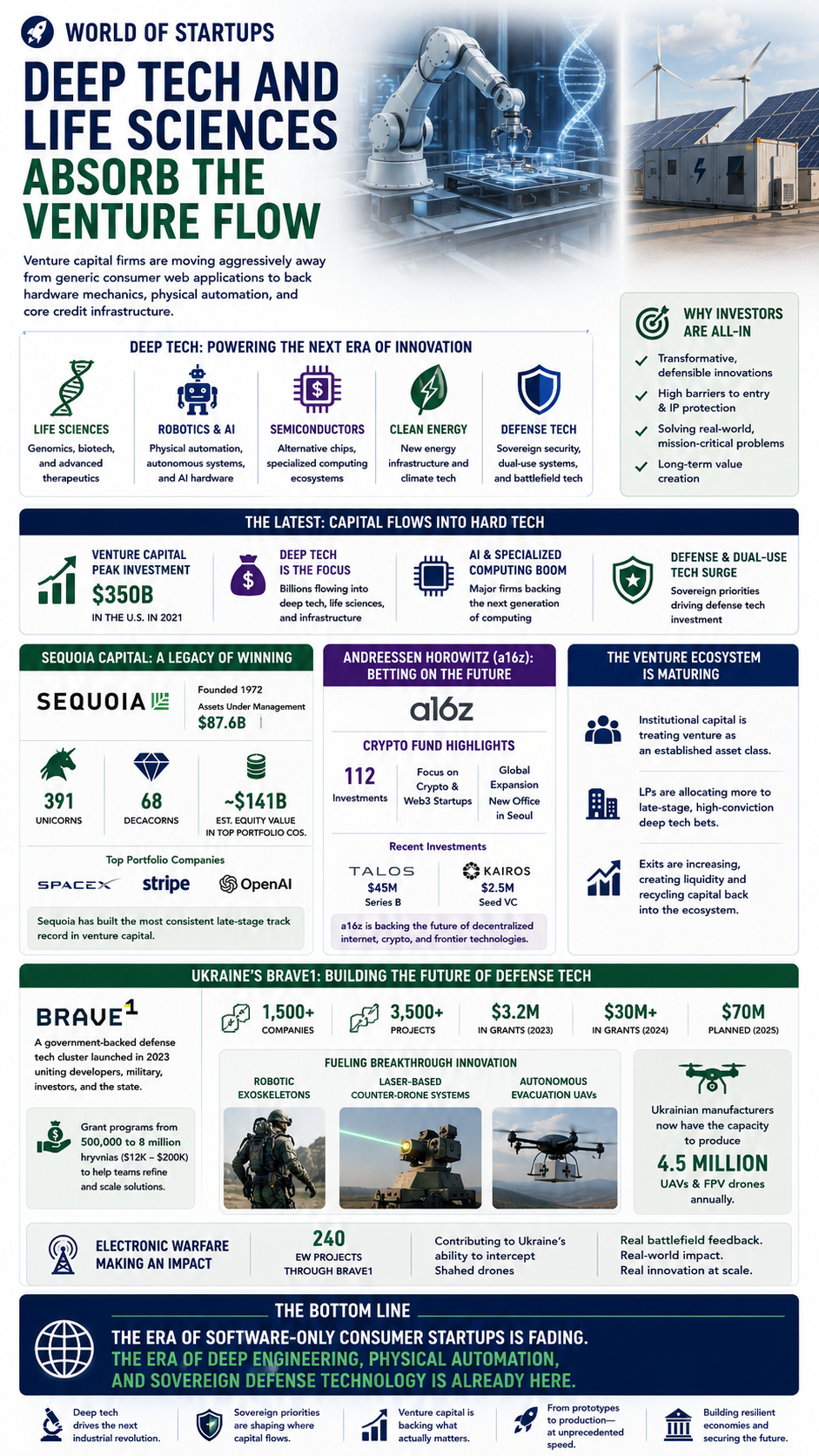
Venture capital firms are moving aggressively away from generic consumer web applications to back hardware mechanics, physical automation, and core credit infrastructure. Deep technology, defined as advanced technologies based on substantial scientific or engineering innovation—ranging from genomics and robotics to nanotechnology and clean energy—has become the primary focus for institutional investors seeking transformative, defensible breakthroughs that push the boundaries of what is technologically possible. Unlike high-tech companies that leverage existing technology in clever ways, deep-tech startups tackle complex engineering challenges without existing frameworks, often spending years in research and development before approaching commercial viability, with success measured by technological milestones, patents granted, and regulatory approvals rather than customer adoption metrics.
The Latest News
Mid-summer venture data reveals that deep tech, new energy infrastructure, and alternative semiconductor clusters are dominating investor interest. The venture capital industry, which provides financing to startups working on novel technologies with high potential to create value but also high risk of failure, has matured into an established asset class reaching peak investment of $350 billion in the U.S. in 2021. Major investment firms like Sequoia Capital and a16z are routing billions into specialized computing ecosystems. Sequoia, the original Silicon Valley venture firm founded in 1972 with $87.6 billion in assets under management, has built the most consistent late-stage track record in venture with 391 unicorns and 68 decacorns, holding estimated equity value of approximately $141 billion across its top portfolio companies including SpaceX, Stripe, and OpenAI. Andreessen Horowitz (a16z), through its crypto fund, has made 112 investments with a focus on crypto and web3 startups, with notable recent investments including Talos ($45 million Series B) and Kairos ($2.5 million Seed VC), while expanding its presence into Asia with a new Seoul office.
The Startup Landscape: Brave1 and Ukraine's Defense Tech Surge
In the European innovation space, clusters like Ukraine's Brave1 have launched sweeping new grant programs specifically targeting breakthrough physical tech. Brave1, a government-backed defense tech cluster launched in 2023, serves as a centralized platform where developers can showcase technological solutions while soldiers assess them, provide feedback, and help adapt them to battlefield needs. The cluster offers grants ranging from 500,000 hryvnias ($12,000) to 8 million hryvnias (around $200,000), allowing teams to refine their products, with the core idea being to unite developers, the military, investors, and the state in one place. The results have been transformative: Brave1 now boasts 1,500 companies and more than 3,500 projects, awarding $3.2 million in grants in its first year, which grew tenfold to over $30 million in 2024, with an even more ambitious plan of nearly $70 million for 2025. Startups are receiving multi-million funding priorities to build ready-to-use functional prototypes for advanced robotic exoskeletons, laser-based counter-drone arrays, and automated evacuation UAVs. The cluster has facilitated the creation of robotic platforms and helped drone manufacturers scale operations dramatically: Ukrainian manufacturers now have the capacity to produce 4.5 million various UAVs and FPV drones annually. Electronic warfare systems offer a clear example of Brave1's impact—in 2023, the cluster launched a dedicated development track for EW capabilities, with 240 projects passing through the cluster to date, contributing to Ukraine's ability to intercept Shahed drones.
The Bottom Line
July 2026 marks a decisive shift in venture capital deployment. Deep tech, life sciences, and physical infrastructure have absorbed the venture flow as investors abandon generic consumer applications for defensible, patent-backed innovations. Sequoia's 391 unicorns and a16z's crypto expansion reflect institutional appetite for transformative technologies. Ukraine's Brave1 cluster, with 1,500 companies and $30 million in 2024 grants, demonstrates how state-backed deep-tech ecosystems can rapidly scale robotic exoskeletons, laser counter-drone systems, and automated evacuation platforms from prototypes to mass production. The era of software-only consumer startups is fading. The era of deep engineering, physical automation, and sovereign defense technology is already here.

Vishal Sable
B.Tech AD @ shri balaji institute of technology and management
Engineering and tech journalist. I love exploring the impact of emerging technologies on global defense, sovereignty, and everyday life. Always looking for the real story behind the headlines.