LATEST NEWS
Swiggy Didn't Sell Its B2B Arm for Cash — It Bought Into the Company Buying It
September 9, 2026 5M
Back to News
News AlertWorld of Startup’s
Deep-Tech & Federal Injections
V
Author
Vishal Sable
Published
August 8, 2026
Reading Time
7 MIN READ
Spread the Word
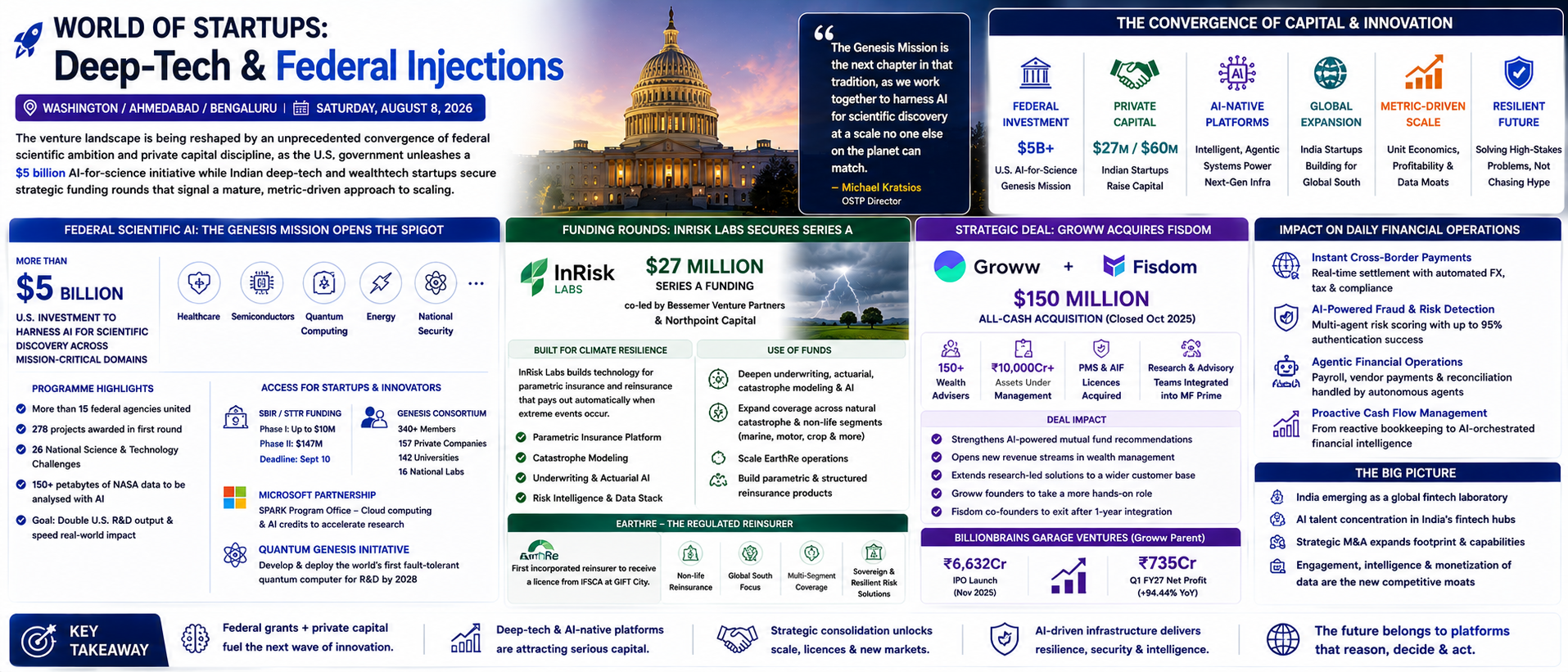
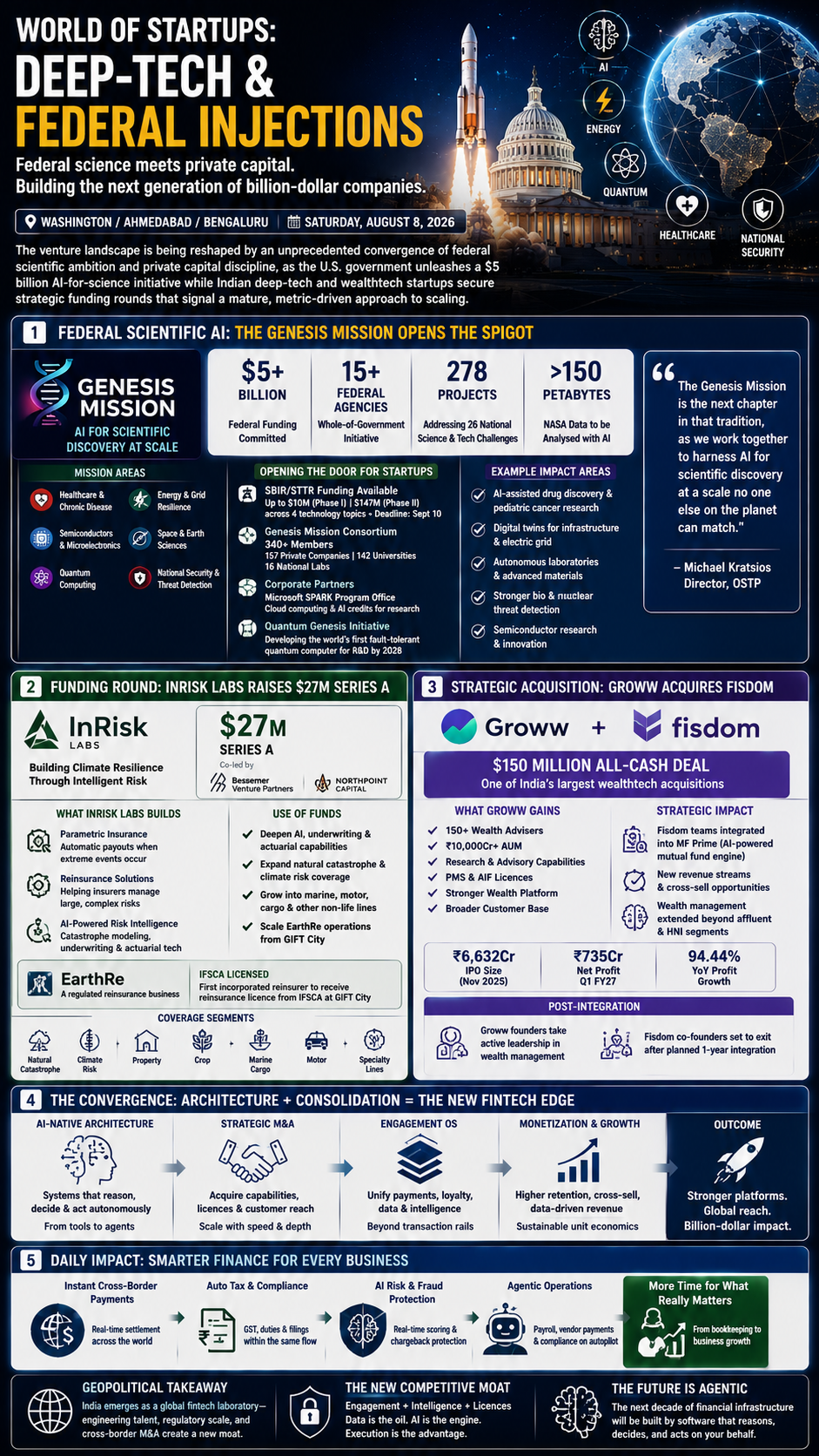
The venture landscape is being reshaped by an unprecedented convergence of federal scientific ambition and private capital discipline, as the U.S. government unleashes a $5 billion AI-for-science initiative while Indian deep-tech and wealthtech startups secure strategic funding rounds that signal a mature, metric-driven approach to scaling. The message from both Washington and India's startup hubs is unequivocal: the next generation of billion-dollar companies will be built at the intersection of physical infrastructure, climate resilience, and AI-native financial architecture, with federal grants and private venture dollars flowing to startups that solve tangible, high-stakes problems rather than chasing ephemeral consumer trends.
FEDERAL SCIENTIFIC AI: The Genesis Mission Opens the Spigot
The Trump administration has committed more than $5 billion in federal funding to expand the Genesis Mission, a whole-of-government initiative that harnesses artificial intelligence to accelerate scientific discovery across healthcare, semiconductors, quantum computing, energy, and national security. Announced by White House Office of Science and Technology Policy Director Michael Kratsios, the initiative brings together more than 15 federal agencies—including the Department of Energy, Department of Health and Human Services, NASA, the National Science Foundation, and the Department of Defense—to provide research funding, scientific datasets, supercomputing resources, and AI infrastructure through the Department of Energy's American Science and Security Platform. The Genesis Mission has evolved from a Department of Energy-led effort into a whole-of-government programme involving more than 15 federal agencies.
The initiative's scope is staggering. The first round of funding has already awarded 278 projects addressing 26 National Science and Technology Challenges released in February. These challenges span chronic disease and pediatric cancer research, AI-assisted drug discovery, semiconductor research, digital twins for infrastructure and the electric grid, and quantum computing. Other efforts will use AI to analyse more than 150 petabytes of NASA data, build autonomous laboratories, develop advanced materials, and strengthen biological and nuclear threat detection. The administration has stated that the initiative aims to double U.S. research and development output while translating scientific breakthroughs into practical benefits more quickly.
Crucially for the startup ecosystem, the Genesis Mission is not merely a programme for national labs and elite universities. The Department of Energy has opened the mission's small-business door through SBIR/STTR funding, with Phase I awards of up to $10 million and Phase II awards of $147 million across four technology topics, with a September 10 deadline. The Genesis Mission Consortium now includes more than 340 members, including 157 private companies, 142 universities, and 16 national laboratories. Corporate partners including Microsoft have also joined, with the tech giant establishing a program office called SPARK (Scientific Partnership Advancing Research & Knowledge) to coordinate research efforts and provide cloud computing and AI credits. The Quantum Genesis initiative, announced last month, adds fault-tolerant quantum computing as a third pillar alongside supercomputing and AI, with an ambitious plan to develop and deploy the world's first such computer for R&D programmes by 2028. Kratsios framed the ambition in sweeping terms: "The Genesis Mission is the next chapter in that tradition, as we work together to harness AI for scientific discovery at a scale no one else on the planet can match".
FUNDING ROUNDS: InRisk Labs Secures Series A for Climate Resilience
While federal dollars flow to American deep-tech, Indian insurtech is attracting significant private capital. Ahmedabad-based InRisk Labs has raised $27 million in a Series A funding round co-led by Bessemer Venture Partners and Northpoint Capital. The startup, founded in 2024, builds technology for parametric insurance—which pays out automatically when predefined events such as extreme weather occur—and for reinsurance, which helps insurers manage large risks.
The fresh capital will be used to deepen the group's underwriting, actuarial, catastrophe-modelling and AI capabilities; expand its coverage across natural catastrophe and climate risk, as well as other non-life segments such as marine cargo and motor; and accelerate development of parametric and structured reinsurance products. The company will also utilise the capital to scale the operations of its subsidiary, EarthRe, which has secured a reinsurance licence from the International Financial Services Centres Authority (IFSCA) at GIFT City, making it the first incorporated reinsurer to receive such a licence.
Under the group's structure, InRisk Labs will continue building the technology, data and risk intelligence stack, while EarthRe will operate as the regulated reinsurance business serving India and other Global South markets. EarthRe focuses on non-life reinsurance, offering coverage across natural catastrophe, climate risk, property, crop, marine cargo, motor, and other specialty segments, using catastrophe modelling, climate-risk analytics, and AI-powered underwriting to develop structured reinsurance solutions. The development comes amid rising exposure to natural catastrophe risks and a widening insurance protection gap in India, underscoring the need for advanced climate-risk assessment tools and technology-led insurance solutions. According to Swiss Re's report, India's insurance market is expected to grow at a real annual rate of 6.9% between 2026 and 2030, making it the fastest-growing major insurance market globally. InRisk Labs competes with the likes of EigenRisk, IBISA and Mitti Labs in the climate risk, parametric insurance and reinsurance space.
FUNDING ROUNDS: Stable Money Launches Series C for Fixed-Income Wealthtech
In the wealth management sector, Bengaluru-based fixed-income investment platform Stable Money has raised a Series C funding round led by The Fundamentum Partnership, with participation from Peak XV Partners, RTP Global, and Z47. The platform enables users to compare and invest in fixed deposits, bonds through its Stable Bonds product, and other fixed-income products across multiple banks. This follows the company's $25 million pre-Series C round in February 2026, which was led by Peak XV Partners and valued the company at $175 million. The pre-Series C round brought the company's total funding to $65 million. Stable Money is targeting profitability by early 2028.
The timing of Stable Money's Series C reflects a broader shift in venture capital toward startups that demonstrate clear paths to positive cash flow and sustainable unit economics. Fixed-income investment platforms have gained traction as retail investors seek stable, secure returns amid interest-rate uncertainty, and Stable Money's ability to attract blue-chip investors across multiple rounds signals confidence in its business model and market positioning. The company's focus on tier-2 expansion aligns with the broader trend of fintech platforms penetrating deeper into India's semi-urban and rural markets, where fixed deposits remain the primary savings vehicle for millions of households.
GEOSTRATEGIC RIPPLE EFFECTS: Public-Private Convergence
The convergence of federal scientific investment and private venture discipline signals a maturation of the deep-tech ecosystem that carries significant geopolitical implications. The Genesis Mission's $5 billion commitment effectively creates a national AI-for-science infrastructure that rivals the scale of private-sector AI spending, while its small-business provisions ensure that startups, not just incumbents, can access federal resources. The inclusion of 157 private companies in the Genesis Mission Consortium suggests that Washington is deliberately fostering a public-private partnership model that could accelerate commercialisation of federally funded research, potentially shortening the timeline from lab discovery to market deployment.
For India's startup ecosystem, the InRisk Labs and Stable Money funding rounds demonstrate that venture capital is flowing to startups that solve tangible, high-stakes problems—climate resilience and fixed-income wealth management—rather than chasing speculative consumer trends. The $27 million Series A for InRisk Labs, co-led by tier-one global VCs, signals that international investors see India's insurtech and climate-risk market as a significant growth opportunity, particularly as the country faces increasing exposure to natural catastrophes. The company's dual structure, with InRisk Labs building the technology stack and EarthRe operating as a regulated reinsurer, offers a template for other Indian deep-tech startups seeking to navigate complex regulatory environments while scaling technology-led solutions.
For entrepreneurs and researchers, the message is clear: the era of funding purely for user acquisition is giving way to an era of funding for infrastructure, resilience, and scientific discovery. Federal initiatives like Genesis Mission are opening doors for startups working on semiconductor R&D, quantum computing, advanced materials, and autonomous laboratories, while private VCs are backing startups that can demonstrate measurable impact in climate risk modelling and financial inclusion. As the first Genesis Mission awards begin flowing to small businesses and the Series C round for Stable Money signals continued confidence in fixed-income wealthtech, the startup world is entering a phase where deep-tech and federal collaboration are not just complementary but essential for building the next generation of enduring, high-impact enterprises.

Vishal Sable
B.Tech AD @ shri balaji institute of technology and management
Engineering and tech journalist. I love exploring the impact of emerging technologies on global defense, sovereignty, and everyday life. Always looking for the real story behind the headlines.