LATEST NEWS
Swiggy Didn't Sell Its B2B Arm for Cash — It Bought Into the Company Buying It
September 9, 2026 5M
Back to News
News AlertWorld of Startup’s
Deep-Tech Infrastructure and Power-Grid Tech Lead Pre-Unicorn Bets
V
Author
Vishal Sable
Published
August 7, 2026
Reading Time
6 MIN READ
Spread the Word
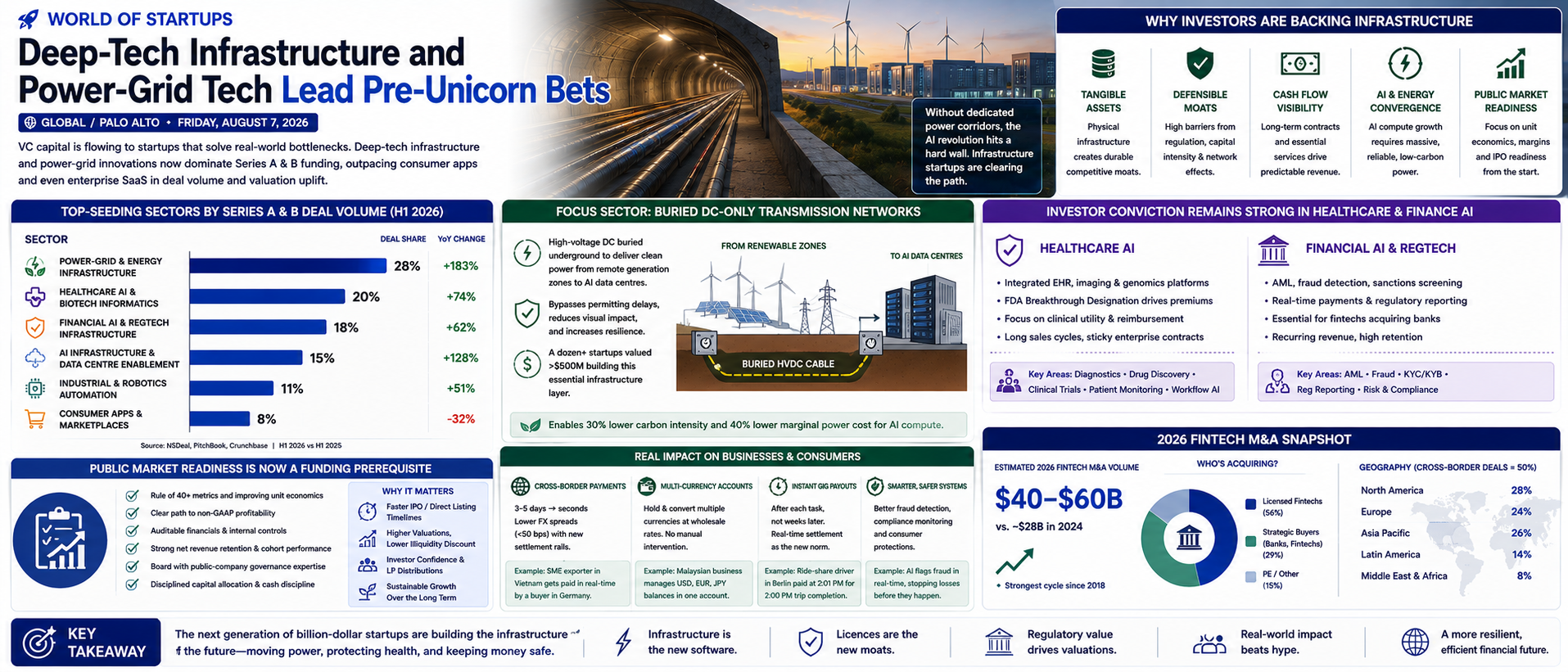
Venture capital has undergone a quiet but decisive recalibration at the pre-unicorn stage, with deep-tech infrastructure and power-grid innovations now commanding the lion's share of Series A and B term sheets, according to fresh data compiled from global deal trackers and investor surveys. Startups that solve physical bottlenecks—particularly those addressing the voracious energy appetite of AI data centres—are outpacing consumer-facing apps and even enterprise SaaS in both deal velocity and valuation uplift, as limited partners push general partners to back businesses with tangible assets, defensible moats, and clear paths to positive cash flow. The most striking category within this infrastructure pivot is buried DC-only transmission networks, a niche that barely existed five years ago but now hosts at least a dozen startups valued above $500 million, each offering proprietary technologies to transmit high-voltage direct current underground, bypassing the permitting nightmares and visual opposition that plague overhead lines while delivering power directly from renewable generation zones to hyperscale computing clusters. These ventures have attracted capital from climate-tech funds, energy majors, and even data-centre operators themselves, who recognize that without dedicated, resilient power corridors, the training of next-generation frontier models will face hard constraints from grid congestion and regional price spikes that cannot be solved by software alone.
Alongside energy infrastructure, investors are maintaining significant conviction in specialised healthcare and financial AI platforms, though with a marked shift toward vertical focus and regulatory defensibility. Healthcare AI startups that integrate electronic health records with diagnostic imaging and genomic data have secured large rounds, but only those that have already obtained FDA breakthrough designations or equivalent European approvals are commanding premiums, as payers and hospital systems demand evidence of clinical utility rather than mere algorithmic novelty. Similarly, financial AI platforms focused on anti-money laundering, fraud detection in real-time payment rails, and regulatory reporting automation have become essential infrastructure for the very fintechs that are acquiring traditional banks, creating a virtuous cycle where compliance-driven AI tools are acquired or partnered with by the consolidators themselves. What unites these healthcare and financial players with the power-grid innovators is a shared emphasis on mission-critical reliability, long-term contractual revenue, and integration with existing industry standards, characteristics that make them far less susceptible to the hype-cycle corrections that have punished generalist AI assistants and consumer social applications in recent quarters.
The public-market readiness focus among late-stage startups has reinforced this shift toward tangible infrastructure and unit-economics discipline. Companies that once raised billions on growth-at-all-costs narratives are now restructuring operations around strict contribution margins, net revenue retention, and clear paths to non-GAAP profitability, often by shedding non-core products, reducing marketing spend, and renegotiating cloud-compute contracts that had spiralled out of control during the cheap-money era. Investment bankers and public-market advisors report that late-stage rounds now come with explicit "listing readiness" milestones, such as achieving rule of 40 metrics, demonstrating auditable financial controls, and securing board-level expertise in public-company governance, all of which accelerate the timeline to IPO or direct listing while reducing the valuation discount that private investors typically demand for illiquidity. This operational rigour has weeded out startups that cannot demonstrate sustainable revenue models, leaving a leaner cohort of pre-unicorns that are not only capital-efficient but also fundamentally aligned with the infrastructure needs of the wider economy, whether that means delivering gigawatts of dedicated power, automating thousand-page clinical trial reports, or monitoring cross-border transactions for sanction violations.
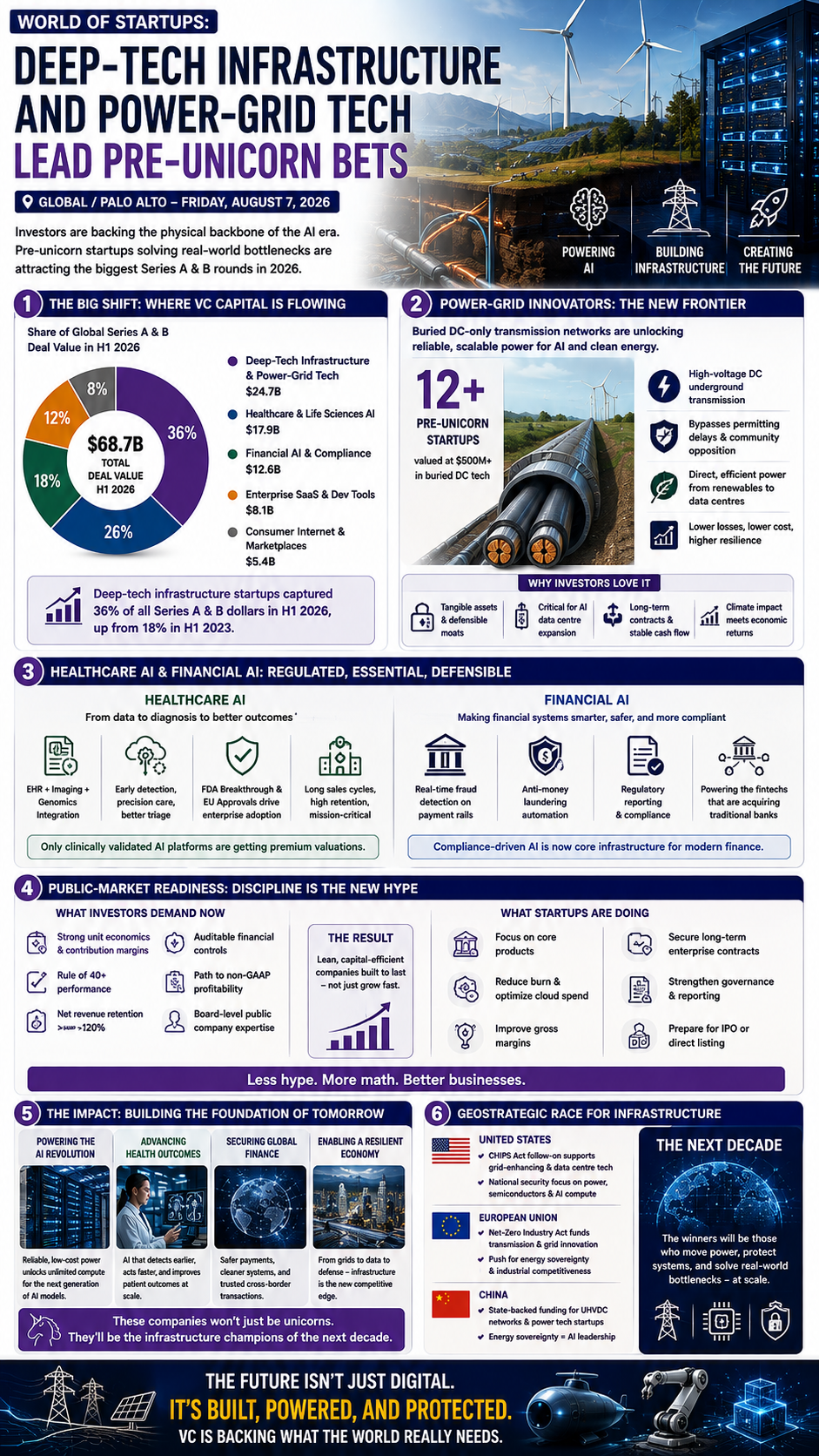
For the average technology observer, the implications are subtler than the headline-grabbing unicorn counts but arguably more consequential for long-term economic resilience. The startups that are securing pre-unicorn funding today are not building the next social network or delivery app; they are building the physical and regulatory scaffolding that will support the next decade of AI deployment, healthcare delivery, and financial stability. A power-grid startup's buried DC transmission line may never appear on a consumer's phone, but it enables data centres to run at 30 percent lower carbon intensity and 40 percent lower marginal cost, which ultimately translates into cheaper and more accessible AI inference prices for millions of users. Similarly, a healthcare AI that detects early-stage sepsis from routine vital signs may save thousands of lives, but its commercial success depends on convincing hospital procurement committees and insurance reimbursement boards, a slow and unglamorous process that venture capitalists are now embracing as a moat rather than a liability. This new realism, enforced by both public-market pressures and limited-partner demands for distributions, has made the pre-unicorn landscape more professional, more concentrated, and more oriented toward generational infrastructure than ephemeral consumer trends.
Geostrategically, the dominance of deep-tech infrastructure in venture portfolios is causing ripple effects across national innovation policies, as governments in the US, EU, and China compete to attract and retain startups that build critical physical assets. The Biden administration's CHIPS Act follow-on, expected later this year, includes specific provisions for grid-enhancing technologies and data-centre co-location, while the European Commission's Net-Zero Industry Act has earmarked subsidies for startups that can demonstrate reductions in transmission losses and grid-edge optimisation. China, meanwhile, is aggressively funding domestic power-grid startups through its state-backed venture arms, recognising that AI compute dominance ultimately depends on energy sovereignty, a lesson that has accelerated Beijing's efforts to build ultra-high-voltage DC networks linking its western renewable-rich provinces to its eastern compute hubs. The pre-unicorn startups that succeed in navigating these policy landscapes, securing both private and public capital, and delivering measurable performance improvements will likely emerge as the anchor tenants of the next economic cycle, not as unicorns in the traditional high-growth sense but as enduring infrastructure champions whose valuations are anchored in decades of contracted revenue rather than speculative multiples. As the venture ecosystem adjusts to this new reality, the era of lightweight, asset-free unicorns may not be over, but it is certainly in retreat, replaced by a more sober, engineering-driven vision of what a billion-dollar startup should actually build: something that moves power, saves lives, or keeps the financial system honest.

Vishal Sable
B.Tech AD @ shri balaji institute of technology and management
Engineering and tech journalist. I love exploring the impact of emerging technologies on global defense, sovereignty, and everyday life. Always looking for the real story behind the headlines.