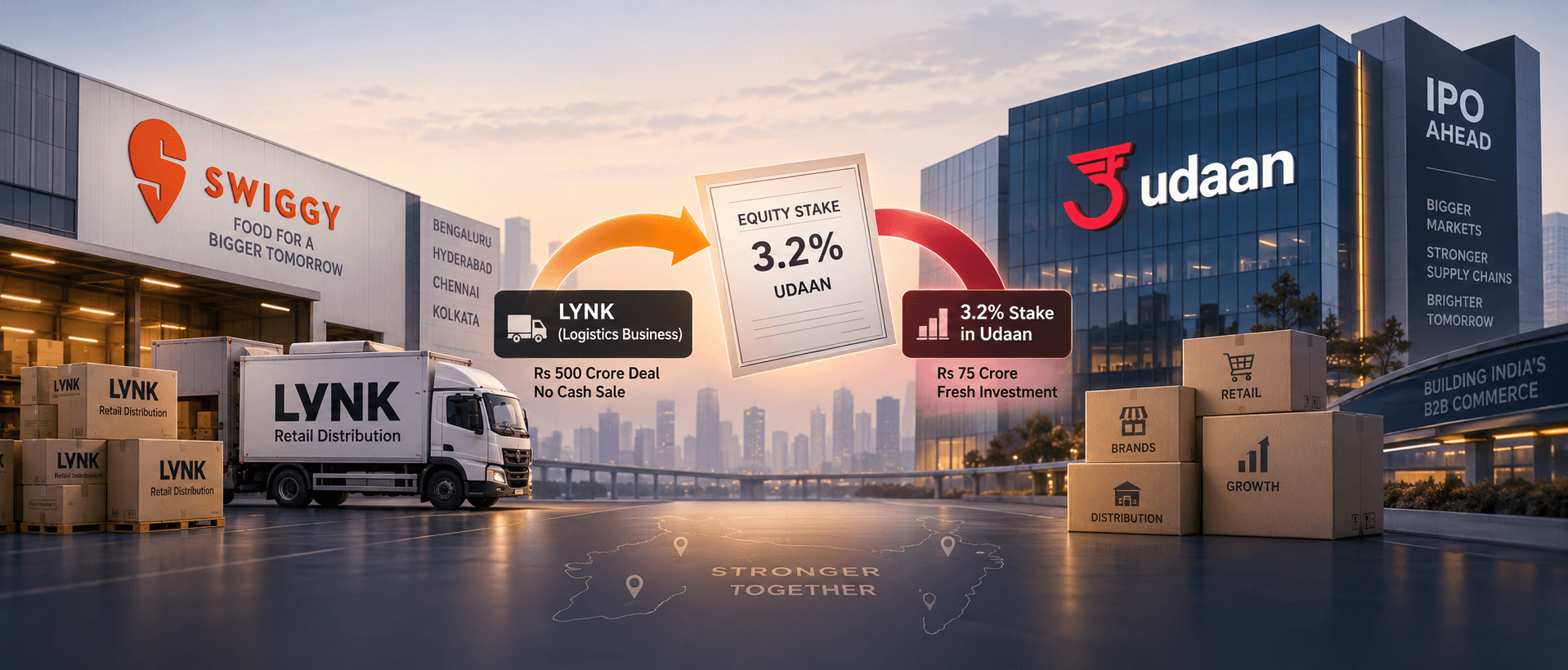
Swiggy Didn't Sell Its B2B Arm for Cash — It Bought Into the Company Buying It
Deep-Tech, Sovereign AI Funds, and the Rise of Medical Tourism Marketplaces

While media headlines increasingly focus on the struggles of
well-funded unicorns wrestling with profitability, a much more vibrant story is
unfolding further down the maturity curve. The "hype" around large,
late-stage deals may have cooled, but the engine of new ideas is running
stronger than ever. In April 2026, the startup world is defined by a clear
strategic pivot: investors and founders alike are moving away from chasing
astronomical valuations at all costs and toward building capital-efficient,
deeply technological solutions for real-world problems. From the AI-driven
restructuring of massive industries like cross-border healthcare to the
formation of massive sovereign funds dedicated to nurturing deep-tech
innovation, the ecosystem is demonstrating a newfound maturity. This shift is
most visible in two distinct poles of entrepreneurial activity: the urgent need
to digitize and demystify the opaque world of international medical travel, and
the strategic necessity for nations to build sovereign artificial intelligence
infrastructure.
CureMeAbroad:
AI-Powered Medical Tourism Hits Multi-Million Dollar Revenues
Perhaps the most compelling proof of the demand for “real-world” AI solutions is the meteoric rise of Pune-based healthtech startup CureMeAbroad. Founded in June 2025 by Aditya Oza and Mikhail Bohra—experienced operators who previously built EMotorad into a global e-cycle brand and bootstrapped Harbor365 to 174 billion by 2035—the company is tackling a massive gap in the medical travel industry, which still largely runs on trust, opaque pricing, and informal WhatsApp referrals. In a space where a core procedure can cost upwards of 80,000, the absence of a transparent and reliable platform for such life-altering decisions represents a significant market failure. To address this, CureMeAbroad developed an AI-first discovery platform that surpasses traditional human agent networks by matching international patients with accredited hospitals and surgeons across 47 countries, offering structured fixed-price estimates, and managing the entire treatment journey through a proprietary AI engine. The early business results have been nothing short of explosive, highlighting AI’s ability to generate immediate economic value even as global productivity metrics lag behind infrastructure investments. Within its first two quarters, the company reached an impressive annual run rate of 600,000 pre-seed round, positioning itself as a strong blueprint for a new generation of global Indian startups—ones that prioritize high-value, trust-driven international markets over low-margin volume from the outset.
Krafton & Naver Launch $720 Million Fund for Indian
Deep-Tech
Complementing this application-layer innovation is a major
strategic bet on the foundational tier of the AI economy. On April 21, 2026, in
a high-level meeting on the sidelines of the South Korean President's state
visit to India, South Korean giants Krafton and Naver Corporation, in
partnership with Mirae Asset Venture Investments, formally launched the Unicorn
Growth Fund (UGF), a massive INR 6,000 crore (approximately $720 million)
vehicle dedicated to investing in high-growth Indian technology companies. The
launch of this fund represents a profound shift in the global perception of the
Indian startup ecosystem. For years, India has been viewed as a
consumption-driven market; with the UGF, leading Korean technology
conglomerates are placing a clear multi-billion-dollar bet that India is
rapidly evolving into a creator economy for deep tech, capable of building
category-leading companies for a global audience. The fund, which will be
managed on the ground by Mirae Asset's experienced local team, is uniquely
structured to provide not just capital but strategic firepower. Portfolio
companies will gain direct access to Krafton's world-leading expertise in
gaming and interactive entertainment, as well as Naver's formidable
capabilities in artificial intelligence, cloud computing, and consumer platform
technologies. This powerful combination of capital and operational expertise is
specifically targeted at closing a critical gap for Indian founders: the
ability to scale their products and business models effectively into
sophisticated, high-margin markets like Japan, South Korea, and other parts of
East Asia.
The Unicorn Growth Fund's thematic focus also provides a
clear roadmap for where the most significant startup opportunities of the next
decade will emerge. The fund is laser-focused on four high-conviction themes
that are expected to shape the Indian technology economy: Technology
Platforms encompassing consumer internet and next-generation digital
marketplaces; the booming Consumer Discretionary sector,
including digitally native brands serving India's rising middle class; AI
& Software, ranging from generative and applied AI to enterprise SaaS
and developer tooling; and critically, Deep Tech, a wide category
covering semiconductors, space-tech, robotics, advanced materials, and frontier
science. The launch of such a focused and well-capitalized vehicle directly
contradicts the narrative of a startup slowdown. It signals a major inflection
point where the most sophisticated global investors are placing their chips not
on "me-too" consumer apps but on foundational, IP-rich startups that
can solve complex engineering and scientific problems. As Puneet Kumar, CEO of
Mirae Asset Venture Investments (India), noted at the launch, "Over the
next decade, we expect a new generation of Indian technology champions to be
built in India, for the world."

From the digitization of a single patient's journey to the
creation of a national fund for semiconductor startups, the threads are clear.
Today's startup world is not just about creating a novel app; it is about
embedding artificial intelligence so deeply into the global economy that it
becomes invisible and reliable. CureMeAbroad's AI engine is replacing
fragmented, untrustworthy information with a data-driven, trusted marketplace
for a service that ultimately touches millions of lives. The Unicorn Growth Fund,
by strategically aligning capital with deep-tech and AI expertise, is laying
the financial and industrial groundwork to ensure that the fundamental
hardware, software, and infrastructure of this new world are not just imported
but built from the ground up in India. In this less-hyped but more mature
startup environment, success belongs to two distinct but equally vital
categories of founders: those who unflinchingly tackle the messy,
trust-deficient "real world" problems with narrow, deep AI solutions,
and those who build the sovereign, strategic infrastructure to make those
solutions possible. The "gold rush" of fleeting valuations is over.
The "build era" of lasting, profitable enterprises has just begun.

Vishal Sable
B.Tech AD @ shri balaji institute of technology and management
Engineering and tech journalist. I love exploring the impact of emerging technologies on global defense, sovereignty, and everyday life. Always looking for the real story behind the headlines.