LATEST NEWS
Swiggy Didn't Sell Its B2B Arm for Cash — It Bought Into the Company Buying It
September 9, 2026 5M
Back to News
News AlertWorld of Startup’s
Deep-Tech Talent Programs Scale for Enterprise AI
V
Author
Vishal Sable
Published
August 2, 2026
Reading Time
5 MIN READ
Spread the Word
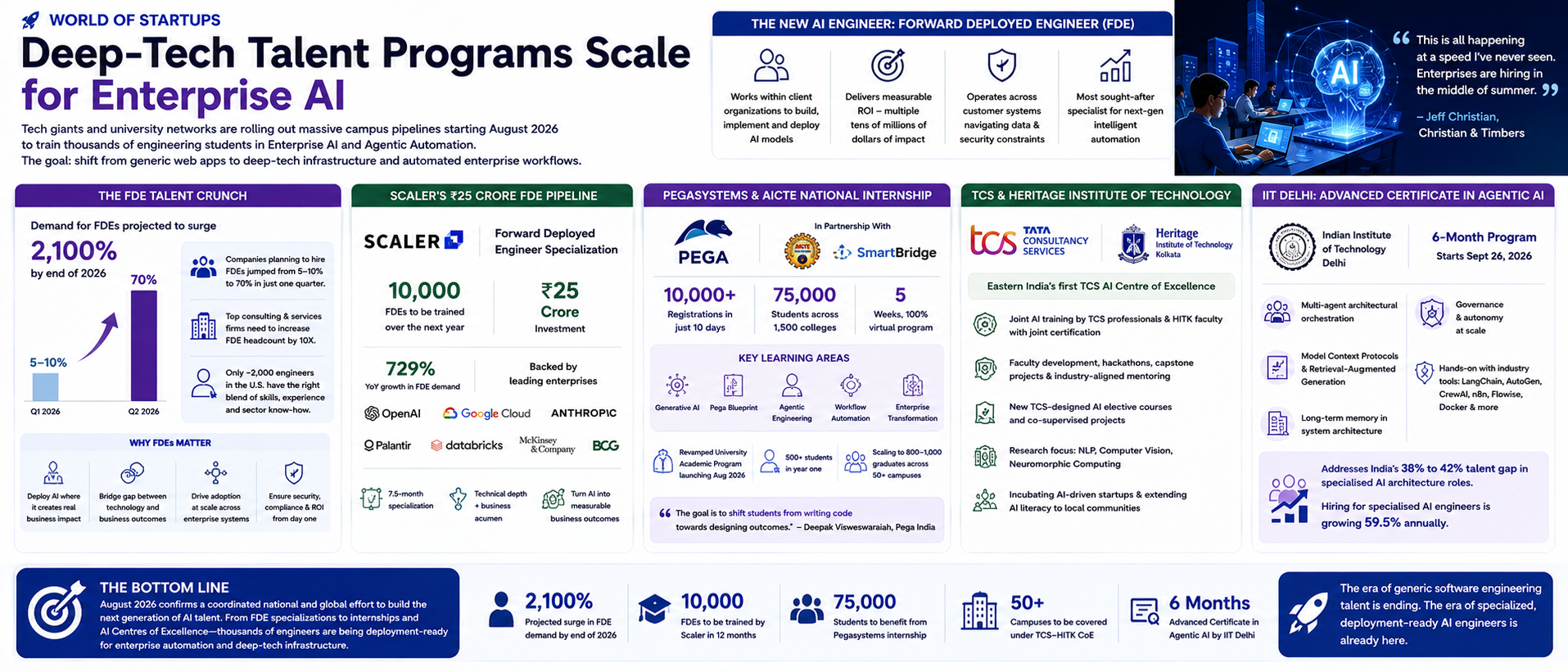
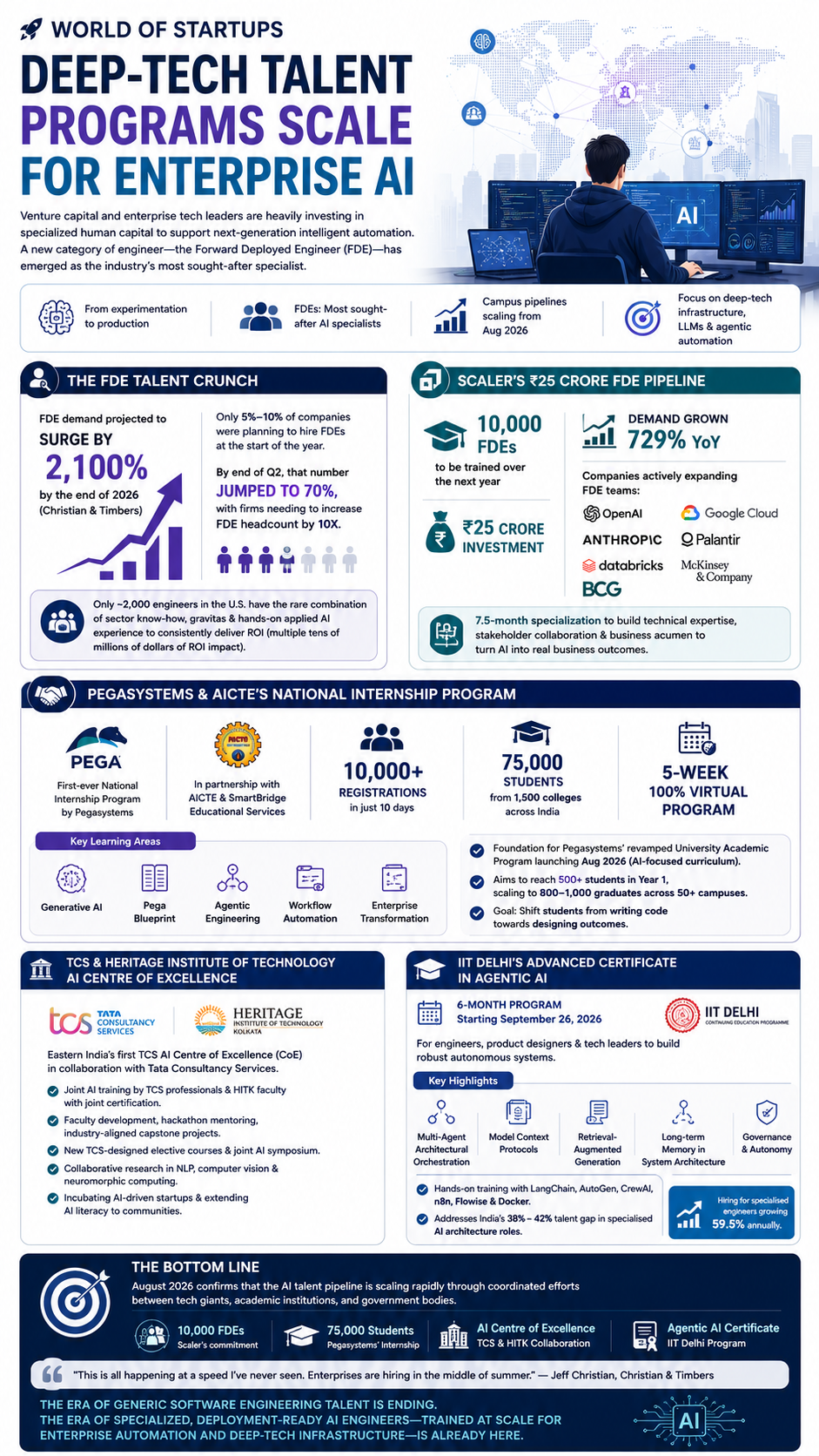
Venture capital and enterprise tech leaders are heavily investing in specialized human capital to support next-generation intelligent automation. As AI moves from experimentation to production, a new category of engineer—the Forward Deployed Engineer (FDE)—has emerged as the industry's most sought-after specialist. Tech giants and university networks are rolling out massive campus pipelines starting August 2026 to train thousands of engineering students directly in Enterprise AI and Agentic Automation, shifting away from generic web app development to focus on deep-tech infrastructure, localized language models, and automated enterprise workflows.
The FDE Talent Crunch
Demand for Forward Deployed Engineers—engineers who work within client organizations to build, implement, and deploy AI models—is projected to surge by 2,100% by the end of 2026, according to a study by executive search firm Christian & Timbers. At the start of the year, only 5% to 10% of companies were planning to hire FDEs, mostly for small pilots. By the end of the second quarter, that number jumped to 70%, with the largest consulting and services firms reporting a need to increase their FDE headcount by 10 times. However, the supply is severely constrained: Christian & Timbers estimates there are only about 2,000 engineers in the U.S. with the combination of sector know-how, gravitas, and hands-on applied AI experience needed to consistently deliver ROI—measured today as "multiple tens of millions of dollars of ROI impact".
Scaler's ₹25 Crore FDE Pipeline
Addressing this gap, Scaler, India's AI-native tech education platform, announced its Forward Deployed Engineer Specialization alongside a commitment to train 10,000 FDEs over the next year with a ₹25 crore investment. Demand for FDEs has grown 729% year-on-year, with companies including OpenAI, Google Cloud, Anthropic, Palantir, Databricks, McKinsey, and BCG actively expanding teams around the role. Unlike traditional software engineers who work within their own company's systems, FDEs operate across both their own and the customer's systems while navigating data and security constraints. The 7.5-month specialization aims to equip engineers with not only technical expertise but also the ability to collaborate with stakeholders, understand business needs, and turn AI into real business outcomes.
Pegasystems and AICTE's National Internship Program
Pegasystems has launched its first-ever National Internship Program in partnership with the All India Council for Technical Education (AICTE) and SmartBridge Educational Services. The five-week, 100% virtual program attracted over 10,000 registrations within 10 days and aims to reach nearly 75,000 students from 1,500 colleges across India. Participants receive practical exposure to generative AI, Pega Blueprint, agentic engineering, workflow automation, and enterprise transformation. The internship serves as the foundation for Pegasystems' revamped University Academic Program, launching in August 2026 with an AI-focused curriculum, and aims to reach 500+ students in year one, scaling to 800–1,000 graduates across 50+ campuses. Pega India's Deepak Visweswaraiah noted the push comes from real hiring demand, with equal focus on human skills that make graduates job-ready. The goal is to shift students from writing code towards designing outcomes—an instinct central to agentic engineering.
TCS and Heritage Institute of Technology's AI Centre of Excellence
Heritage Institute of Technology, Kolkata, has inaugurated Eastern India's first TCS AI Centre of Excellence in collaboration with Tata Consultancy Services. Designed as a long-term strategic partnership, the CoE brings together TCS's technological expertise and HITK's academic excellence to build an innovation-driven ecosystem. A selected HITK cohort will undergo joint AI training by TCS professionals and HITK faculty, culminating in a joint certification. The collaboration will feature faculty development programmes, mentoring of hackathon teams, co-supervision of capstone projects aligned with industry needs, new TCS-designed elective courses, and a joint symposium on AI's transformative role in engineering education. Looking ahead, the CoE will anchor collaborative research in NLP, computer vision, and neuromorphic computing, incubate AI-driven startups rooted in indigenous innovation, and extend AI literacy to neighbouring communities.
IIT Delhi's Advanced Certificate in Agentic AI
IIT Delhi's Continuing Education Programme has opened admissions for its six-month Advanced Certificate in Agentic AI, beginning September 26, 2026. The program is specifically designed for engineers, product designers, and tech leaders who seek to move beyond basics to develop robust autonomous systems. The curriculum highlights multi-agent architectural orchestration, Model Context Protocols, Retrieval-Augmented Generation, and long-term memory in system architecture, with a strong focus on governance and autonomy. The learning experience includes extensive hands-on training with industry-standard tools including LangChain, AutoGen, CrewAI, n8n, Flowise, and Docker. The program addresses India's 38% to 42% talent gap in specialised AI architecture roles, with hiring requirements for specialised engineers growing 59.5% annually.
The Bottom Line
August 2026 confirms that the AI talent pipeline is scaling rapidly through coordinated efforts between tech giants, academic institutions, and government bodies. Scaler's 10,000 FDE commitment, Pegasystems' 75,000-student internship, TCS's AI Centre of Excellence, and IIT Delhi's Agentic AI certificate program represent a coordinated response to the widening AI skills gap. As Jeff Christian of Christian & Timbers observed: "This is all happening at a speed I've never seen. Enterprises are hiring in the middle of summer". The era of generic software engineering talent is ending. The era of specialized, deployment-ready AI engineers—trained at scale for enterprise automation and deep-tech infrastructure—is already here.

Vishal Sable
B.Tech AD @ shri balaji institute of technology and management
Engineering and tech journalist. I love exploring the impact of emerging technologies on global defense, sovereignty, and everyday life. Always looking for the real story behind the headlines.