LATEST NEWS
Swiggy Didn't Sell Its B2B Arm for Cash — It Bought Into the Company Buying It
September 9, 2026 5M
Back to News
News AlertWorld of Startup’s
Embodied AI and Physical Robotics Claim Venture Capital Dominance
V
Author
Vishal Sable
Published
August 4, 2026
Reading Time
5 MIN READ
Spread the Word
SAN FRANCISCO / SHANGHAI / LONDON – Wednesday, August 4, 2026
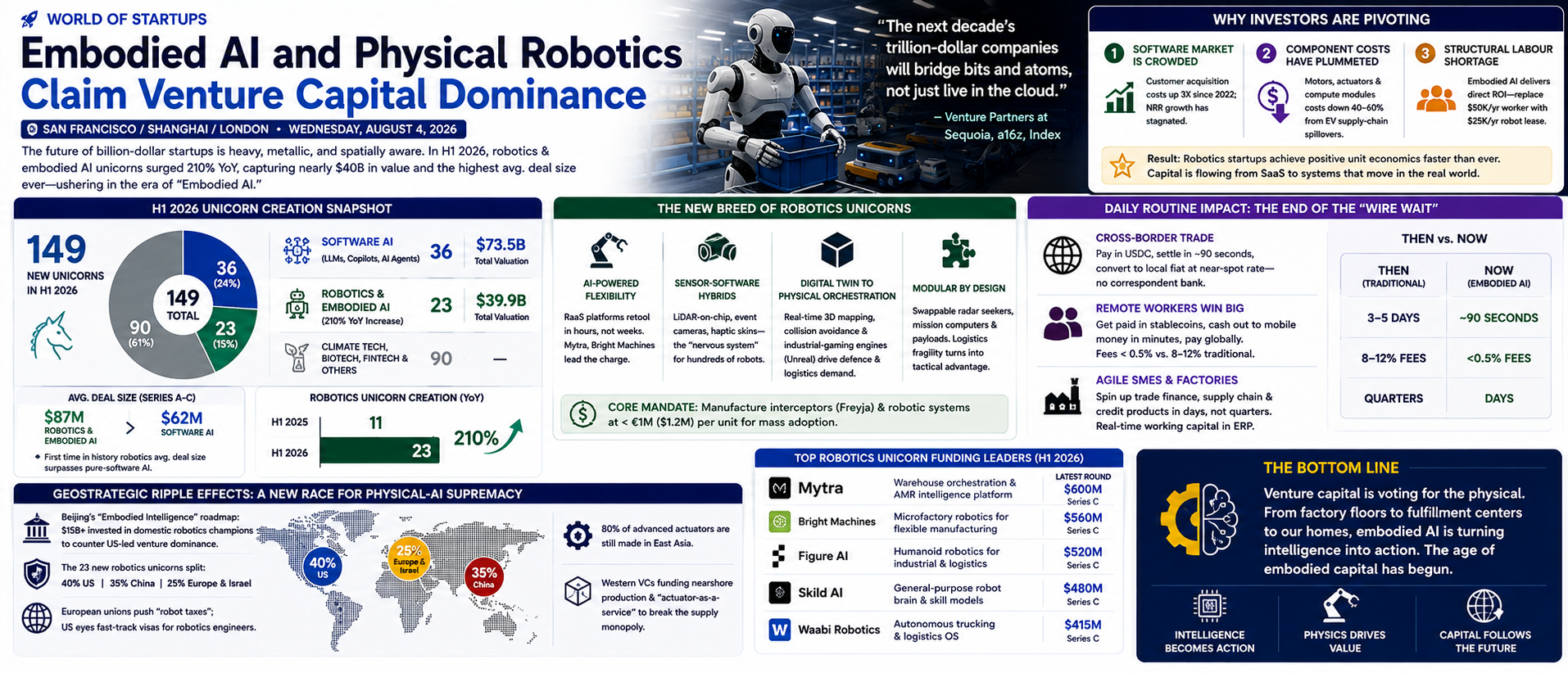
The venture capital landscape has officially turned a corner. After nearly a decade of software-only "light-asset" plays dominating unicorn creation, the first-half 2026 data paints a stark new picture: the future of billion-dollar startups is heavy, metallic, and spatially aware. Investors are abandoning pure web-app SaaS in droves, pouring record sums into startups that build physical factory mechanics, sensor fusion stacks, and spatial computing layers, ushering in the era of "Embodied AI." According to freshly compiled global venture data, the first six months of 2026 produced 149 new startups crossing the $1 billion valuation threshold, a robust number, but the composition tells the real story. Software AI, which includes next-generation LLM orchestrators, enterprise copilots, and vertical AI agents, led with 36 new unicorns collectively valued at $73.5 billion. However, robotics and embodied AI emerged as a close second with 23 new unicorns amassing a combined valuation of $39.9 billion, representing a 210% year-over-year increase in robotics unicorn creation compared to H1 2025. The remaining 90 unicorns spanned climate tech, biotech, and fintech, but the average deal size for robotics rounds, spanning Series A through C, surpassed pure-software AI rounds for the first time in history, with $87 million against $62 million, respectively. The message from Sand Hill Road is unambiguous: the "token" era of AI is saturating, and investors now seek startups that can ground intelligence in physics, friction, and three-dimensional space.
The robotics unicorns of 2026 are not your factory-floor arms of yesteryear; they are a new breed tightly integrating large-world models with real-time actuation, tactile sensors, and edge-compute stacks that operate in chaotic, unstructured environments. Startups like Mytra, which specialises in warehouse orchestration, and Bright Machines, focusing on microfactory assembly, are securing billion-dollar rounds by offering robotics-as-a-service that outperforms traditional automation in flexibility, retooling within hours instead of weeks. Yet the top performers are not necessarily robot builders per se; they are sensor-software hybrids. Companies developing solid-state LiDAR-on-a-chip, event-based cameras, and force-torque haptic skins are commanding premium multiples because they supply the "nervous system" for hundreds of OEM robot variants. Perhaps the hottest sub-sector is the "digital twin to physical" orchestration, with startups building real-time 3D mapping and collision-avoidance engines, drawing from gaming engines like Unreal but hardened for industrial latency, attracting defence and logistics contracts concurrently and fuelling rapid revenue growth that justifies lofty valuations.
Why this sudden pivot from software to hardware? Three converging forces explain the exodus. First, the enterprise software market is overcrowded; customer acquisition costs have tripled since 2022 while net revenue retention has stagnated, leaving investors wary of "me-too" AI wrappers. Second, component costs for motors, actuators, and compute modules have plummeted by 40 to 60 percent due to electric vehicle supply-chain spillovers, allowing robotics startups to achieve positive unit economics faster than ever. Third, global manufacturing and logistics face a structural labour shortage, and embodied AI offers a direct, monetizable ROI—replacing a $50,000-per-year warehouse worker with a $25,000-per-year robot lease is an irresistible arithmetic. Venture partners from Sequoia, a16z, and Index are publicly stating that the next decade's trillion-dollar companies will be those that bridge bits and atoms, not those that live solely in the cloud, and they are backing that conviction with their chequebooks.
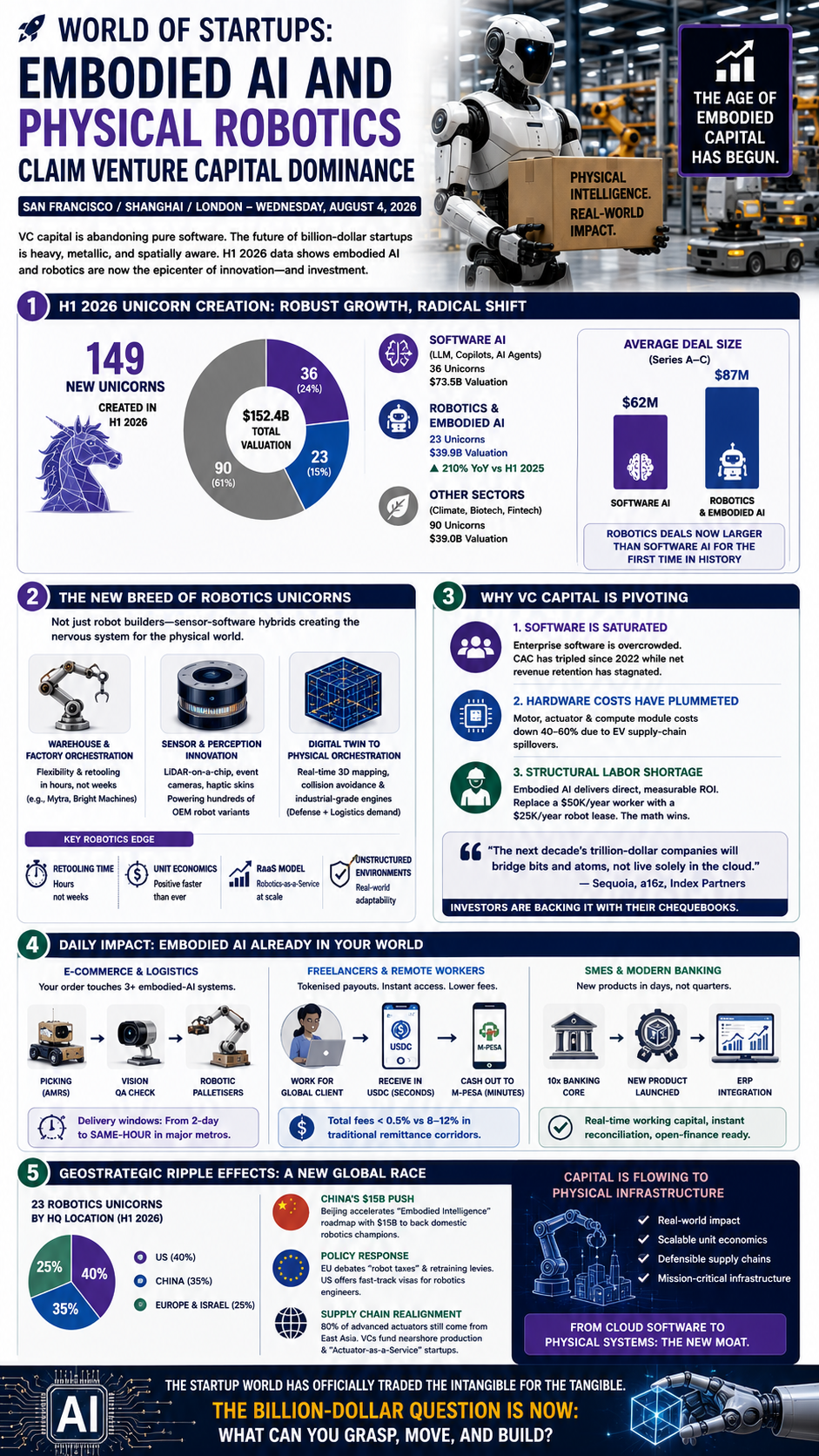
For everyday consumers and businesses, the shift is already tangible. The average e-commerce order now touches at least three embodied-AI systems, from autonomous mobile robots picking bins, to computer-vision quality checkers, to robotic palletisers, and delivery windows have shrunk from two-day to same-hour in major metro areas, driven by physical AI orchestrating micro-fulfillment centres. Mid-sized factories in Germany, Japan, and Vietnam are leasing "robot fleets" with pay-per-pick pricing, eliminating the need for expensive in-house automation engineers; a furniture maker in Ho Chi Minh City can now retool a production line for a new design within 48 hours entirely via cloud-reprogrammed robotic arms. While still nascent, the first wave of home embodied-AI devices—laundry-folding robots, autonomous lawnmowers with 3D obstacle avoidance, and kitchen assistants that adapt to countertop layouts—are entering early adopter homes, backed by the same sensor-spatial stacks that industrial unicorns are perfecting.
The venture pivot is not happening in a vacuum; it is colliding with state-level industrial strategies that amplify its geopolitical weight. Beijing has accelerated its "Embodied Intelligence" roadmap, pouring $15 billion into domestic robotics champions to counter US-led venture dominance, and the 23 new robotics unicorns are split roughly 40 percent US, 35 percent China, and 25 percent Europe and Israel, signalling a new bipolar race for physical-AI supremacy. Meanwhile, European unions are already petitioning for "robot taxes" and retraining levies, while US policymakers are considering fast-track visas for robotics engineers, a reversal from the H-1B skirmishes of the early 2020s. With 80 percent of advanced actuators still manufactured in East Asia, Western VCs are actively funding nearshore production pilots for critical components, suggesting that the next wave of robotics unicorns may not be robot makers but "actuator-as-a-service" providers that break the Asian supply monopoly. Today, the startup world has officially traded the intangible for the tangible; the billion-dollar question is no longer "what can you generate?" but "what can you grasp, move, and build?" and investors are answering with their capital. The age of embodied capital has begun.

Vishal Sable
B.Tech AD @ shri balaji institute of technology and management
Engineering and tech journalist. I love exploring the impact of emerging technologies on global defense, sovereignty, and everyday life. Always looking for the real story behind the headlines.