LATEST NEWS
Swiggy Didn't Sell Its B2B Arm for Cash — It Bought Into the Company Buying It
September 9, 2026 5M
Back to News
News AlertWorld of Startup’s
Encore AI Lands $30M for Sales Agents; VCs Pivot to Deep Infrastructure
V
Author
Vishal Sable
Published
July 31, 2026
Reading Time
3 MIN READ
Spread the Word
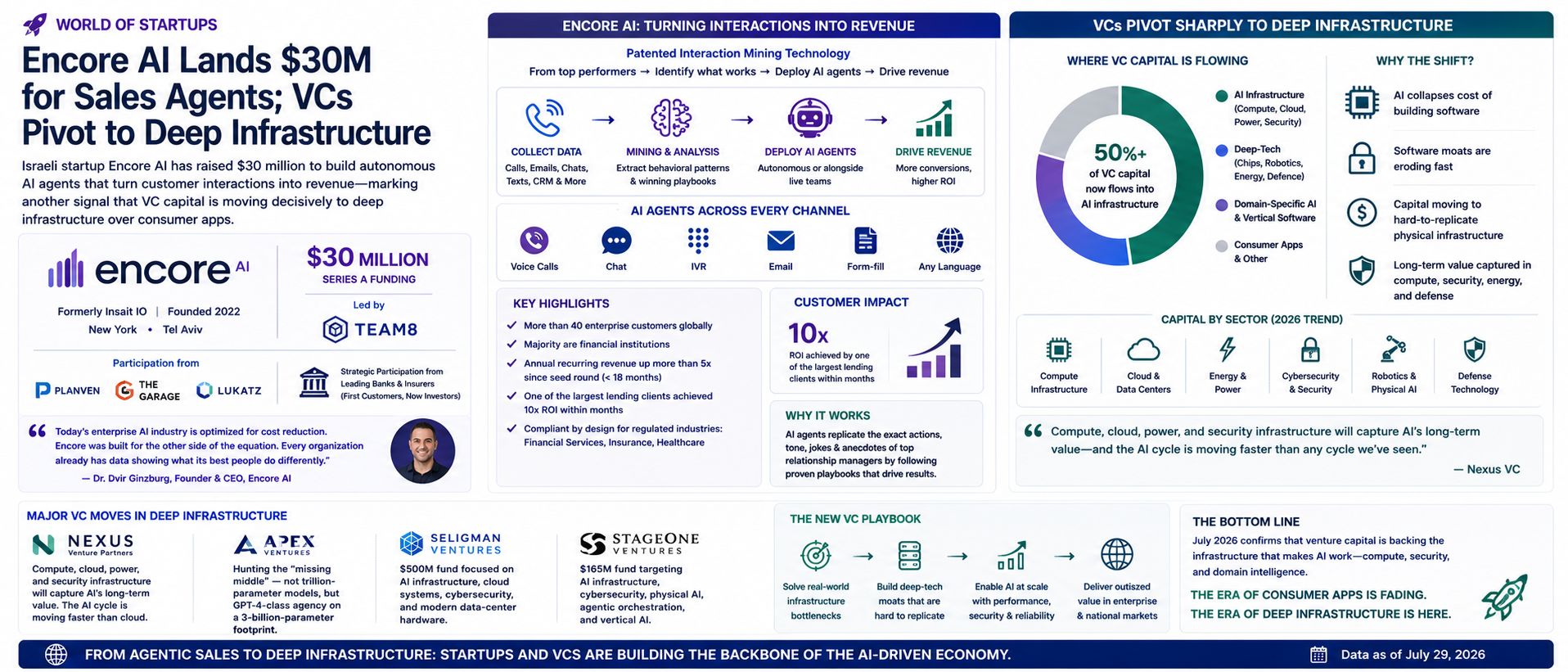
Enterprise startup Encore AI has secured $30 million to build autonomous AI agents designed to analyze customer call data, extract behavioral patterns, and dynamically optimize corporate sales workflows. The Israeli startup, formerly known as Insait IO, announced on July 29 a Series A funding round led by Team8, with participation from Planven, The Garage, Lukatz, and several large commercial banks and insurers that first became Encore AI customers before choosing to invest. The New York-based company said it will use the capital to expand global deployment of an enterprise AI platform it describes as built to generate revenue from customer interactions rather than deflect them.
The company's patented Interaction Mining technology studies an organization's top performers, extracts specific actions that drive results, and deploys them as AI agents. Those agents operate autonomously or alongside live teams, across voice, chat, IVR, email, and form-fill channels, in any language, while meeting compliance requirements in regulated industries such as financial services and healthcare. Encore AI founder and CEO Dr. Dvir Ginzburg, who founded the company in 2022, calls the process "interaction mining"—the platform collects call recordings, emails, text messages, and CRM data to identify which conversational approaches lead to successful outcomes. "Sometimes our agents even tell the jokes that the relationship managers are telling, or give the anecdotes or examples that the relationship managers are giving, because we literally run by the playbooks that we see working," Ginzburg told TechCrunch. The company has more than 40 enterprise customers globally, the majority of which are financial institutions, and its annual recurring revenue has increased more than 5x since its seed round less than 18 months ago. One of its largest lending clients reportedly achieved a 10x return on investment within months. "Today's enterprise AI industry is optimized for cost reduction," Ginzburg said. "Encore was built for the other side of the equation. Every organization already has data showing what its best people do differently".
Global venture capital data highlights a clear shift in early-stage funding. Capital is increasingly bypassing consumer-facing web apps to concentrate on deep infrastructure, domain-specific AI models, low-latency edge computing hardware, and cybersecurity automation. As AI collapses the cost of building software and erodes its moats, capital is flowing toward chips, robotics, energy, and defense—the expensive, hard-to-replicate physical infrastructure. Over half of VC capital is now expected to flow into AI infrastructure, while consumer-driven models face growing concerns around scalability and differentiation. Nexus, a venture capital firm, has argued that compute, cloud, power, and security infrastructure will capture AI's long-term value—and that the AI cycle is moving faster than prior technology waves such as cloud computing. APEX Ventures has noted that the hunt is on for the "missing middle"—startups that aren't building trillion-parameter models, but rather deploying GPT-4-class agency on a 3-billion-parameter footprint. Seligman Ventures has launched a $500 million fund focused on AI infrastructure, cloud systems, cybersecurity, and modern data-center hardware, while StageOne Ventures has closed a $165 million fund targeting AI infrastructure, cybersecurity, physical AI, agentic orchestration, and vertical AI. July 2026 confirms that venture capital is pivoting sharply toward infrastructure that makes AI work—compute, security, and domain-specific intelligence. The era of consumer apps is fading. The era of deep infrastructure is already here.

Vishal Sable
B.Tech AD @ shri balaji institute of technology and management
Engineering and tech journalist. I love exploring the impact of emerging technologies on global defense, sovereignty, and everyday life. Always looking for the real story behind the headlines.