Back to News
News AlertWorld Money
Global Fintech Capital Reaches $28.6B via AI Financial Infrastructure
V
Author
Vishal Sable
Published
August 25, 2026
Reading Time
5 MIN READ
Spread the Word
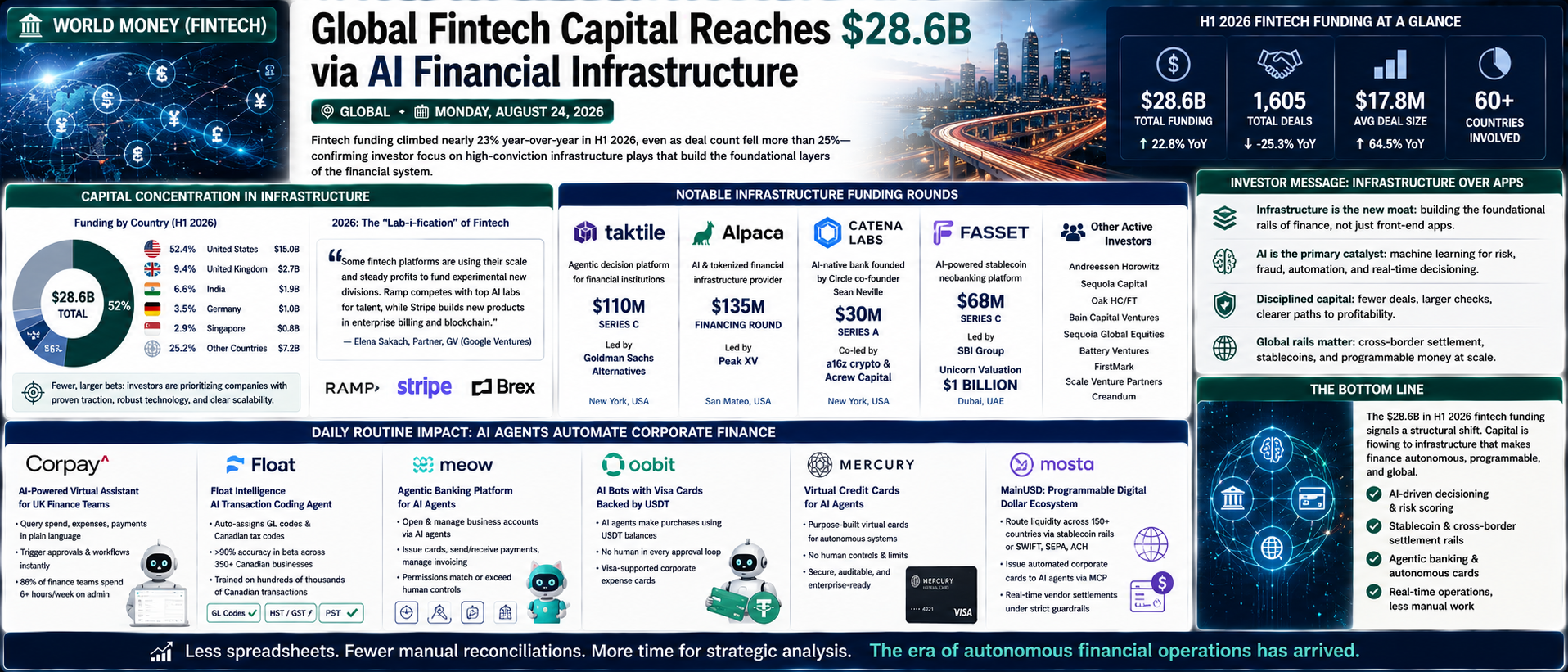
The fintech sector has delivered a clear signal that the era of speculative, consumer-facing apps is giving way to a more disciplined, infrastructure-driven investment landscape. Mid-year data reveals that global fintech funding reached $28.6 billion across 1,605 deals in the first half of 2026. While overall deal volume contracted by more than 25% year-over-year, institutional capital concentrated heavily in high-conviction infrastructure plays—particularly AI-driven risk scoring, credit analytics, and cross-border settlement rails. The message from venture capitalists and institutional investors is unambiguous: the future of fintech belongs to platforms that build the foundational layers of the financial system, not those that merely layer apps on top of it.
CAPITAL CONCENTRATION IN INFRASTRUCTURE: The "Lab-i-fication" of Fintech
The numbers tell a story of strategic consolidation. Fintech funding climbed nearly 23% year-over-year in H1 2026, even as deal count fell sharply—a sign that investors are writing fewer, but substantially larger, checks into the sector. The United States continues to dominate, capturing more than 52% of global fintech funding—$15 billion—followed by the United Kingdom with $2.7 billion and India with $1.9 billion.
Elena Sakach, a partner at GV (Google Ventures), described 2026 as marking "the definitive 'lab-i-fication' of the modern corporation," with some fintech platforms using their scale and steady profits to fund experimental new divisions. Companies like Ramp are now competing directly with top AI research labs for engineering talent, while Stripe is using its dominant position to build out new products in enterprise billing and blockchain.
Notable funding rounds underscore this infrastructure pivot. Taktile, a New York-based company developing an agentic decision platform for financial institutions, secured $110 million in a Series C round led by Goldman Sachs Alternatives. Alpaca, an AI and tokenized financial infrastructure provider, completed a $135 million financing round led by Peak XV. Catena Labs, an AI-native bank founded by Circle co-founder Sean Neville, raised $30 million in a Series A co-led by a16z crypto and Acrew Capital. Fasset, the AI-powered stablecoin neobanking platform, reached unicorn status with a $1 billion valuation after raising $68 million in a Series C led by SBI Group.
The concentration of capital reflects a maturing investment thesis: investors are prioritizing companies with proven traction, robust technology, and clear pathways to scalability, moving away from a broader distribution of smaller checks. AI is emerging as the primary catalyst, with fintech companies incorporating machine learning for risk assessment, personalized services, fraud prevention, and operational automation drawing heightened attention.
DAILY ROUTINE IMPACT: Autonomous AI Agents Transform Corporate Finance
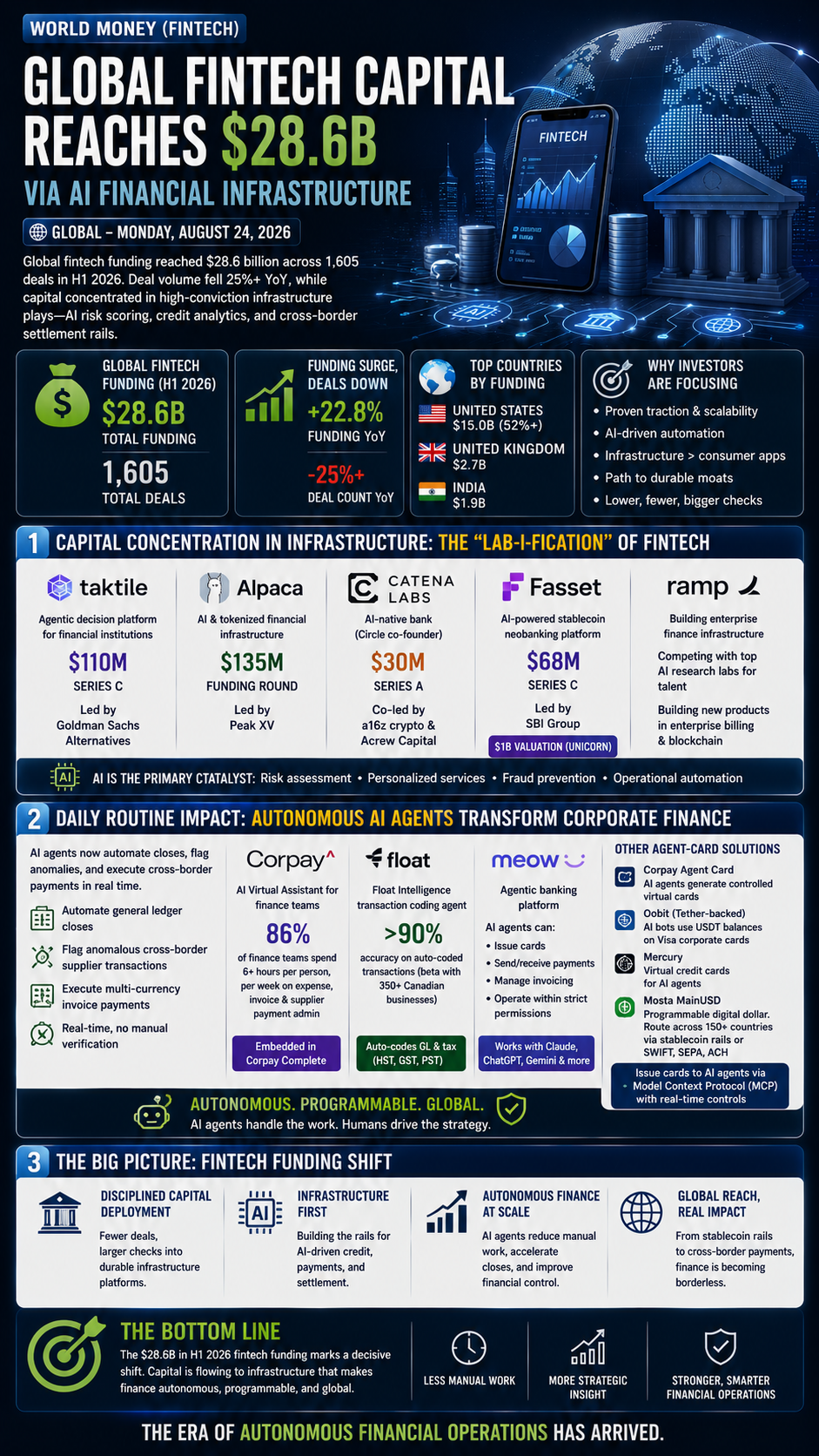
While institutional capital flows to infrastructure, the daily reality for finance teams and business owners is being transformed by autonomous AI agents embedded directly into corporate cards and business accounts. These platforms now automate general ledger closes, flag anomalous cross-border supplier transactions, and execute multi-currency invoice payments in real time without manual human verification.
Corpay, the S&P 500 corporate payments group, has launched an AI-powered Virtual Assistant for UK finance teams, embedded within its Corpay Complete platform. The tool allows users to query card spend, expense reports, supplier payments, and approval queues in plain language, surfacing relevant data or triggering workflows without manual navigation. Research commissioned by Corpay found that 86% of finance teams spend six or more hours per person, per week on expense, invoice, and supplier payment administration.
Float Financial, a Toronto-based FinTech firm, has launched Float Intelligence, an AI automation layer that bundles existing automation tools with a new transaction coding agent. The agent automatically assigns general ledger codes and Canadian tax codes—HST, GST, PST—to transactions made on Float corporate cards. During beta testing across more than 350 Canadian businesses, the agent was accurate more than 90% of the time on auto-coded transactions. The key differentiator: Float trained its large language model on hundreds of thousands of transactions from Canadian vendors with Canadian tax and ledger codes, and custom-trained it with each business's historical transactions.
Meow Technologies has launched an agentic banking platform enabling AI agents to open and manage business bank accounts on behalf of users. The platform supports Claude, ChatGPT, Cursor, Gemini, and other AI tools through a Model Context Protocol endpoint. Once an account is established, AI agents can issue virtual and physical corporate cards, send and receive payments, manage invoicing, and handle ongoing account activity. The platform's permissioning system ensures agents operate within the same controls that govern human employees—and in some cases, stricter ones.
Corpay also launched Agent Card, a capability enabling AI agents to generate controlled virtual cards for business transactions. Oobit, a Tether-backed startup, offers AI bots Visa-supported corporate expense cards, allowing AI agents to make purchases using USDT balances without requiring a human in every approval loop. Mercury Technologies has introduced virtual credit cards designed specifically for AI agents.
Mosta, an AI-native business banking platform for global enterprises, has launched MainUSD, a highly regulated, programmable digital dollar ecosystem built directly into everyday financial workflows. Companies can route liquidity across more than 150 countries using either stablecoin rails or traditional clearers, including SWIFT, SEPA, and ACH. Through MainUSD, companies can issue controlled, automated corporate cards directly to autonomous systems connected via the Model Context Protocol, enabling AI agents to independently execute multi-step business transactions and handle real-time vendor settlements under strict programmatic guardrails.
THE BOTTOM LINE
The $28.6 billion in H1 2026 fintech funding represents not just a number but a directional shift. Investors are betting on infrastructure that makes finance autonomous, programmable, and global—from AI-driven credit decisioning to stablecoin settlement rails, from agentic banking platforms to autonomous corporate cards. For the finance professionals and business owners who will use these systems, the daily routine is already changing: fewer spreadsheets, fewer manual reconciliations, and more time for strategic analysis. The era of autonomous financial operations has arrived, and the capital is flowing to match.

Vishal Sable
B.Tech AD @ shri balaji institute of technology and management
Engineering and tech journalist. I love exploring the impact of emerging technologies on global defense, sovereignty, and everyday life. Always looking for the real story behind the headlines.