Back to News
News AlertWorld Money
Global Fintech Revenue Surpasses $500B as Sector Outpaces Traditional Banking
V
Author
Vishal Sable
Published
August 2, 2026
Reading Time
4 MIN READ
Spread the Word
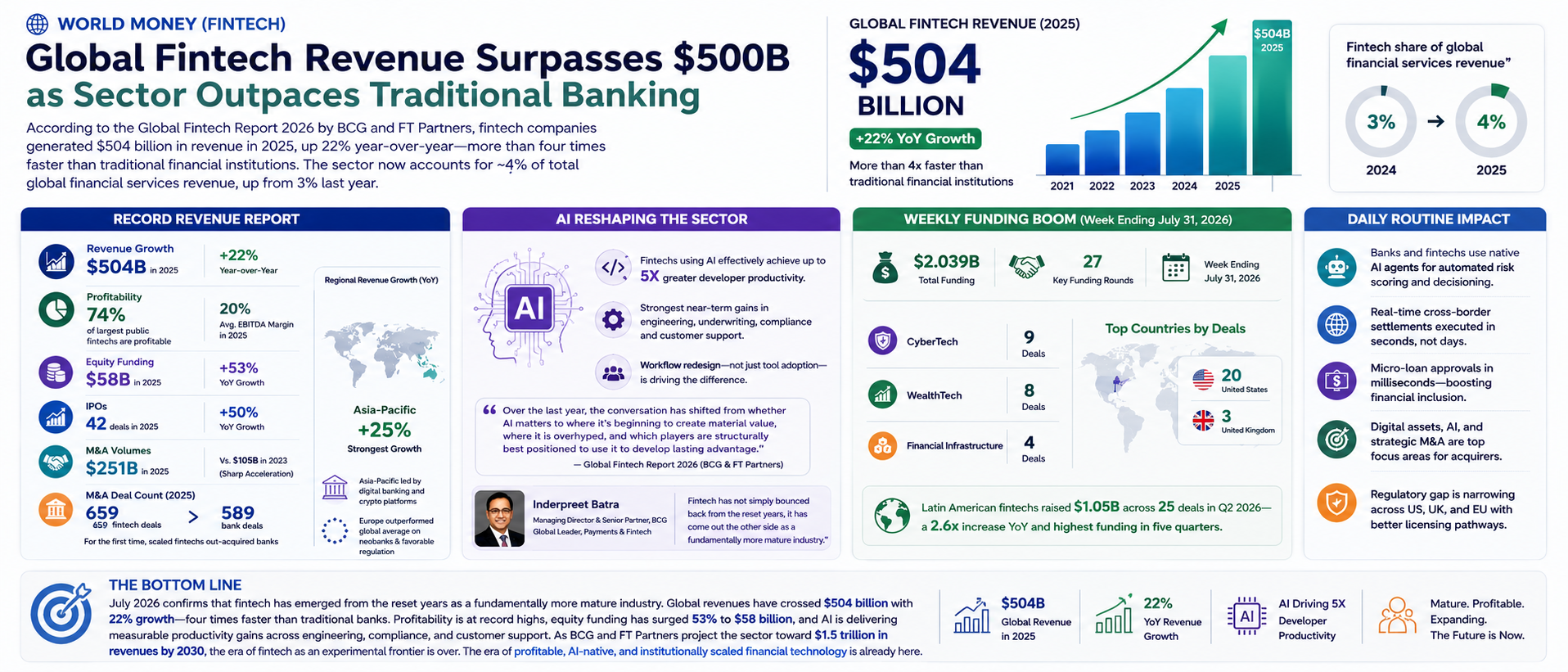
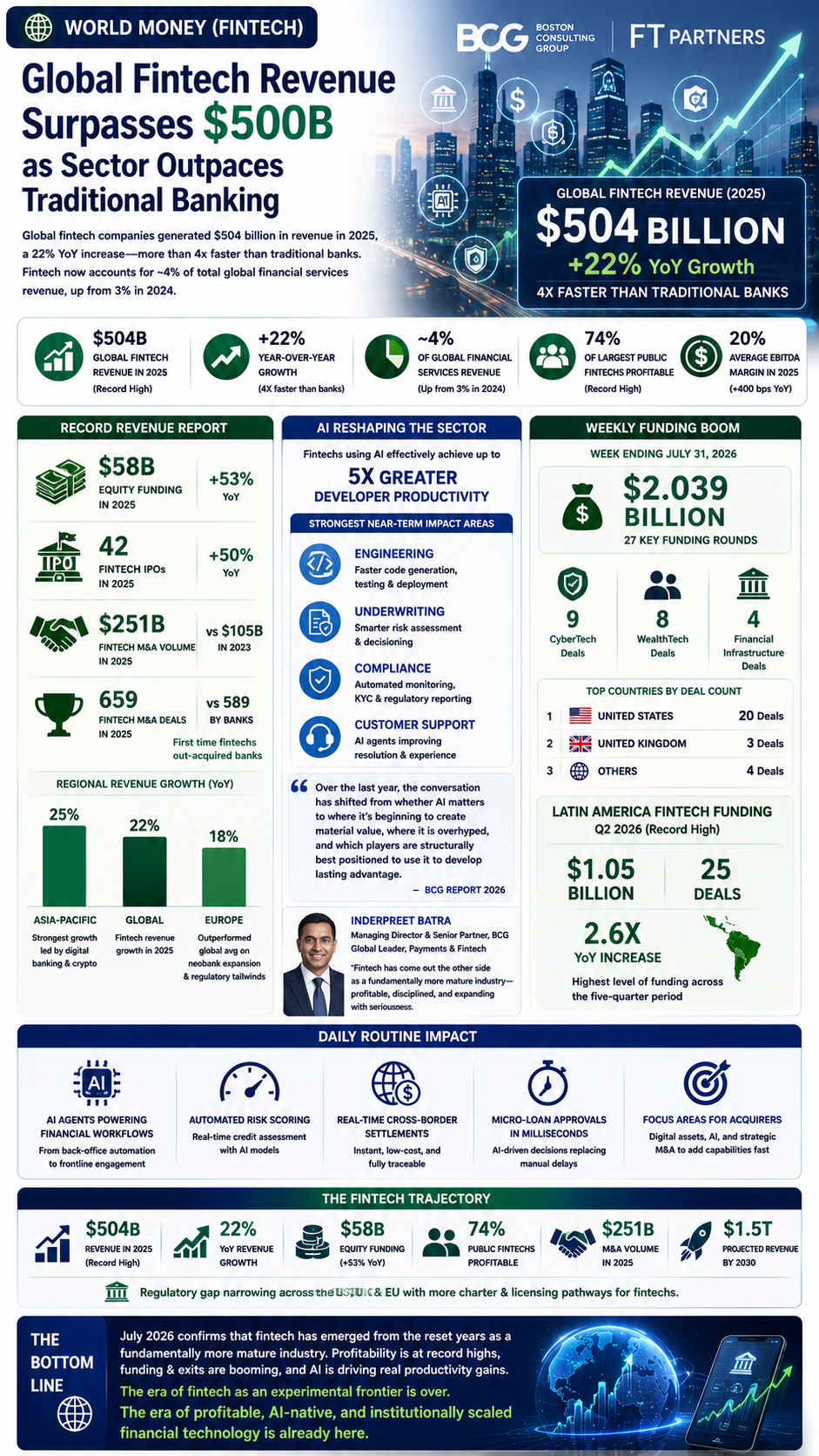
The financial technology sector has officially entered a new era of maturity and profitability, with global revenues crossing the half-trillion-dollar mark for the first time. According to the Global Fintech Report 2026, published by Boston Consulting Group (BCG) and FT Partners, fintech companies generated $504 billion in revenue in 2025, representing a 22% year-over-year growth rate—more than four times faster than traditional financial institutions. The sector now accounts for approximately 4% of the total global financial services revenue pool, up from 3% the prior year, confirming its status as a distinct, mature industry with significant white space remaining.
Record Revenue Report
The recovery is not driven by cheap capital or speculative optimism, but by operating performance. The report found that 74% of the largest public fintech companies are now profitable, with average EBITDA margins rising 400 basis points to 20% in 2025. Equity funding surged 53% year-over-year to $58 billion. Exit markets have followed suit: fintech IPOs rose 50% to 42 deals, while M&A volumes accelerated sharply from $105 billion in 2023 to $251 billion in 2025. For the first time on record, scaled fintech companies out-acquired banks in M&A, completing 659 deals compared to 589 by incumbents.
Asia-Pacific posted the strongest regional growth at 25%, driven by digital banking and crypto platforms, while Europe outperformed the global average on the back of neobank expansion and a more accommodating regulatory environment.
AI Reshaping the Sector
Artificial intelligence is fundamentally reshaping how the sector competes. BCG data shows fintechs using AI effectively are achieving up to five times greater developer productivity, with the strongest near-term gains coming in engineering, underwriting, compliance, and customer support. These are areas where workflow redesign, rather than tool adoption alone, is driving the difference. As the report notes, "Over the last year, the conversation has shifted from whether AI matters to where it's beginning to create material value, where it is overhyped, and which players are structurally best positioned to use it to develop lasting advantage".
Inderpreet Batra, Managing Director and Senior Partner at BCG and Global Leader of its Payments & Fintech business, observed: "Fintech has not simply bounced back from the reset years, it has come out the other side as a fundamentally more mature industry. The firms leading today are profitable, disciplined, and expanding into new products and geographies with a seriousness that was not always present in the boom years".
Weekly Funding Boom
The momentum has continued into 2026. In the week ending July 31, fintech investment soared to $2.039 billion across 27 key funding rounds, according to FinTech Global data. CyberTech led the sector with nine deals, followed by WealthTech with eight raises, while financial infrastructure firms secured four. The United States dominated with 20 deals, followed by the UK with three.
Latin American fintechs also posted record growth, raising $1.05 billion across 25 deals in Q2 2026—a 2.6x increase year-over-year and the highest level of funding recorded across the five-quarter period.
Daily Routine Impact
Banks and fintech platforms are using native AI agents to execute automated risk scoring, real-time cross-border settlements, and micro-loan approvals in milliseconds, replacing traditional back-office delays. The report identified digital assets, AI, and strategic M&A as major focus areas for acquirers, with companies using acquisitions to rapidly add capabilities as competition intensifies and in-house timelines lengthen. The regulatory gap between banks and fintechs is also narrowing across the US, UK, and EU, with charter and licensing pathways becoming more accessible.
The Bottom Line
July 2026 confirms that fintech has emerged from the reset years as a fundamentally more mature industry. Global revenues have crossed $504 billion with 22% growth—four times faster than traditional banks. Profitability is at record highs, equity funding has surged 53% to $58 billion, and AI is delivering measurable productivity gains across engineering, compliance, and customer support. As BCG and FT Partners project the sector toward $1.5 trillion in revenues by 2030, the era of fintech as an experimental frontier is over. The era of profitable, AI-native, and institutionally scaled financial technology is already here.

Vishal Sable
B.Tech AD @ shri balaji institute of technology and management
Engineering and tech journalist. I love exploring the impact of emerging technologies on global defense, sovereignty, and everyday life. Always looking for the real story behind the headlines.