Back to News
News AlertWorld Money
Global Fintech Revenue Tops $504 Billion
V
Author
Vishal Sable
Published
August 2, 2026
Reading Time
3 MIN READ
Spread the Word
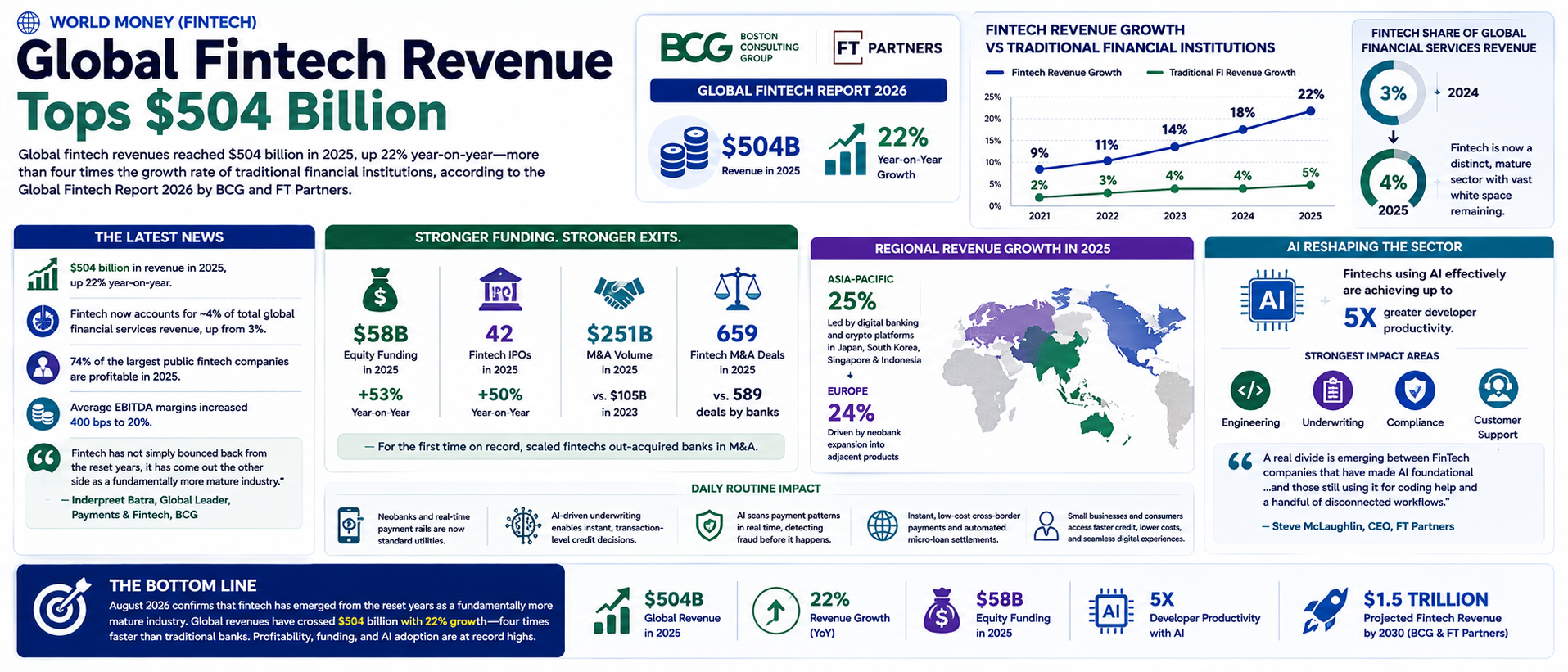
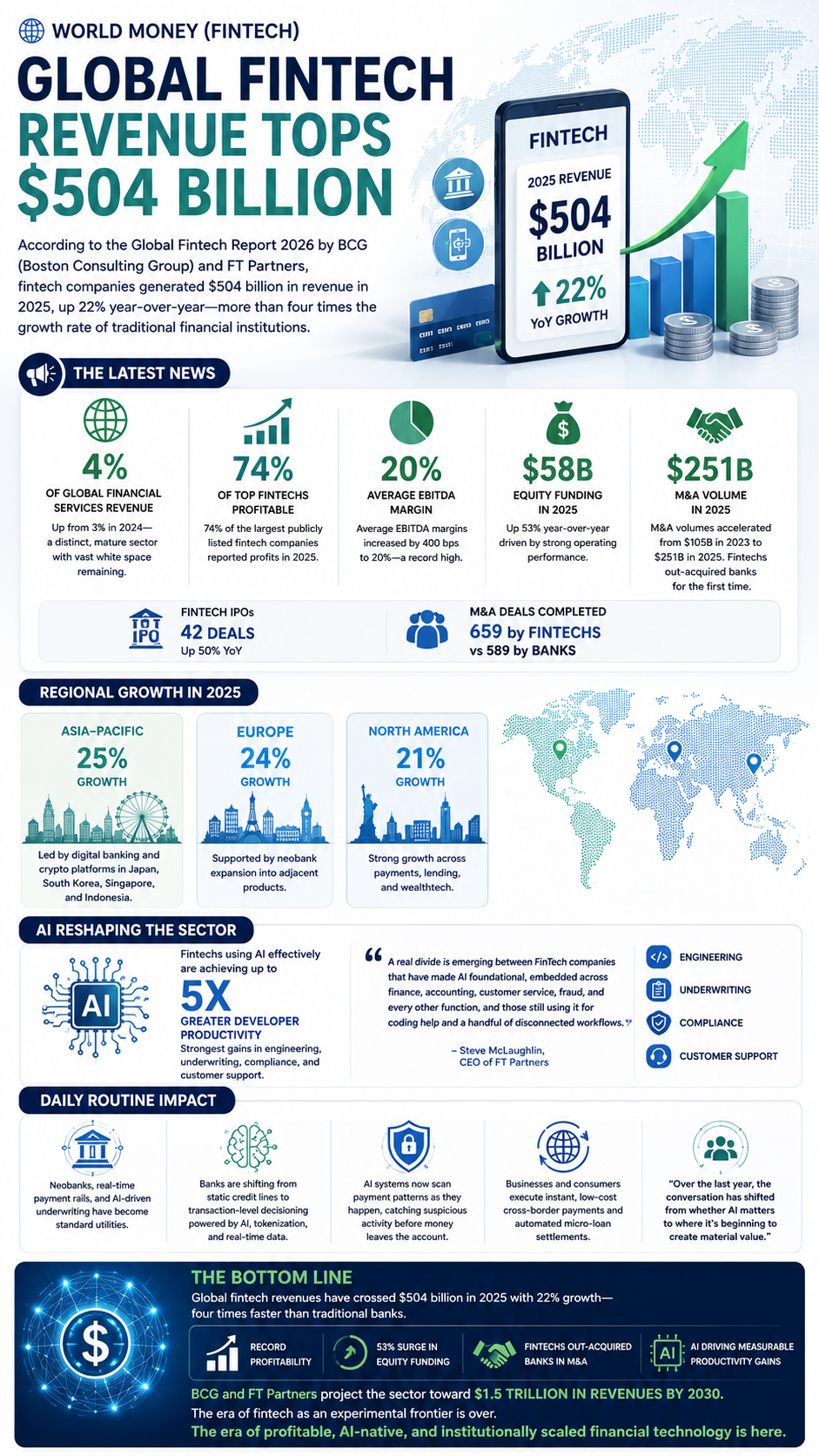
Financial technology has officially evolved from a post-pandemic recovery phase into a mature, highly profitable global sector. According to the Global Fintech Report 2026 released by Boston Consulting Group (BCG) and FT Partners on June 1, fintech companies generated $504 billion in revenue in 2025, representing a 22% year-on-year increase—more than four times the growth rate of traditional financial institutions.
The Latest News
Fintech now accounts for approximately 4% of the total global financial services revenue pool, up from 3% a year earlier—enough to be considered a distinct, mature sector with vast white space remaining. The rebound is not driven by cheap capital or speculative optimism, but by operating performance.
Profitability across the sector reached record levels: 74% of the largest publicly listed fintech companies reported profits in 2025, while average EBITDA margins increased by 400 basis points to 20%. “Fintech has not simply bounced back from the reset years, it has come out the other side as a fundamentally more mature industry,” said Inderpreet Batra, Managing Director and Senior Partner at BCG and Global Leader of its Payments & Fintech business.
The sector attracted $58 billion in equity funding in 2025, up 53% year-over-year. Exit markets have followed suit: fintech IPOs rose 50% to 42 deals, while M&A volumes accelerated sharply from $105 billion in 2023 to $251 billion in 2025. For the first time on record, scaled fintech companies out-acquired banks in M&A, completing 659 deals compared to 589 by incumbents.
Regionally, Asia-Pacific led growth at 25%, driven by digital banking and crypto platforms in Japan, South Korea, Singapore, and Indonesia. Europe grew 24%, supported by neobank expansion into adjacent products, while North America grew 21%.
AI Reshaping the Sector
Artificial intelligence is fundamentally reshaping how the sector competes. BCG data shows fintechs using AI effectively are achieving up to five times greater developer productivity, with the strongest gains coming in engineering, underwriting, compliance, and customer support. “A real divide is emerging between FinTech companies that have made AI foundational, embedded across finance, accounting, customer service, fraud, and every other function, and those still using it for coding help and a handful of disconnected workflows,” said Steve McLaughlin, CEO of FT Partners.
Daily Routine Impact
Neobanks, real-time payment rails, and AI-driven underwriting have become standard utilities. Banks are shifting from static credit lines to transaction-level decisioning powered by AI, tokenization, and real-time data—changing how credit is priced and delivered. AI systems now scan payment patterns as they happen, catching suspicious activity before money leaves the account. Small businesses and consumers are using these systems to execute instant, low-cost cross-border payments and automated micro-loan settlements without traditional bank delays. As the report notes, “Over the last year, the conversation has shifted from whether AI matters to where it's beginning to create material value”.
The Bottom Line
August 2026 confirms that fintech has emerged from the reset years as a fundamentally more mature industry. Global revenues have crossed $504 billion with 22% growth—four times faster than traditional banks. Profitability is at record highs, equity funding has surged 53% to $58 billion, and AI is delivering measurable productivity gains across engineering, compliance, and customer support. As BCG and FT Partners project the sector toward $1.5 trillion in revenues by 2030, the era of fintech as an experimental frontier is over. The era of profitable, AI-native, and institutionally scaled financial technology is already here.

Vishal Sable
B.Tech AD @ shri balaji institute of technology and management
Engineering and tech journalist. I love exploring the impact of emerging technologies on global defense, sovereignty, and everyday life. Always looking for the real story behind the headlines.