LATEST NEWS
Swiggy Didn't Sell Its B2B Arm for Cash — It Bought Into the Company Buying It
September 9, 2026 5M
Back to News
News AlertWorld of Startup’s
Glow Raises $180M to Revolutionize AI-Era Endpoint Security
V
Author
Vishal Sable
Published
July 22, 2026
Reading Time
4 MIN READ
Spread the Word
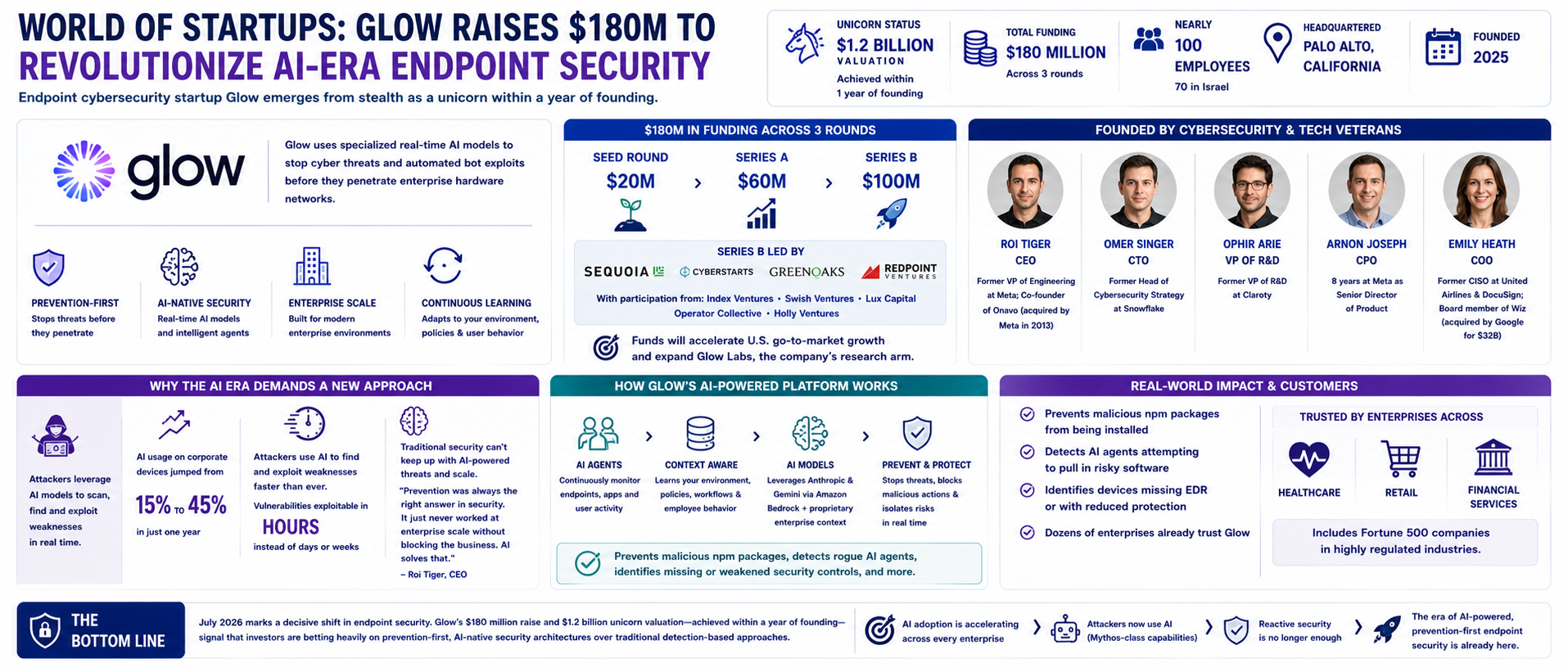
Endpoint cybersecurity startup Glow has emerged from stealth with $180 million in funding at a $1.2 billion valuation, becoming a unicorn within a year of its founding. Founded by former Meta, Snowflake, and Claroty executives, Glow uses specialized real-time AI models to stop cyber threats and automated bot exploits before they penetrate enterprise hardware networks. The company has nearly 100 employees, including 70 in Israel, and is headquartered in Palo Alto.
The Latest News
Glow announced on July 22 that it has raised $180 million across three financing rounds: a $20 million seed round, a $60 million Series A round, and a $100 million Series B round. The Series B was led by Sequoia Capital, Cyberstarts, Greenoaks, and Redpoint Ventures, with participation from Index Ventures, Swish Ventures, Lux Capital, Operator Collective, and Holly Ventures. The funding will be used to accelerate the growth of the go-to-market team in the United States and expand Glow Labs, the company's research arm.
The company was founded by CEO Roi Tiger, a former VP of engineering at Meta and co-founder of Onavo (acquired by Meta in 2013); CTO Omer Singer, former Head of Cybersecurity Strategy at Snowflake; and VP of R&D Ophir Arie, former VP of R&D at Claroty. The leadership team also includes Chief Product Officer Arnon Joseph, who spent eight years at Meta as Senior Director of Product, and Chief Operating Officer Emily Heath, former CISO at United Airlines and DocuSign, who served on the board of Wiz through its $32 billion acquisition by Google.
Why the AI Era Demands a New Approach
Glow operates in the field of endpoint security—the computers and devices through which employees connect to enterprise systems. The company says the spread of AI has fundamentally changed the security landscape. In the past, most attention was directed at protecting servers, networks, or cloud services. Today, AI tools, autonomous agents, and new software enter organizations mainly through employees' personal computers. Regular usage of AI on corporate devices—authorized or not—has skyrocketed from 15% to 45% in just one year.
At the same time, attackers are also using AI models to detect weaknesses and exploit them more quickly. The time available to security teams has been significantly shortened. Security vulnerabilities that could once be exploited within days or weeks can now be compromised in hours. "Prevention was always the right answer in security. It just never worked at enterprise scale without blocking the business. AI solves that," said Tiger. The platform developed by Glow is based on AI agents that continuously study the organization's work environment, security policies, and employee usage patterns. It uses AI models from Anthropic and Google's Gemini through Amazon Bedrock, while building its own software to provide the models with enterprise context.
Daily Routine Impact
Early-stage startups are focusing heavily on "prevention-first" architecture. In daily office environments, security software runs continuous background AI checks that proactively isolate suspicious code and file downloads without disrupting employee productivity. Glow's platform has already prevented malicious npm packages from being installed in customer environments, identified AI agents attempting to pull in such software, and detected employee devices where endpoint detection and response tools were missing or operating with reduced functionality. The company said it already works with dozens of enterprises, including Fortune 500 companies in healthcare, retail, and financial services. "The goal is to build a large company, not just another niche product," Tiger said, noting that enterprises prefer to work with fewer vendors that provide broad solutions rather than purchasing a long list of dedicated products.
The Bottom Line
July 2026 marks a decisive shift in endpoint security. Glow's $180 million raise and $1.2 billion unicorn valuation—achieved within a year of founding—signal that investors are betting heavily on prevention-first, AI-native security architectures over traditional detection-based approaches. With AI adoption accelerating and attackers leveraging Mythos-class capabilities, the era of reactive security is ending. The era of AI-powered, prevention-first endpoint security is already here.

Vishal Sable
B.Tech AD @ shri balaji institute of technology and management
Engineering and tech journalist. I love exploring the impact of emerging technologies on global defense, sovereignty, and everyday life. Always looking for the real story behind the headlines.