Back to News
News AlertWorld Defence Tech
Helsing Secures Mammoth $1.8B for Autonomous Jet Infrastructure
V
Author
Vishal Sable
Published
July 14, 2026
Reading Time
3 MIN READ
Spread the Word
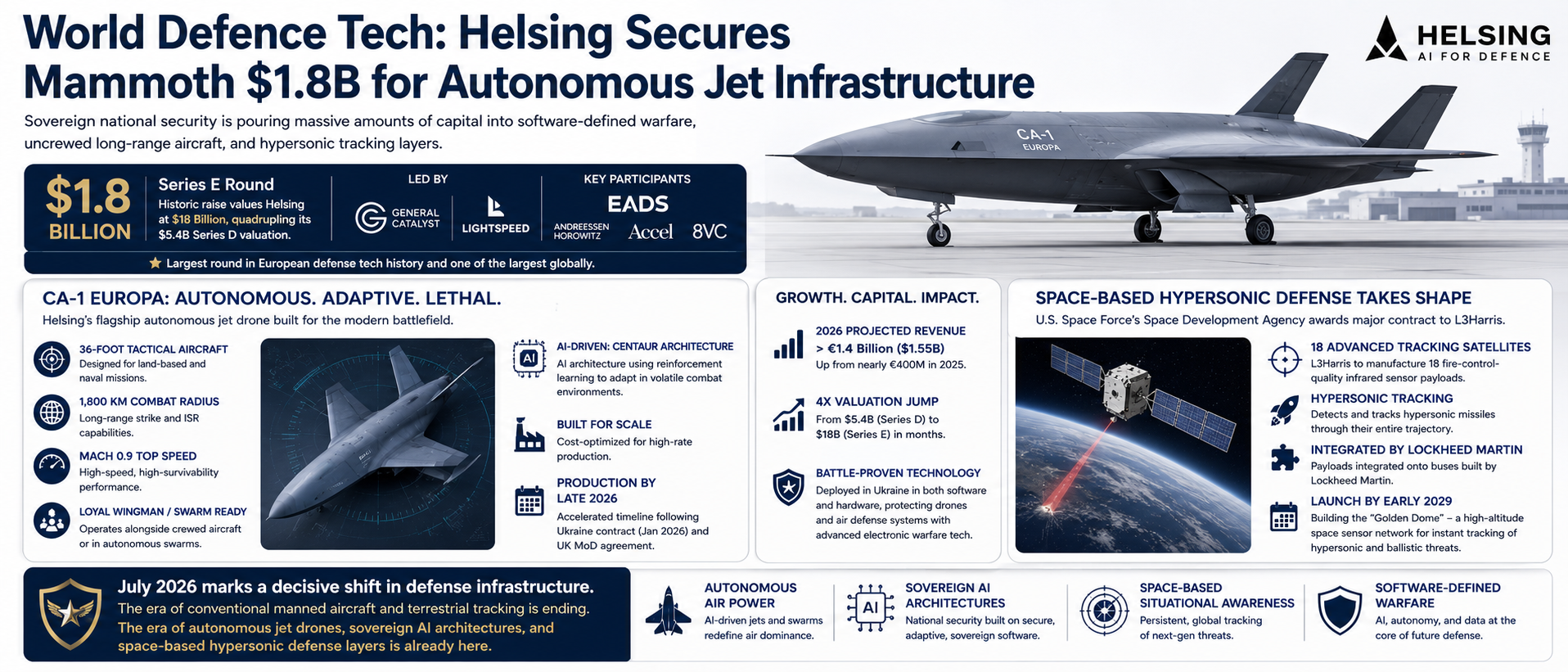
Sovereign national security is pouring massive amounts of capital into software-defined warfare, uncrewed long-range aircraft, and hypersonic tracking layers. German defense technology standout Helsing officially raised a historic $1.8 billion Series E round led by General Catalyst and Lightspeed, sending its private valuation soaring to $18 billion . The round marks the largest in European defense tech history and one of the largest globally, with participation from Germany's EADS and a broad mix of backers including European defense funds, and U.S. investors such as Andreessen Horowitz, Accel, and 8VC .
The capital will directly fund production facilities in the UK and Germany for their flagship CA-1 Europa autonomous jet drone . The 36-foot tactical aircraft, designed for land-based and naval missions, has a 1,800-kilometer combat radius and a top speed of Mach 0.9 . Designed to operate as a "loyal wingman" alongside crewed aircraft or in autonomous swarms, the CA-1 is cost-optimized for production at scale . The aircraft is entirely guided by an AI architecture named Centaur, which utilizes complex reinforcement learning to adapt to volatile field combat alongside human pilots . Helsing has already accelerated the CA-1's development timeline, with the platform expected to reach production by late 2026 after the company won a combat drone contract from Ukraine in January 2026 and reached a foundational agreement with the UK Ministry of Defence to build a tactical uncrewed aerial system .
The Series E round valued Helsing at approximately $18 billion, quadrupling the $5.4 billion valuation the company received in a Series D round just months earlier . The company's projected 2026 revenue exceeds €1.4 billion ($1.55 billion), up from nearly €400 million in 2025 . Helsing's technology is already deployed in Ukraine in both software and hardware form, with its electronic warfare technology helping protect Ukrainian drones and air defense systems .
Simultaneously, the U.S. Space Force's Space Development Agency awarded defense pioneer L3Harris a major contract to manufacture 18 advanced tracking satellites . The award includes 18 fire-control-quality infrared sensor payloads designed to detect and track hypersonic missiles through their entire trajectory . The payloads will be integrated onto buses built by Lockheed Martin and are expected to launch by early 2029 . The tactical payloads are designed to build out the "Golden Dome"—a high-altitude space sensor network tasked with instantly tracking hypersonic and ballistic weapons . July 2026 marks a decisive shift in defense infrastructure. The era of conventional manned aircraft and terrestrial tracking is ending. The era of autonomous jet drones, sovereign AI architectures, and space-based hypersonic defense layers is already here.

Vishal Sable
B.Tech AD @ shri balaji institute of technology and management
Engineering and tech journalist. I love exploring the impact of emerging technologies on global defense, sovereignty, and everyday life. Always looking for the real story behind the headlines.