How Global Currencies, Digital Payments and Financial Technology Are Changing the Economy
Money is the
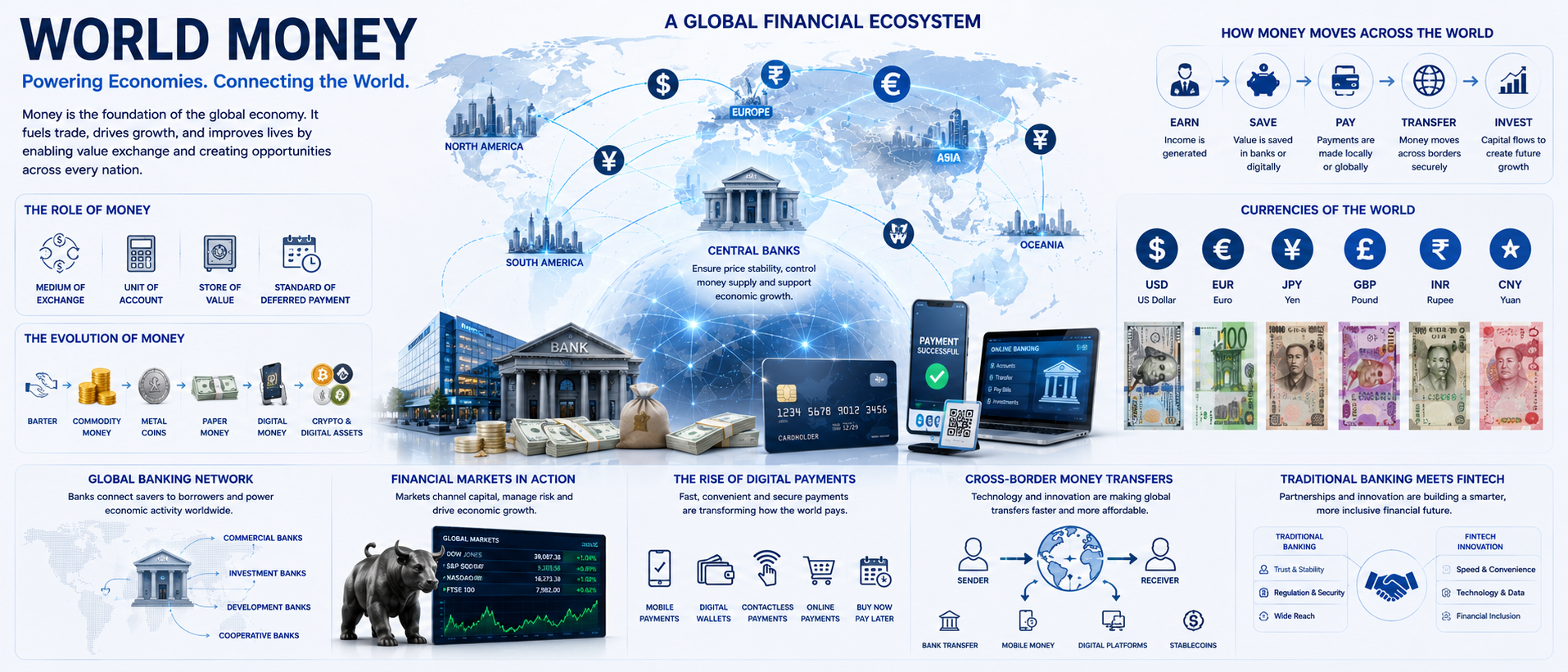
foundation of the global economy, allowing people, businesses and governments
to buy goods, pay for services, save wealth and conduct international trade.
Today, world money exists in many forms, including physical cash, bank
deposits, electronic transfers, payment cards and digital payment systems.
Major currencies such as the U.S. dollar, euro, Japanese yen, British pound and
Chinese yuan play important roles in international trade and financial markets.
The U.S. dollar remains particularly important in global finance, with the
International Monetary Fund reporting that the dollar accounted for about 57%
of allocated global foreign-exchange reserves in the fourth quarter of 2025.
This international role means that changes in major economies and central-bank
policies can influence markets and businesses around the world.
The global
financial system is closely connected through banks, central banks, investment
markets and international payment networks. Central banks influence the economy
through monetary policy, especially by changing interest rates and managing the
supply of money. When interest rates rise, borrowing generally becomes more
expensive and spending can slow; when rates fall, borrowing and investment can
become easier. Exchange rates also constantly change as currencies respond to
inflation, interest rates, economic growth, trade flows and investor
confidence. Because countries trade with one another, movements in one major
currency can affect import prices, exports, investments and the cost of
international transactions. This interconnected system allows money to move
around the world rapidly, but it can also transmit financial shocks between
economies.
Digital
payments are now transforming how ordinary people interact with money. Mobile
banking, contactless cards, QR-code payments and instant bank transfers have
reduced the need to carry physical cash in many markets. India is a major
example of this transformation, with the Unified Payments Interface becoming
one of the world's most significant instant-payment systems by transaction
volume. Digital finance is also expanding access to banking and financial
services, allowing people to transfer money, save, invest and make purchases
through smartphones. At the same time, digital finance creates challenges
involving cybersecurity, fraud, privacy and financial literacy. The future of
money is therefore not simply about replacing cash with digital payments; it is
about creating financial systems that are fast, accessible, secure and
reliable.
The future
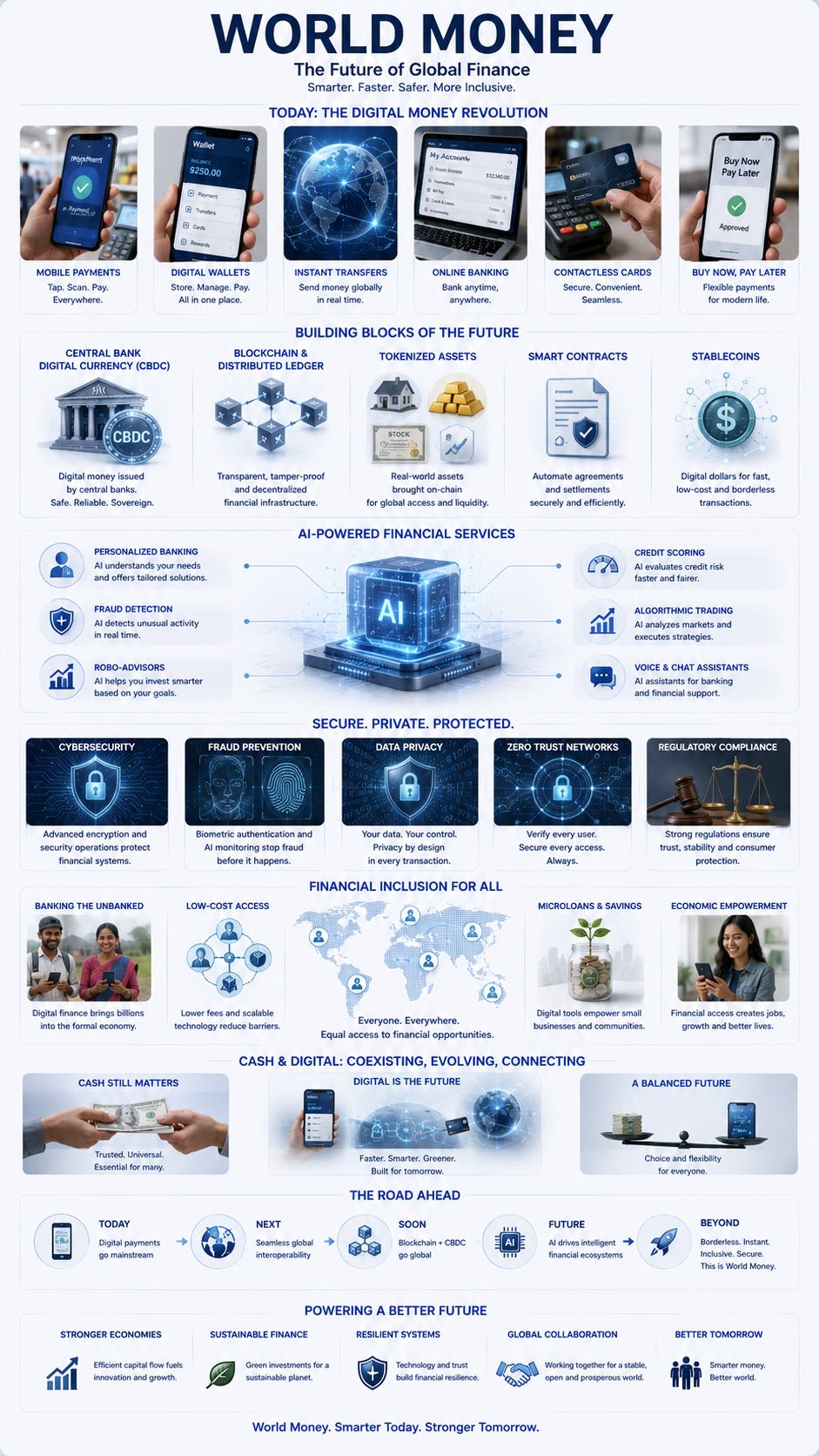
of world money is likely to involve even greater integration between
traditional banking and financial technology. Central banks in several
countries are researching or developing central bank digital currencies, while
financial institutions are experimenting with faster settlement systems,
tokenized assets and programmable financial services. Artificial intelligence
is also being used for fraud detection, risk analysis, customer service and
financial forecasting. These developments could make international transactions
faster and reduce some of the costs associated with moving money across
borders. However, they also raise important questions about privacy,
cybersecurity, regulation and the stability of financial systems. Digital money
must therefore be developed with strong security and clear rules rather than
focusing only on speed and convenience.
The global
financial system is entering a period in which traditional money, digital
payments and emerging financial technologies will increasingly operate
together. Cash is still important in many parts of the world, while bank
accounts and electronic payments are becoming central to everyday economic
activity. At the international level, major currencies will continue to
influence trade, investment and financial markets, while new technologies could
change how money is transferred and stored. The most important challenge will
be balancing innovation with stability, security and public trust. As financial
technology continues to develop, the future of World Money will likely be
defined by faster payments, more connected markets, wider financial access and
increasingly digital forms of money.