Back to News
News AlertWorld Defence Tech
India and Japan Sign Historic AI & Maritime Security Treaty
V
Author
Vishal Sable
Published
July 2, 2026
Reading Time
9 MIN READ
Spread the Word
Modern defense is shifting toward shared technological intelligence, co-development, and automated logistical services. The first week of July 2026 has delivered two major developments that confirm this trajectory: a landmark India-Japan defense pact centered on co-developing advanced naval technology and artificial intelligence, and the accelerating rise of Drones-as-a-Service (DaaS) as military organizations worldwide embrace scalable, AI-powered unmanned systems.
The Latest News
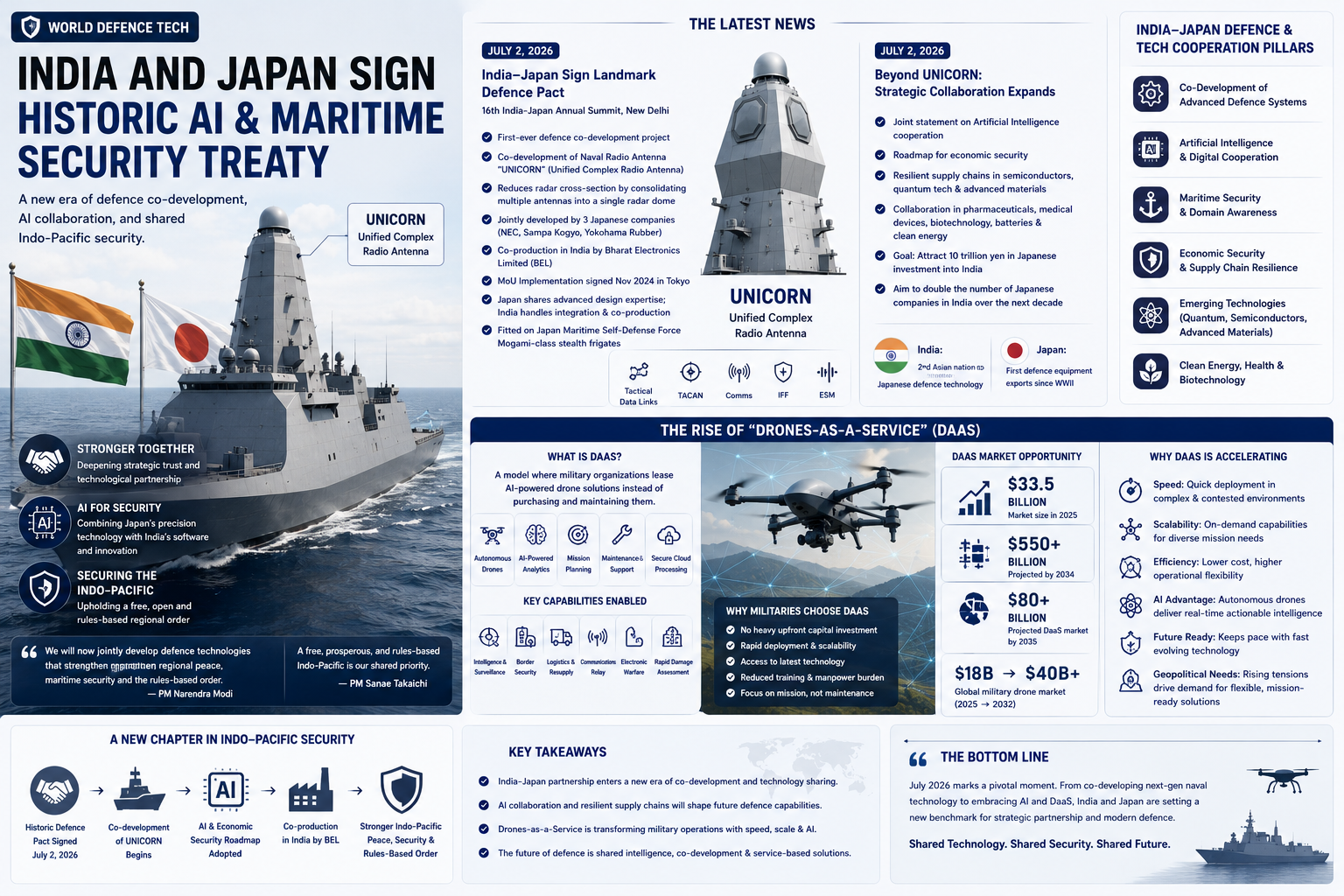
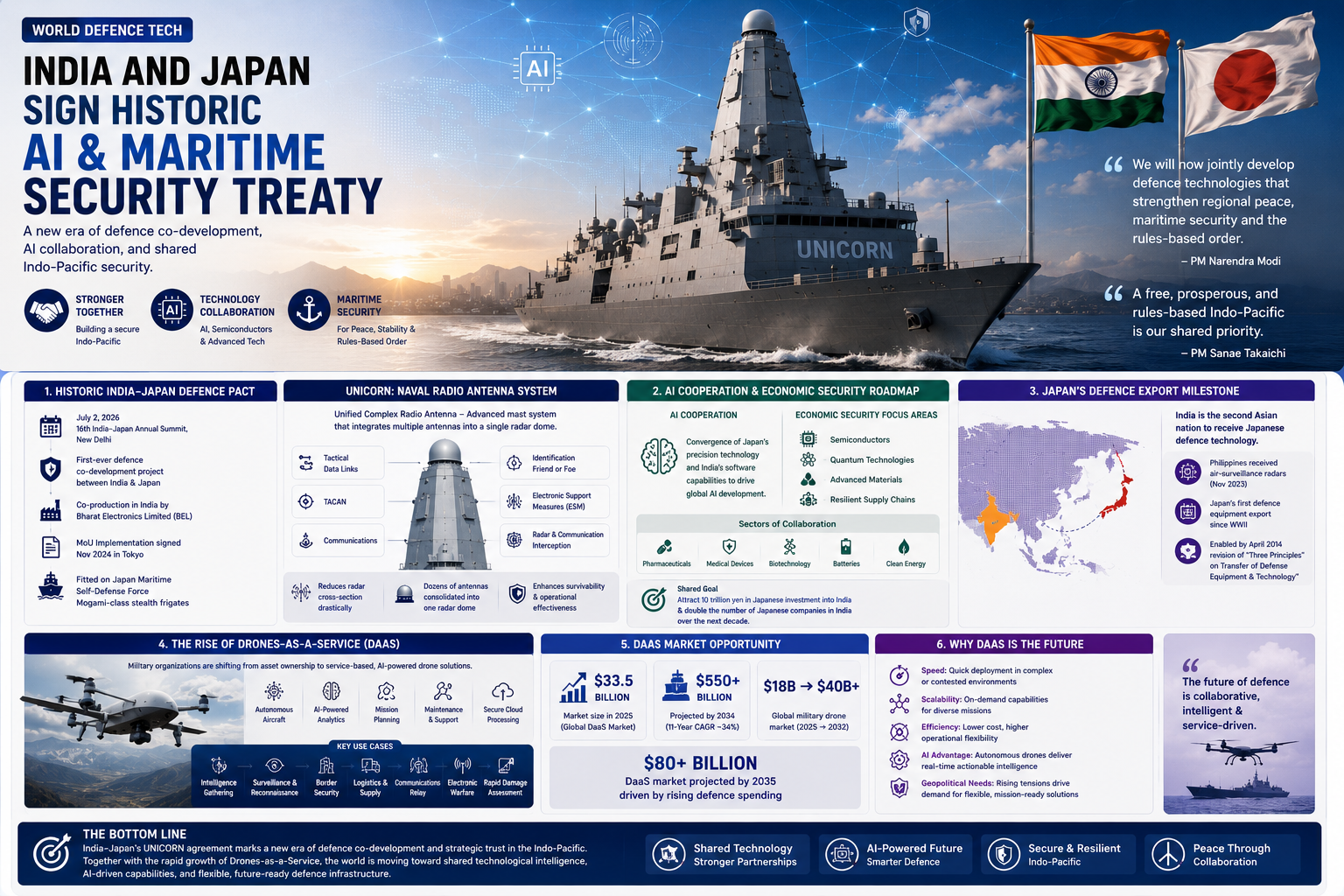
At the 16th India-Japan Annual Summit in New Delhi on July 2, Prime Minister Narendra Modi and Japanese Prime Minister Sanae Takaichi signed a sweeping strategic defense pact, marking the first-ever defense co-development project between the two nations. The centerpiece of the agreement is the co-development of the Naval Radio Antenna "UNICORN" (Unified Complex Radio Antenna), a technologically advanced mast system that consolidates dozens of exposed antennas into a single radar dome, sharply reducing a warship's radar cross-section. The system houses antennas for tactical data links, TACAN, communications, Identification Friend or Foe, and Electronic Support Measures for radar and communication interception.
UNICORN was jointly developed by three Japanese companies—NEC Corporation (lead contractor), Sampa Kogyo K.K., and The Yokohama Rubber Co.—and is currently fitted on the Japan Maritime Self-Defense Force's Mogami-class stealth frigates. The co-production will be executed by Bharat Electronics Limited (BEL) in India, with Japan providing advanced design expertise and India handling integration and co-production, aligning with Modi's 'Make in India' initiative. The agreement follows a Memorandum of Implementation signed in November 2024 at the Embassy of India in Tokyo.
PM Modi described the agreement as the beginning of "a new chapter" in defence technology collaboration between the two nations. "We will now jointly develop defence technologies that strengthen regional peace, maritime security and the rules-based order," he said. Japanese PM Takaichi, on her first official visit to India since taking office, stated: "Today, both India and Japan are among the world's largest economies. A free, prosperous, and rules-based Indo-Pacific is our shared priority".
Beyond the UNICORN project, the two countries issued a joint statement on artificial intelligence cooperation and adopted a joint roadmap for economic security. The roadmap focuses on building resilient supply chains in semiconductors, quantum technologies, and advanced materials. Modi emphasized that "the convergence of Japan's precision technology and India's software capabilities will impart new momentum and strength to global AI development". The agreements also span pharmaceuticals, medical devices, biotechnology, batteries, and clean energy. Modi reiterated the shared goal of attracting 10 trillion yen in Japanese investment into India and doubling the number of Japanese companies operating in the country over the next decade.
This makes India the second Asian nation to receive Japanese defense technology, after the Philippines received air-surveillance radars under a November 2023 contract—Japan's first defense equipment export since the Second World War. Both transfers flow from Tokyo's April 2014 overhaul of the "Three Principles on Transfer of Defense Equipment and Technology," which replaced the near-total ban on arms exports that had been in force since 1967.
The Rise of "DaaS"
Simultaneously, defense data released today shows that the global military infrastructure is aggressively shifting to a Drones-as-a-Service (DaaS) model. Military organizations are outsourcing the heavy lifting of drone operations—moving away from buying fleets to instead leasing completely autonomous, AI-powered aerial surveillance platforms for real-time intelligence gathering and electronic warfare.
Rather than purchasing aircraft, ground stations, software, and training personnel, defense agencies can access comprehensive drone solutions when needed, including autonomous aircraft, AI-powered analytics, mission planning, maintenance, and secure cloud-based data processing. This strategy allows military units to quickly enhance their operations while keeping pace with fast-evolving technology.
The defense sector is expected to be one of the fastest-growing segments within the DaaS industry. Armed forces are increasingly relying on outsourced drone services for intelligence gathering, surveillance, border security, logistics, communications, electronic warfare, and rapid damage assessment. Autonomous drones powered by artificial intelligence can effectively patrol vast areas, quickly identify potential threats, and provide actionable intelligence to military leaders within moments.
The market opportunity is substantial. The global Drone-as-a-Service market was valued at about $33.5 billion in 2025 and is projected to climb to more than $550 billion by 2034. The global military drone market is forecasted to grow from around $18 billion in 2025 to over $40 billion by 2032. Industry experts predict the DaaS market could exceed $80 billion by 2035 due to increased government and defense spending.
A big reason behind the rise in defense-focused DaaS adoption comes down to speed, scalability, and efficiency. Today's military operations require constant surveillance coverage, quick deployment in complex or contested environments, and flexible logistics support in remote areas—all strengths of service-based drone platforms compared to traditional procurement approaches. As geopolitical tensions rise and armed forces worldwide modernize, there is a projected surge in demand for flexible, mission-ready drone services.
The Bottom Line
July 2026 marks a pivotal moment in global defense cooperation and procurement strategy. The India-Japan UNICORN agreement represents the first co-development of advanced naval technology between the two nations, signaling a deepening strategic partnership in the Indo-Pacific. The joint AI and economic security roadmap reflects growing convergence on technology, supply-chain resilience, and regional stability. Meanwhile, the accelerating shift to Drones-as-a-Service demonstrates that military organizations are embracing flexible, scalable, AI-powered solutions to meet the demands of modern warfare. The era of traditional defense procurement and isolated national development is giving way to an era of shared technological intelligence, co-development, and service-based military infrastructure.

Vishal Sable
B.Tech AD @ shri balaji institute of technology and management
Engineering and tech journalist. I love exploring the impact of emerging technologies on global defense, sovereignty, and everyday life. Always looking for the real story behind the headlines.