Back to News
News AlertWorld Defence Tech
India Approves ₹52,000 Crore Tech Procurement; Europe Escalates EDPCIs
V
Author
Vishal Sable
Published
July 3, 2026
Reading Time
9 MIN READ
Spread the Word
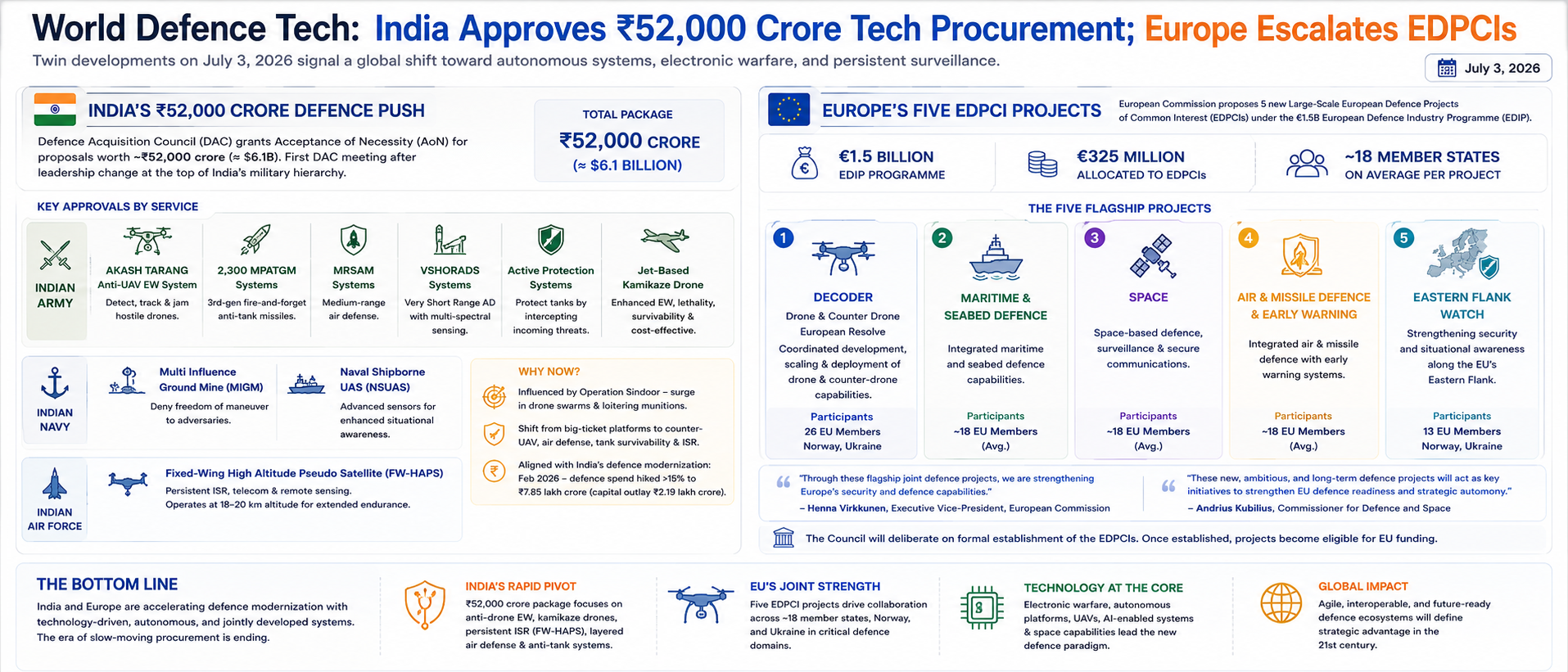
Modern defense platforms are aggressively procuring next-generation automation to handle electronic warfare, drone swarms, and persistent space observation. July 3, 2026, has delivered twin developments from New Delhi and Brussels that confirm this global shift—India's Defence Acquisition Council clearing a massive ₹52,000 crore procurement package, and the European Commission proposing five flagship joint defense projects under its new €1.5 billion program.
India's ₹52,000 Crore Defence Push
The Defence Acquisition Council (DAC), chaired by Defence Minister Rajnath Singh, granted Acceptance of Necessity (AoN) for defense proposals worth approximately ₹52,000 crore (approximately $6.1 billion) on July 3. The AoN is the first formal step in India's defense procurement process, clearing proposals to proceed through technical evaluation, trials, and price negotiations. The meeting was the first DAC session since a sweeping leadership change at the top of India's military hierarchy, with Gen Raja Subramani as Chief of Defence Staff, Gen Dhiraj Seth as Army Chief, and Adm Krishna Swaminathan as Navy Chief attending in their current positions.
For the Indian Army, the DAC approved six major systems. The centerpiece is the AKASH TARANG Anti-Unmanned Aerial Vehicles Electronic Warfare System, designed to detect, track, and jam hostile drones before they reach forward troop positions. The system will provide effective anti-UAV protection to Army formations—a capability that has become an urgent operational necessity following recent conflicts where swarms of drones and loitering munitions have emerged as defining battlefield threats.
The DAC also cleared 2,300 indigenous Man Portable Anti-Tank Guided Missile (MPATGM) systems, along with 100 launchers and five simulators, for approximately ₹2,600 crore. Developed by DRDO for production by state-run Bharat Dynamics, the third-generation, fire-and-forget missile features an imaging infrared seeker, tandem warhead, and top-attack capability. Additional approvals include Medium Range Surface-to-Air Missile (MRSAM) systems for medium-range air defense, Very Short Range Air Defence Systems (VSHORADS) with multi-spectral sensing for enhanced countermeasure resilience, Active Protection Systems for tanks to intercept incoming projectiles, and a Jet-Based Kamikaze Drone System providing better electronic warfare capability with greater lethality and survivability while remaining cost-effective.
For the Indian Navy, the DAC approved procurement of a Multi Influence Ground Mine (MIGM) to deny freedom of maneuver to adversaries, a Naval Shipborne Unmanned Aerial System (NSUAS) equipped with advanced sensors to enhance situational awareness at sea, and the establishment of a Land Based Testing Facility for Electric Propulsion Systems.
For the Indian Air Force, the DAC approved procurement of a Fixed-Wing High Altitude Pseudo Satellite (FW-HAPS) for persistent Intelligence, Surveillance and Reconnaissance (ISR), telecommunication, and remote sensing. HAPS are solar-powered, high-endurance unmanned aircraft operating in the stratosphere at 18 to 20 kilometers altitude, capable of remaining airborne for extended periods and offering satellite-like surveillance at a fraction of the cost.
The approvals reflect the influence of Operation Sindoor—the recent hostilities with Pakistan where swarms of drones and loitering munitions engaged air defense networks on both sides—which has accelerated the military's shift away from big-ticket conventional platforms toward counter-UAV systems, layered air defense, tank survivability, and persistent ISR. The package also aligns with India's broader defense modernization push: in February 2026, India hiked defense spending by more than 15% to ₹7.85 lakh crore, including a capital outlay of ₹2.19 lakh crore.
Europe's Five EDPCI Projects
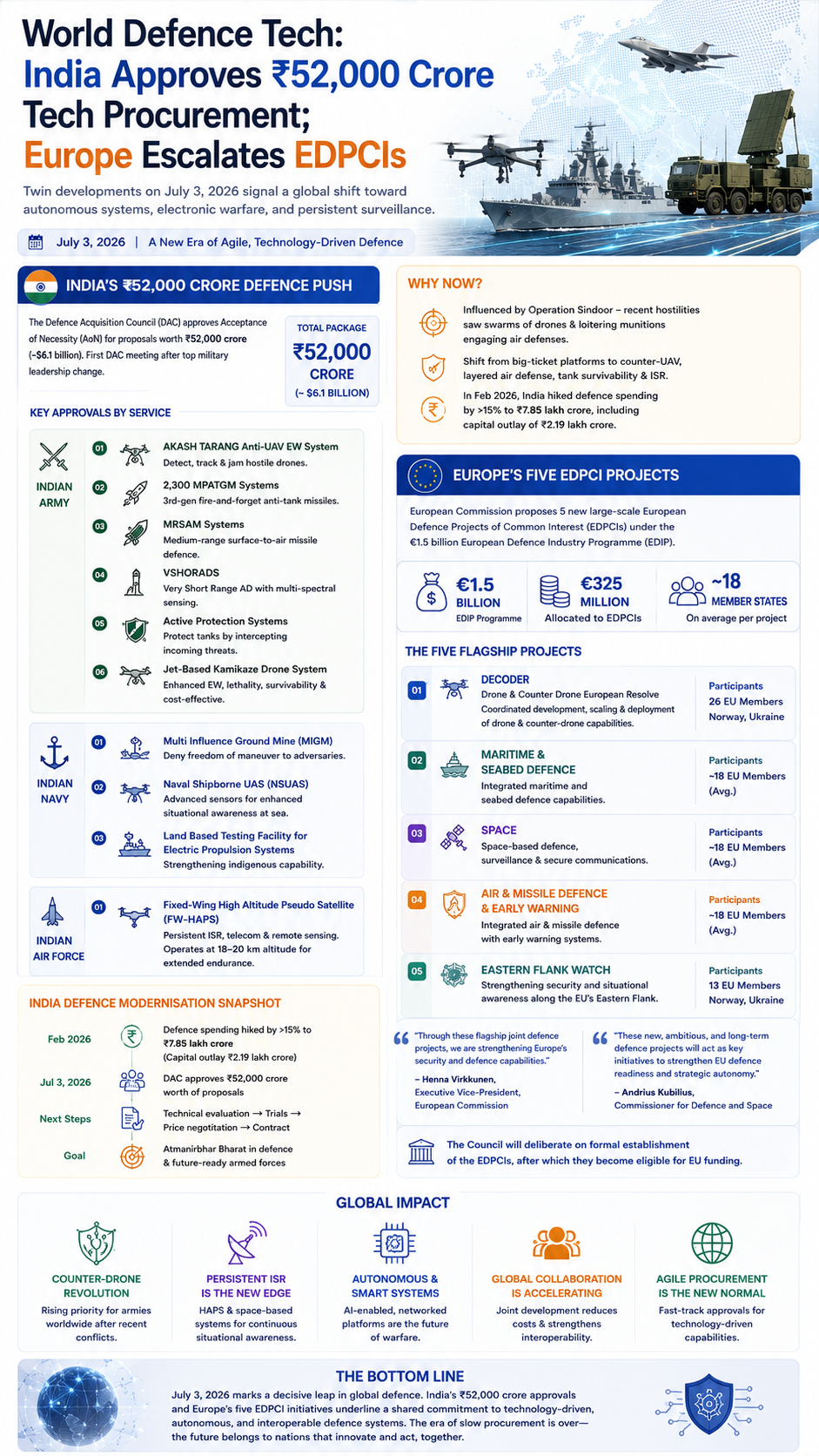
Simultaneously, on July 3, the European Commission proposed five new large-scale European Defence Projects of Common Interest (EDPCIs) to help EU countries strengthen their defense capabilities by jointly developing key military systems. The projects focus on five priority areas: drones and counter-drone systems; maritime and seabed defence; space; air and missile defence; and strengthening security along the EU's Eastern Flank.
Under the €1.5 billion European Defence Industry Programme (EDIP) , the Commission has allocated €325 million to support the establishment and deployment of the EDPCIs. On average, 18 Member States participate in each project, and Ukraine participates in four of the five.
The drone project, named DECODER (Drone and Counter Drone European Resolve) , aims to enable coordinated development, scaling, and deployment of drone and counter-drone capabilities involving 26 EU member countries, Norway, and Ukraine. The Eastern Flank Watch project involves 13 EU members, Norway, and Ukraine, while additional projects cover integrated maritime and seabed defense, air and missile defense and early warning, and space-based defense.
Executive Vice-President Henna Virkkunen stated: "Through these flagship joint defence projects, we are strengthening Europe's security and defence capabilities. These initiatives reinforce our capacity to safeguard our sovereignty under all circumstances and deepen European defence cooperation". Commissioner for Defence and Space Andrius Kubilius added: "These new, ambitious, and long-term defence projects will act as key initiatives to strengthen EU defence readiness and bolster our strategic autonomy". The Council will now deliberate on formal establishment of the EDPCIs, after which they become eligible for EU funding.
The Bottom Line
July 3, 2026, marks a decisive moment in global defense procurement. India's ₹52,000 crore DAC approval—covering the AKASH TARANG anti-drone EW system, jet-based kamikaze drones, FW-HAPS persistent surveillance platforms, and a comprehensive suite of air defense and anti-tank systems—signals New Delhi's rapid pivot toward counter-UAV capabilities and layered defense architectures following recent conflicts. Simultaneously, Europe's five EDPCI proposals under the €1.5 billion EDIP program demonstrate the EU's commitment to joint development of drone defenses, maritime security, and Eastern Flank protection. The era of slow-moving defense procurement is ending. The era of agile, technology-driven, and jointly developed defense systems—prioritizing electronic warfare, autonomous platforms, and persistent surveillance—is already here.

Vishal Sable
B.Tech AD @ shri balaji institute of technology and management
Engineering and tech journalist. I love exploring the impact of emerging technologies on global defense, sovereignty, and everyday life. Always looking for the real story behind the headlines.