Back to News
News AlertWorld Defence Tech
India Just Handed Its Missile Blueprints to Private Industry. Here’s Why That’s a Bigger Deal Than It Sounds
V
Author
Vishal Sable
Published
August 26, 2026
Reading Time
4 MIN READ
Spread the Word
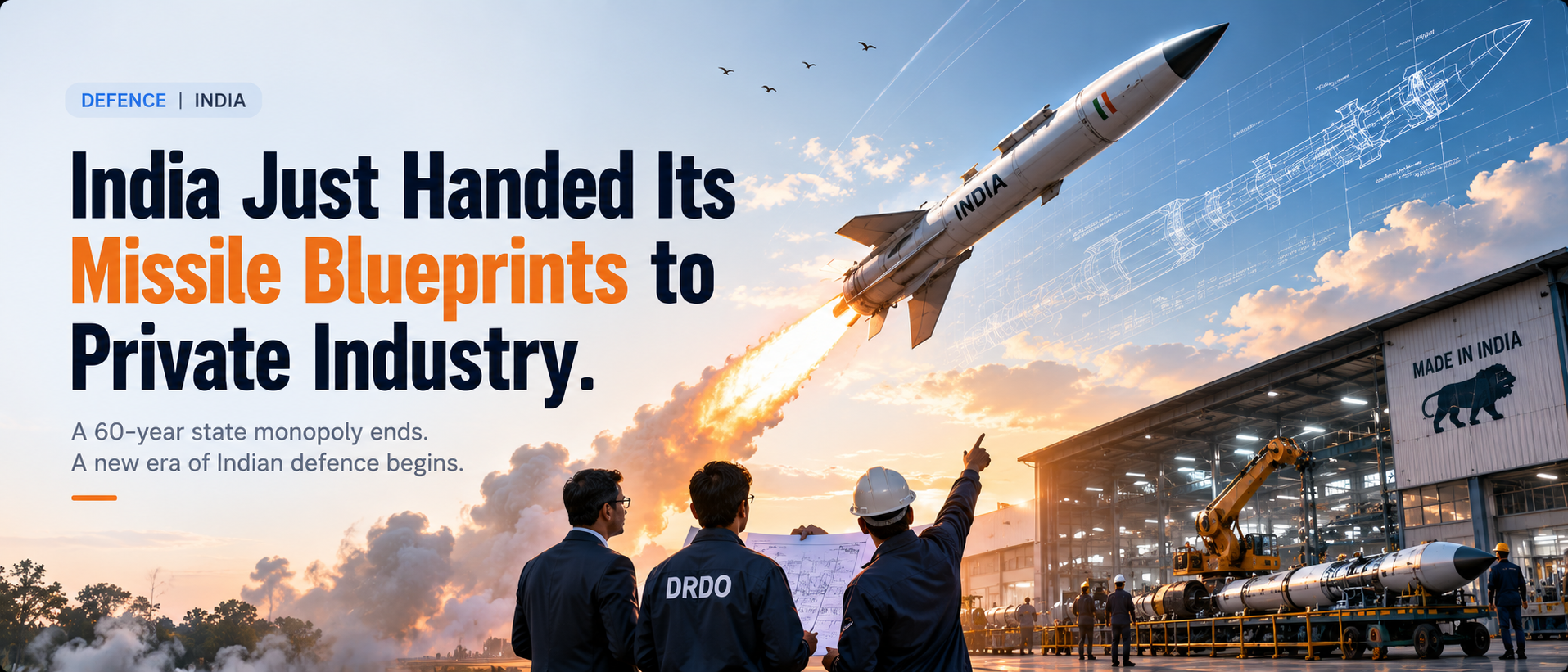
India’s Defence Ministry approved transferring all DRDO conventional missile tech to private industry—ending decades of state monopoly. Here’s what changed, who benefits, and why it matters.
Why India Is Giving Private Firms Access to DRDO Missile Technology
For most of India’s post-independence defense history, weapon manufacturing followed an unbending rule: a state laboratory designed the weapon, and a state-owned enterprise manufactured it. That 60-year monopoly quietly dissolved this week. Defence Minister Rajnath Singh approved the transfer of technology for all conventional missile systems developed by the Defence Research and Development Organisation (DRDO) to private Indian industry. This is not a single pilot project or a routine licensing handshake; it opens the nation’s entire conventional missile inventory to private assembly lines. Paired with a newly signed Army-DRDO Joint Working Arrangement, the move marks one of the most consequential structural realignments in how India equips its armed forces.
The End of the Nomination Monopoly
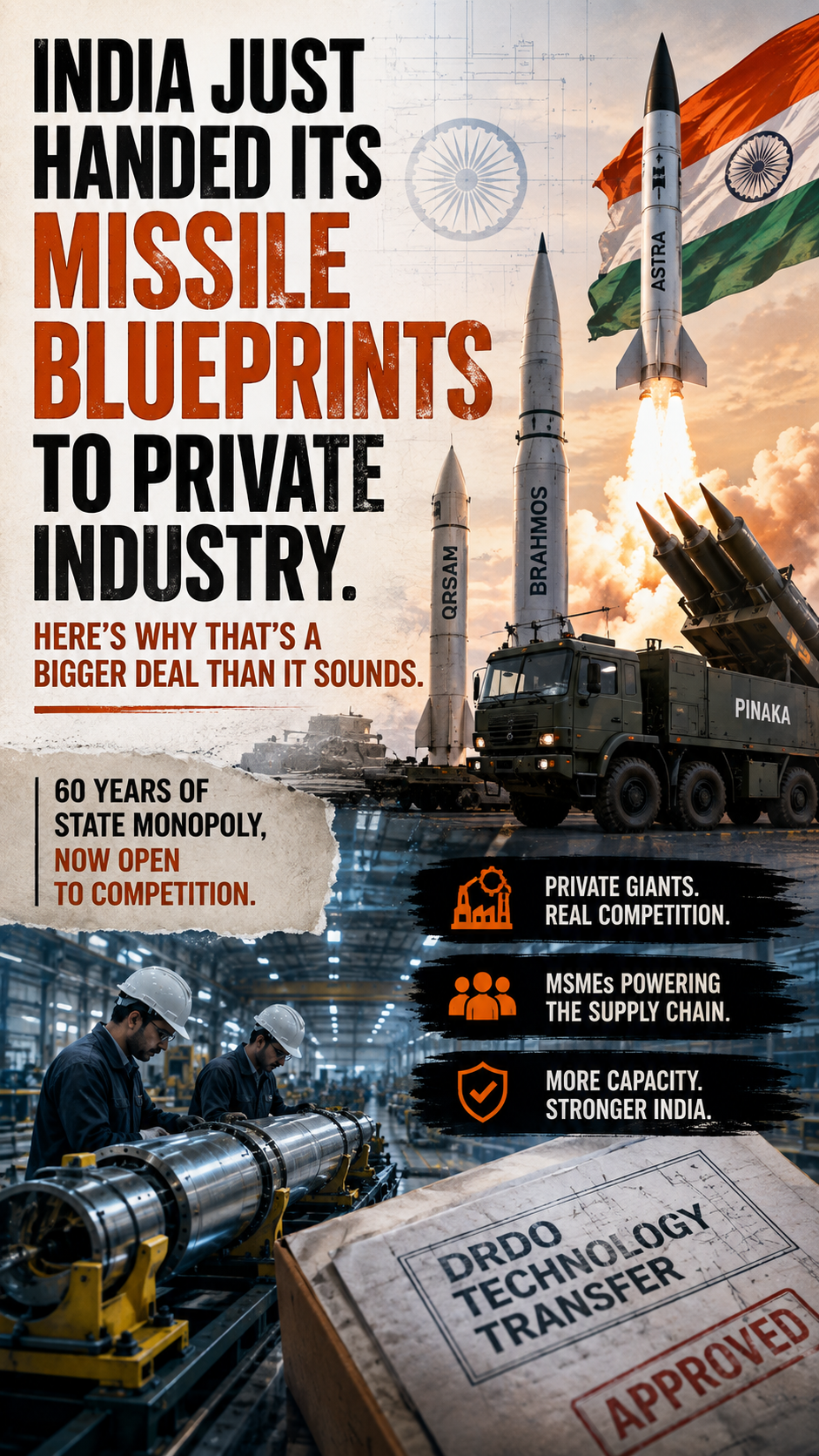
The shift upends decades of state-controlled procurement. Historically, production orders for missile platforms flowed almost exclusively to defense public sector undertakings like Bharat Dynamics Limited (BDL) and Bharat Electronics Limited (BEL) on a nomination basis, effectively bypassing competitive bidding. Under the new policy, private defense primes will compete directly against state-run giants for production rights. Winning firms will step in as Development-cum-Production Partners (DcPP), embedding their engineers with DRDO early in the development lifecycle rather than merely acting as build-to-print factories. The scope covers frontline tactical systems, from the Astra beyond-visual-range air-to-air missile and Quick Reaction Surface-to-Air Missiles (QRSAM) to naval anti-ship missiles and extended-range Pinaka guided rockets.
Industrial Heavyweights and the MSME Multiplier
This transition creates immediate industrial scale for established private heavyweights. Integrators like Tata Advanced Systems, Larsen & Toubro Defence, Bharat Forge, and Adani Defence now have a direct legal path to assemble complete missile platforms. Meanwhile, propulsion and energetics specialists like Solar Industries India can expand into primary subsystem suppliers for solid rocket motors and warheads. Crucially, the policy breathes institutional stability into the wider supply network. Precision-engineering micro, small, and medium enterprises (MSMEs) that manufacture radio-frequency seekers, thermal batteries, and control actuation fins will transition from unpredictable subcontracting to stable, long-term defense supplier pipelines.
The Army–DRDO Fast-Track Pipeline
The operational counterpart to this industrial reform arrived forty-eight hours later when DRDO’s technology management wing and the Indian Army signed a Joint Working Arrangement. Designed to tear down the traditional wall separating laboratory R&D from battlefield doctrine, the framework establishes a single synchronized pipeline uniting the military, private manufacturers, research universities, and state labs. Instead of waiting years for weapons to finish protracted trial loops before factories begin tooling up, industry and academia will co-develop emerging technologies—specifically in directed energy, autonomous guidance, and advanced metallurgy—alongside front-line commanders from day one.
Shifting from Ceremony to Industrial Depth
The overarching significance lies in trading ceremonial self-reliance for industrial depth. Previous efforts toward Atmanirbhar Bharat often leaned on one-off memorandums signed at defense expos to license non-critical subsystems. This standing policy formalizes a vital institutional division of labor: DRDO focuses strictly on high-end research and prototyping, while scalable private lines handle mass industrialization. As modern conflicts demonstrate, precision munitions burn through stockpiles faster than centralized state factories can replenish them. Opening production creates the surge capacity needed for sustained national defense, while driving the price efficiencies required to make Indian missile platforms competitive across export markets in Southeast Asia, Africa, and the Middle East.
The Next Hurdle: Execution and Gatekeeping
The decisive test now lies in execution. Opening missile manufacturing to competitive bidding solves factory bottlenecks on paper, but defense production is governed by capital intensity and stringent security vetting. If qualification protocols and trial costs remain prohibitively rigid, the reform risks replacing a state monopoly with an oligopoly of a few conglomerate gatekeepers. How the Ministry of Defence manages intellectual property access, quality assurance, and tier-two vendor financing will ultimately determine whether India builds a truly diverse defense industrial base.
---
---
Sources: Ministry of Defence (India), DRDO Official Releases, Business Standard, Al Jazeera Defence Analysis.

Vishal Sable
B.Tech AD @ shri balaji institute of technology and management
Engineering and tech journalist. I love exploring the impact of emerging technologies on global defense, sovereignty, and everyday life. Always looking for the real story behind the headlines.