Back to News
News AlertWorld Defence Tech
India Just Named Its Missiles for Sale. Astra and Pralay Are Going to Private Industry.
V
Author
Vishal Sable
Published
August 28, 2026
Reading Time
5 MIN READ
Spread the Word
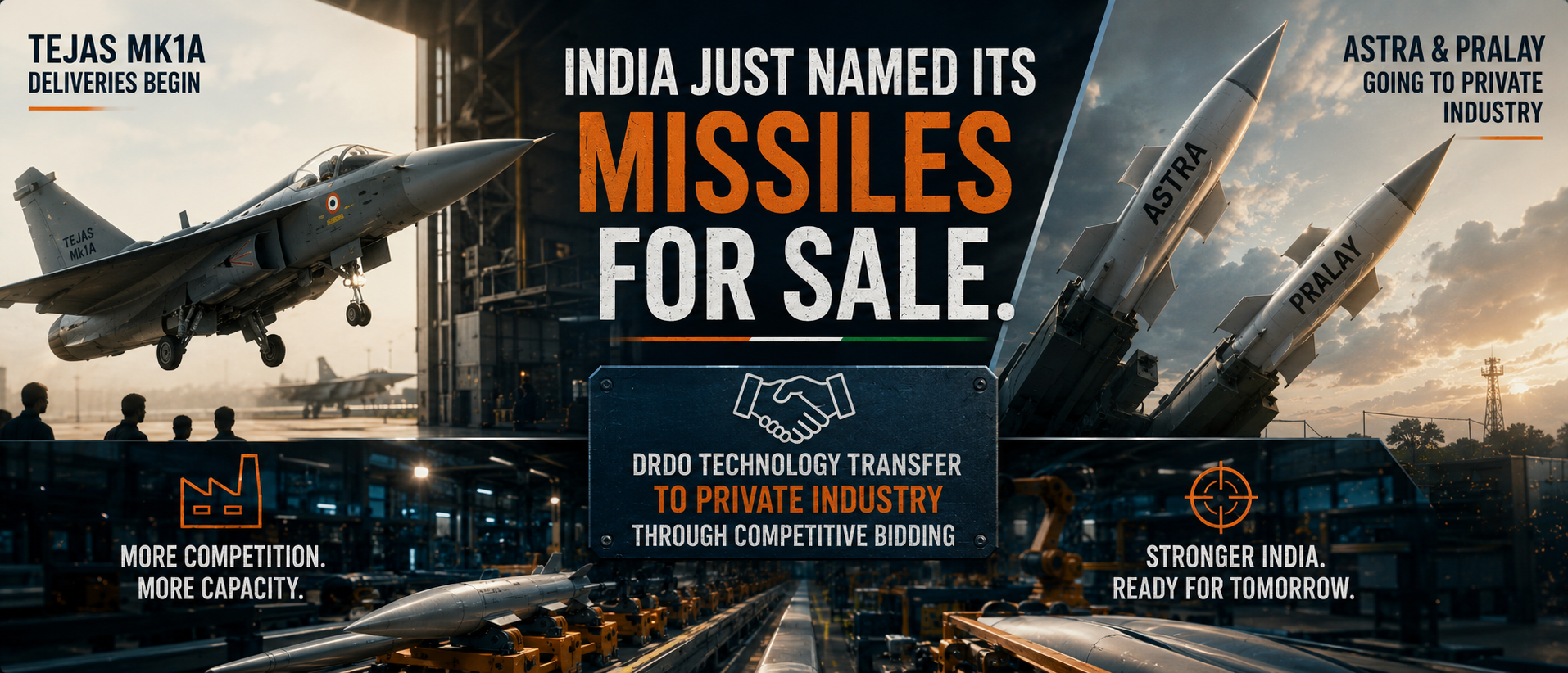
India approved DRDO's transfer of Astra and Pralay missile tech to private industry via competitive bidding — timed with HAL's first Tejas Mk1A deliveries. Here's what it actually means.
Two milestones, one week, one message
India's defence establishment delivered two milestones almost simultaneously this week, and together they say something bigger than either headline alone: India is done waiting on state monopolies to scale its weapons production.
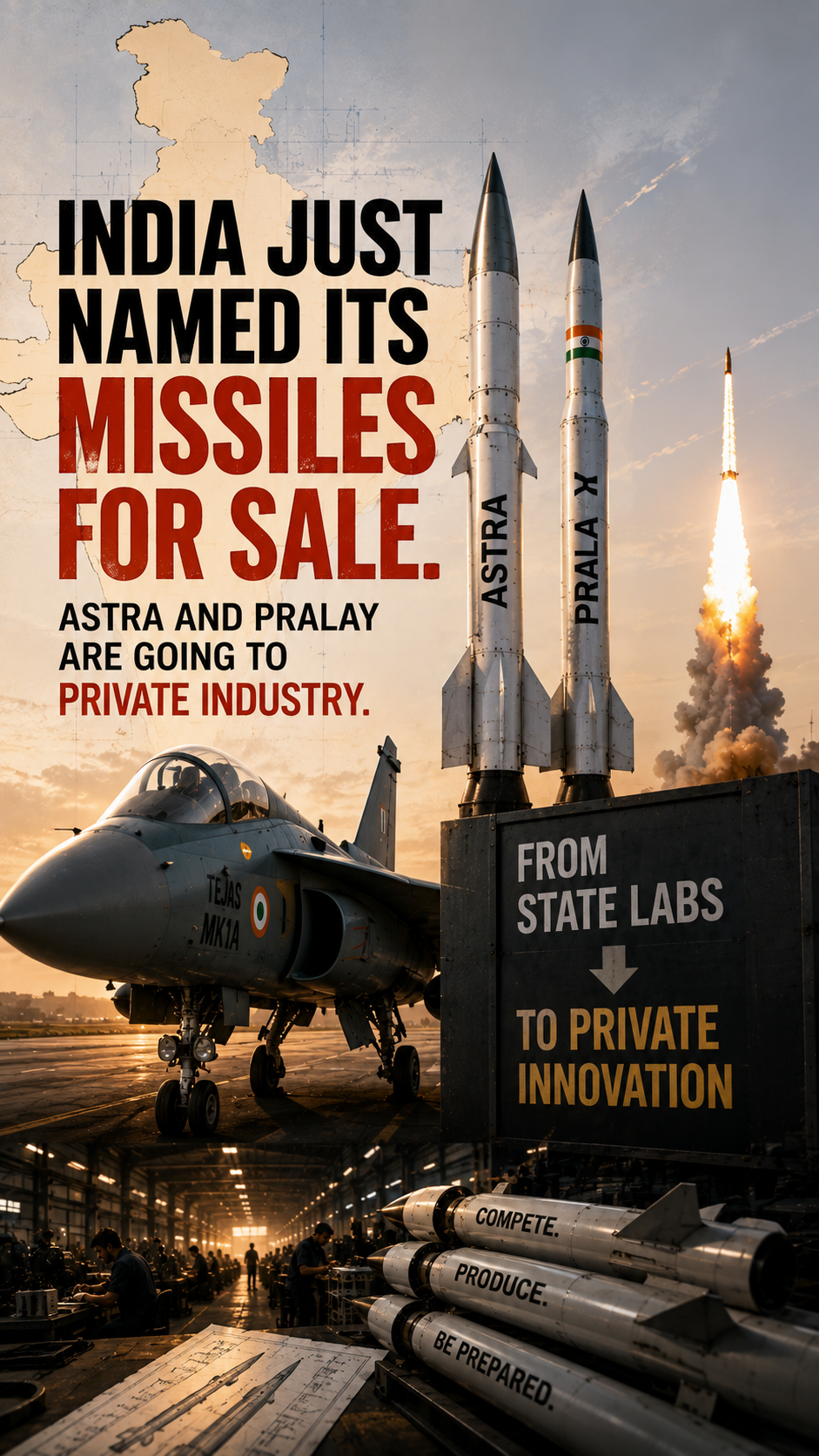
Defence Minister Rajnath Singh approved the transfer of all DRDO-developed conventional missile technologies to India's private defence sector and MSMEs, opening the door for named systems like the Astra beyond-visual-range air-to-air missile and the Pralay quasi-ballistic strike missile to be built by private companies through competitive bidding. In the same window, Hindustan Aeronautics Limited (HAL) began the long-delayed first deliveries of the Tejas Mk1A fighter jet to the Indian Air Force — a program that had slipped past its original 2024 target by more than two years.
One story is about who gets to build weapons. The other is a live case study in what happens when only one company can.
What's actually on the table
This isn't a vague policy gesture. Defence officials have named the specific systems now open to private bidding: the Astra air-to-air missile already flying on IAF fighters, the Pralay precision-strike missile (nearly 370 units already contracted), the Akash and Akash-NG air-defence systems, VSHORADS, the Rudram anti-radiation missile family, anti-tank systems including Nag and SANT, the NASM-SR anti-ship missile, and India's indigenous land-attack cruise missiles.
What's notably excluded matters too: strategic systems like the Agni and K-series submarine-launched missiles stay firmly in government hands. This is about conventional firepower — the kind of missile that gets used often, gets consumed in large numbers, and needs to be manufactured at a pace no single state-run lab or company can currently sustain.
Selection happens through competitive bidding, not the nomination system that has historically handed contracts to a single government-owned firm without competition. Winning private companies become development-cum-production partners, working directly alongside DRDO on systems integration rather than simply manufacturing to an already-finished blueprint hand-delivered from a government lab.
Why now — the timing isn't subtle
Defence officials have been explicit about what's driving this: lessons drawn from the West Asia conflict and the Russia-Ukraine war, both of which exposed how quickly modern militaries burn through precision munitions stockpiles, plus regional pressure from Pakistan's move to stand up its own Army Rocket Force Command. The goal isn't abstract self-reliance — it's affordable mass: the ability to replace consumed missiles fast enough to matter in a real, sustained conflict.
That's a different rationale than past technology-transfer announcements, which tended to frame private-sector involvement around cost savings and industrial policy. This one is framed around wartime stockpile math.
The Tejas Mk1A: what happens when there's only one supplier
The Tejas Mk1A's delivery timeline is the cautionary tale sitting right next to this announcement. The Indian Air Force signed a ₹48,000-crore contract for 83 Mk1A fighters back in February 2021, with deliveries originally promised by March 2024. They didn't arrive. Engine supply problems from GE Aerospace pushed the date back repeatedly — first to 2025, then past March 2026 — before HAL finally began handing over aircraft around August-September 2026, more than two years late.
HAL had built roughly 30 airframes and left them sitting on the assembly line, fully flown and tested, simply waiting on engines and final certification. The IAF's own Chief of Air Staff said publicly that the fix wasn't more patience — it was more assembly lines and more private-sector partnerships, so the country isn't dependent on a single production pipeline for a fighter jet it urgently needs.
That's the exact argument now being applied to missiles, a full step ahead of the fighter jet program's mistake, rather than after the fact.
The pattern: don't wait for the bottleneck to happen
Put together, these two stories describe the same lesson learned twice — once painfully, once preemptively. The Tejas program showed what happens when critical defence production runs through one company with no competitive alternative: years of slippage the country's air power genuinely couldn't afford. The missile technology transfer is India trying not to repeat that mistake with Astra, Pralay, and the rest of its conventional arsenal — building competitive, multi-supplier capacity in before a shortage forces the issue during an actual conflict.
If a single-supplier bottleneck delayed India's most important fighter jet program by over two years, how much of the country's missile production capacity is quietly running the same risk right now — and does opening bidding to private industry actually fix that, or just add new companies to the same qualification pipeline that slowed HAL down in the first place?
-----
-----
Sources: The Print, Business Standard, The Week, Bharat Shakti, Gujarat Samachar, Defence.in.

Vishal Sable
B.Tech AD @ shri balaji institute of technology and management
Engineering and tech journalist. I love exploring the impact of emerging technologies on global defense, sovereignty, and everyday life. Always looking for the real story behind the headlines.