Back to News
News AlertWorld Defence Tech
India's DRDO Successfully Field-Tests Quantum Defense Networks
V
Author
Vishal Sable
Published
August 2, 2026
Reading Time
4 MIN READ
Spread the Word
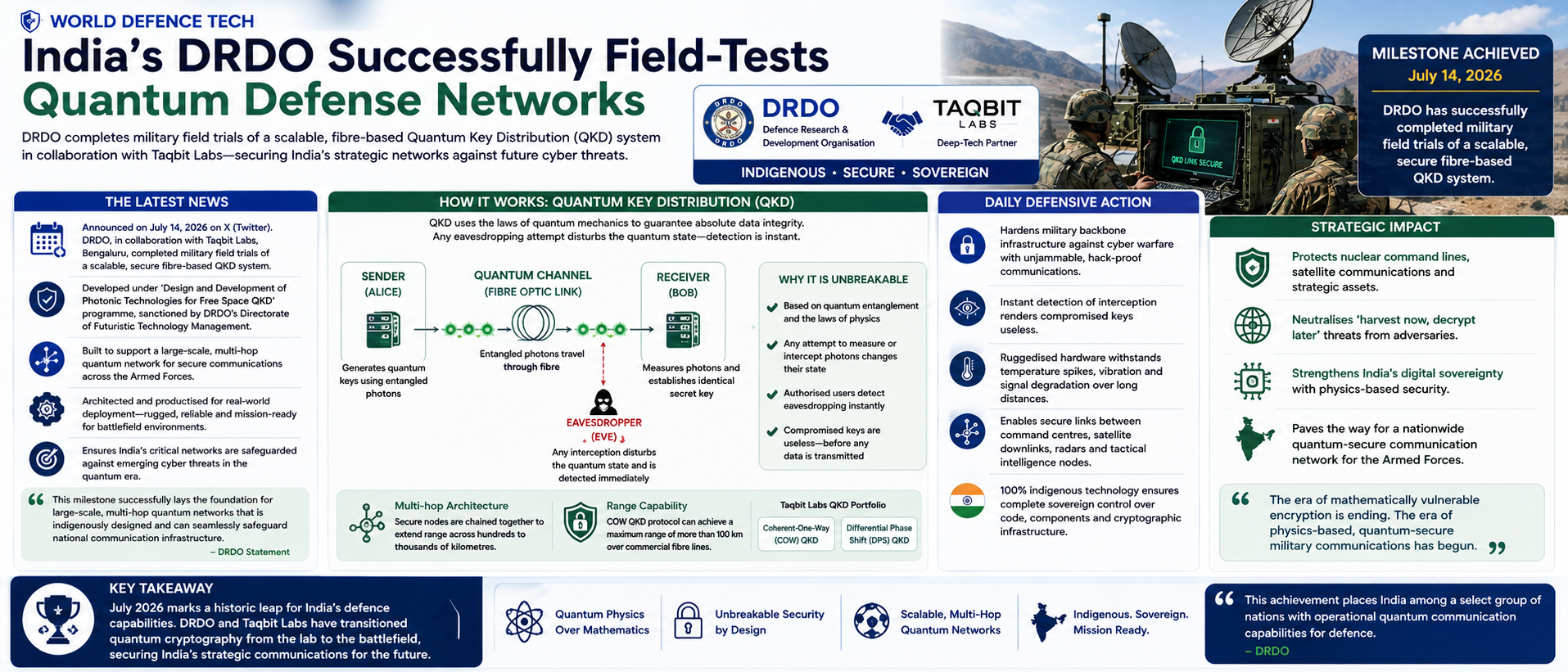
Quantum technology is moving from experimental laboratories directly into operational military communications. In a decisive leap toward securing the nation's digital sovereignty, India's Defence Research and Development Organisation (DRDO) has successfully completed military field trials of a scalable, fibre-based Quantum Key Distribution (QKD) system, marking a critical milestone in securing the nation's strategic networks against future cyber threats.
The Latest News
The DRDO announced on social media platform X on July 14, 2026, that it had completed military field trials of a scalable, secure fibre-based QKD system. The system was developed by DRDO in collaboration with Bengaluru-based deep-tech startup Taqbit Labs, with which the organisation has been working since 2020 to advance QKD systems for the Indian Armed Forces. “Leveraging their lab-level proof of concept and experience of previous trials, the DRDO team, along with their industry partner Taqbit Labs, Bengaluru, has successfully architected and productised this advanced system to secure critical networks,” the DRDO said in a statement.
The project has been executed under the 'Design and Development of Photonic Technologies for Free Space QKD' programme, sanctioned by DRDO's Directorate of Futuristic Technology Management. The milestone transitions quantum cryptography from a controlled laboratory concept into a ruggedized, combat-ready reality for the Armed Forces. “This milestone successfully lays the foundation for large-scale, multi-hop quantum networks that is indigenously designed and can seamlessly safeguard national communication infrastructure against emerging cyber threats in the quantum era,” the DRDO added. The trial is intended to support the development of a “large-scale, multi-hop quantum network” for secure communications. Taqbit Labs CEO Animesh Aaryan told Janes that the partnership is focused on integrating the systems into existing military networks and establishing a new secure, self-contained tactical network.
How It Works
The system leverages fundamental principles of quantum mechanics to guarantee absolute data integrity. Unlike conventional encryption systems that rely on complex mathematical algorithms, quantum communication is based on the laws of quantum mechanics, making it more secure. The DRDO's system uses quantum entanglement-based QKD, which offers significant advantages over traditional prepare-and-measure methods by enhancing both security and functionality.
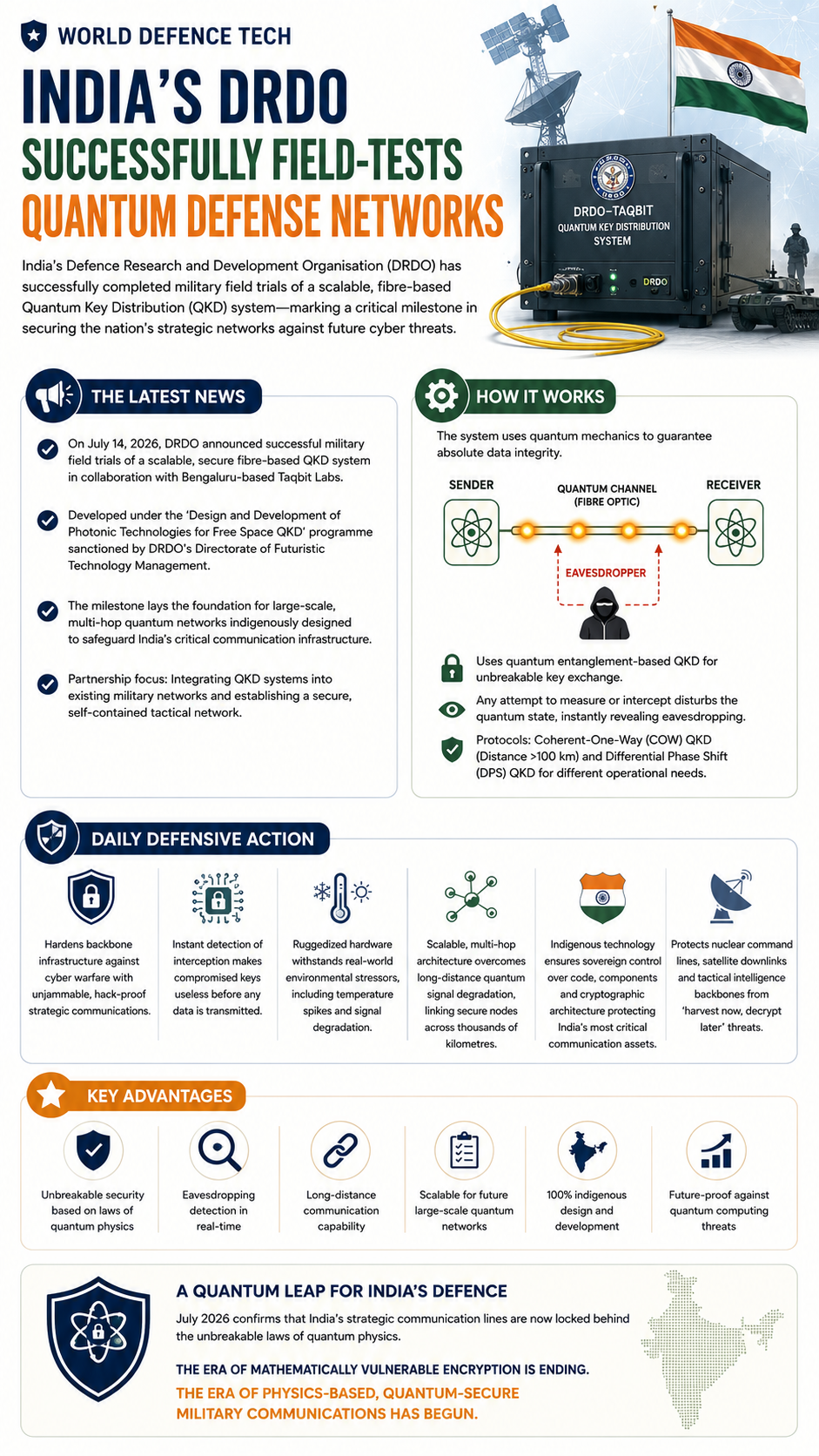
Even if communication devices are compromised or imperfect, the use of quantum entanglement ensures secure key distribution. Any attempt to measure or intercept the entangled photons disturbs their quantum state, allowing authorised users to detect the presence of an eavesdropper. This ability to detect interception makes the technology particularly valuable for protecting sensitive communications. According to Taqbit, its QKD portfolio comprises two complementary protocols—Coherent-One-Way (COW) QKD and Differential Phase Shift (DPS) QKD—each optimised for different operational requirements. COW QKD can achieve a maximum range of more than 100 km.
Daily Defensive Action
Sovereign military networks are hardening their backbone infrastructure against cyber warfare, guaranteeing that field commands maintain unjammable, hack-proof strategic communications. The ability to detect interception instantly renders compromised keys useless before any data is transmitted. By productizing the system, DRDO and Taqbit Labs have ensured the hardware can withstand real-world environmental stressors, including temperature spikes and signal degradation over commercial fibre lines. One of the steepest hurdles—quantum signal degradation over long distances—has been addressed through a scalable, multi-hop architecture capable of chaining secure nodes together, eventually spanning thousands of kilometres and connecting command centres across the country.
By co-developing this technology entirely within India, DRDO and Taqbit Labs ensure complete sovereign control over the code, components, and cryptographic architecture guarding India's nuclear command lines, satellite downlinks, and tactical intelligence backbones. As adversaries already engage in "harvest now, decrypt later" tactics—intercepting and storing encrypted military data today with the intent to decode it the moment quantum computing matures—deploying QKD effectively neutralises this threat. July 2026 confirms that India's strategic communication lines are now locked behind the unbreakable laws of quantum physics. The era of mathematically vulnerable encryption is ending. The era of physics-based, quantum-secure military communications has begun.

Vishal Sable
B.Tech AD @ shri balaji institute of technology and management
Engineering and tech journalist. I love exploring the impact of emerging technologies on global defense, sovereignty, and everyday life. Always looking for the real story behind the headlines.