Back to News
News AlertWorld Defence Tech
India Unveils First High-Altitude Anti-Drone MPADS; US Advances VENOM Fighter Program
V
Author
Vishal Sable
Published
July 27, 2026
Reading Time
4 MIN READ
Spread the Word
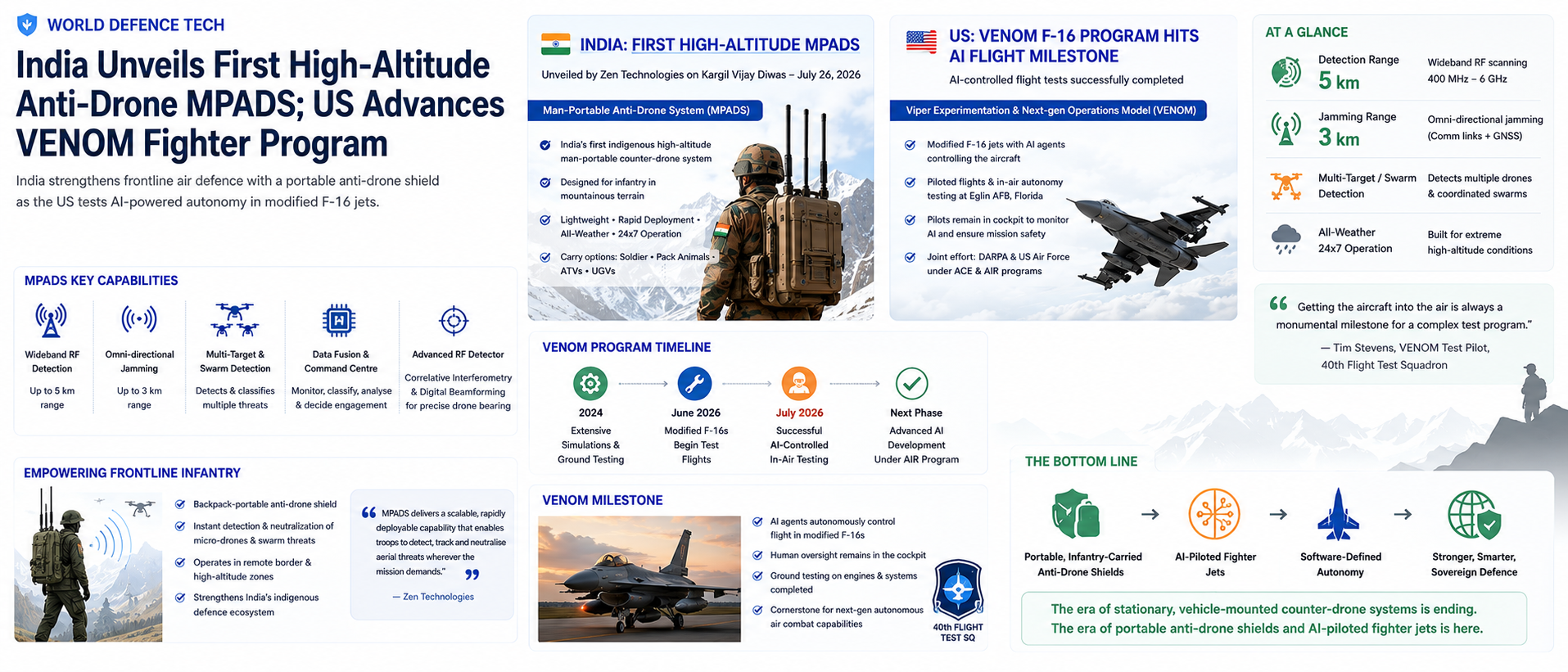
Marking Kargil Vijay Diwas on July 26, defence technology company Zen Technologies unveiled India's first High-Altitude Man-Portable Anti-Drone System (MPADS), an indigenous counter-unmanned aerial system designed specifically for infantry operating in mountainous terrain. Simultaneously, the US military has accelerated its VENOM program, successfully testing AI-controlled flight systems integrated directly into modified F-16 combat jets.
The Latest News
Zen Technologies launched the MPADS on the occasion of Kargil Vijay Diwas, a day commemorating the courage and sacrifice of the Indian Armed Forces during the Kargil conflict, while addressing one of the most pressing challenges in modern warfare: the growing use of drones across high-altitude battlefields. The lightweight system is designed for rapid deployment in terrain where conventional vehicle-mounted counter-drone systems are difficult to operate. The platform combines radio frequency detection, data fusion and omni-directional jamming in a portable configuration that can be carried by soldiers, pack animals, all-terrain vehicles, or unmanned ground vehicles, ensuring mobility across diverse operational environments. The MPADS offers drone detection ranges of up to 5 km through wideband RF scanning across the 400 MHz to 6 GHz spectrum and omni-directional jamming of up to 3 km to disrupt drone command links and global navigation satellite system signals simultaneously. The system is capable of multi-target and swarm detection and is designed for 24x7, all-weather operation with indigenous, state-of-the-art architecture. At its core is the company's RF-Based Drone Detector, which uses advanced Correlative Interferometry and Digital Beamforming techniques to determine the bearing of hostile drones, integrated with a Data Fusion & Command Centre that enables operators to monitor threats, classify aerial targets, analyse spectrum activity and make engagement decisions.
Internationally, the US Air Force has advanced its Viper Experimentation and Next-gen Operations Model – Autonomy Flying Testbed (VENOM) program to piloted flights and in-air autonomy testing at Eglin Air Force Base, Florida. The VENOM F-16s are modified test platforms with additional hardware, software and instrumentation that allow artificial intelligence agents to fly the aircraft. The modified F-16s began flying in June to verify that the aircraft operated safely and properly after the technology upgrades. The team then moved in July to successful in-air testing using an agent to autonomously control flight. Pilots remain in the cockpit during these missions to monitor the AI agents and ensure flight and mission systems test objectives are met, keeping human oversight inside the aircraft during testing. "Getting the aircraft into the air is always a monumental milestone for a complex test program," said Tim Stevens, a VENOM test pilot with the 40th Flight Test Squadron. "It represents years of design, modification and test planning poured into this project by a dedicated team of hundreds. As we cross this starting line, we are excited to watch VENOM redefine the boundaries of autonomous flight". The flight phase followed months of ground testing on aircraft engines and systems, as well as extensive simulator work dating back to 2024. VENOM is a joint effort between DARPA and the Air Force, initiated under the Air Combat Evolution program, and the aircraft will serve as a cornerstone for the next phase of AI development under DARPA's Artificial Intelligence Reinforcements program.
Daily Defensive Action
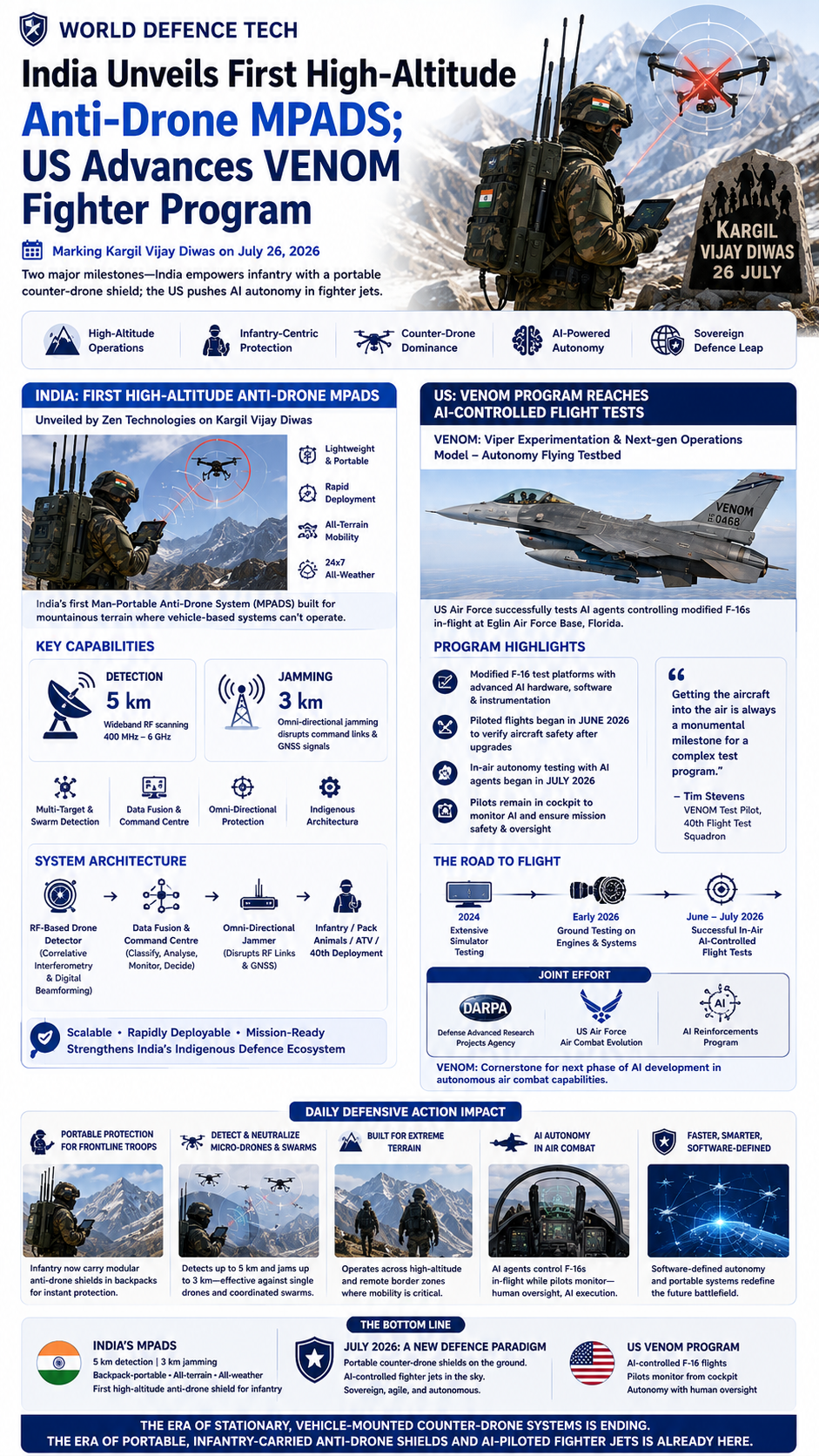
Sovereign military forces are prioritizing agile, portable force protection. Frontline infantry units can now carry modular anti-drone shields in backpacks to immediately detect and neutralize hostile micro-drones and coordinated swarms across remote border zones. Zen Technologies said the system strengthens India's indigenous defence ecosystem by delivering a scalable, rapidly deployable capability that enables troops to detect, track and neutralise aerial threats wherever the mission demands. Meanwhile, the VENOM program's successful AI-controlled flight tests mark a significant step toward autonomous air combat capabilities, with the Air Force's 40th Flight Test Squadron leading early tests to rapidly evolve autonomous capabilities while keeping human oversight.
The Bottom Line
July 2026 confirms that sovereign defense is prioritizing speed, portability, and software-defined autonomy. India's first high-altitude MPADS—capable of 5 km detection and 3 km jamming in remote mountainous terrain—gives infantry a lightweight, backpack-portable counter-drone shield for the first time. Meanwhile, the US VENOM program has moved from ground testing to successful in-air AI-controlled F-16 flights, with pilots monitoring from the cockpit as autonomous agents take control. The era of stationary, vehicle-mounted counter-drone systems is ending. The era of portable, infantry-carried anti-drone shields and AI-piloted fighter jets is already here.