Back to News
News AlertWorld Defence Tech
IAF Launches "Dronathon 2026" at Pokhran as Ukraine Scales AI-Guided Drone Strikes
V
Author
Vishal Sable
Published
September 9, 2026
Reading Time
7 MIN READ
Spread the Word
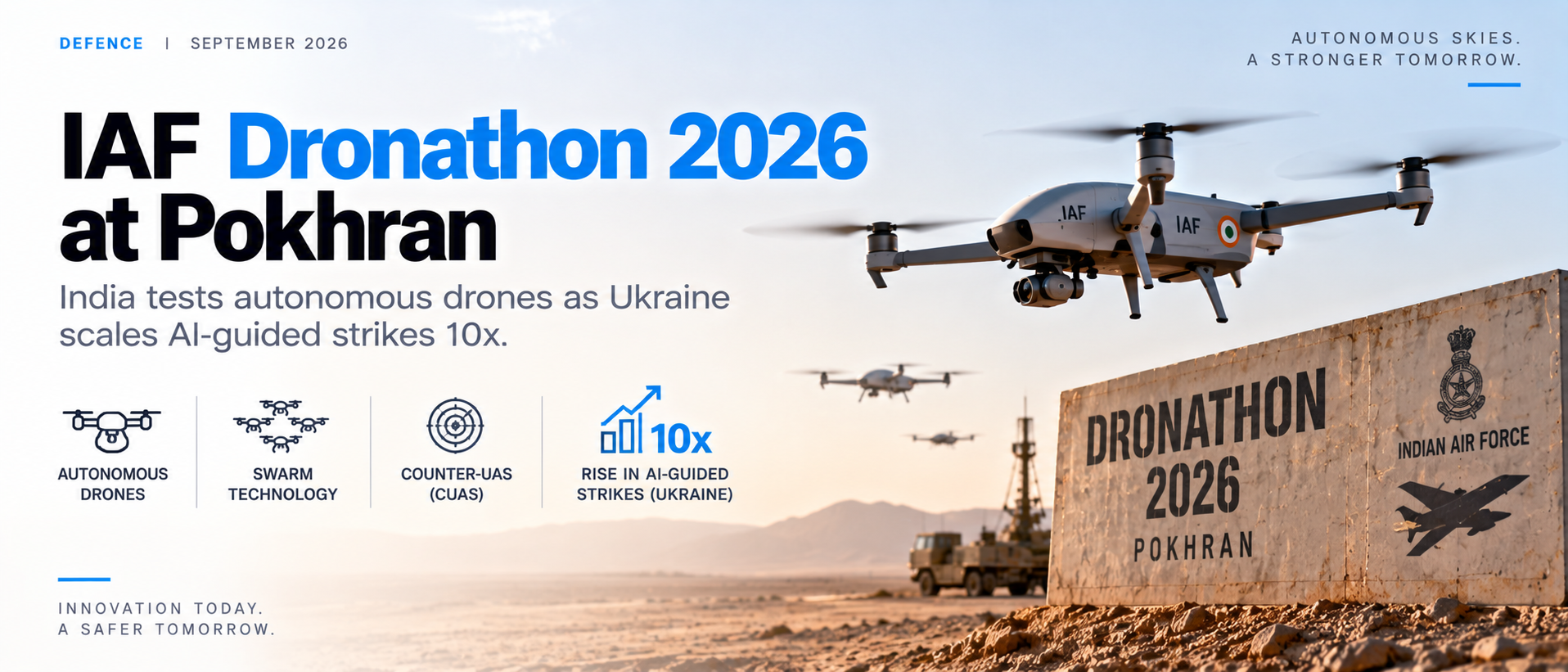
IAF Dronathon 2026 will test autonomous, swarm and Counter-UAS systems at Pokhran as Ukraine reports a 10x rise in successful strikes using AI guidance.
Dronathon 2026, IAF Dronathon 2026, Dronathon 2026 Pokhran, AI-guided drones, autonomous drones, swarm drone technology, Counter-UAS India, CUAS India, Ukraine AI drones, AI drone guidance, defence technology 2026
Dronathon 2026, IAF Dronathon 2026, Dronathon 2026 Pokhran, AI-guided drones, autonomous drones, swarm drone technology, Counter-UAS India, CUAS India, Ukraine AI drones, AI drone guidance, defence technology 2026
The word that's replacing the remote-controlled drone
For years, military drone development was largely measured by range, endurance, payload and the number of aircraft that could be deployed. The focus is increasingly moving toward autonomy — giving unmanned systems more onboard capability to detect, track and guide themselves through parts of a mission rather than relying entirely on continuous manual control .
That shift is now visible in India and Ukraine at the same time. The Indian Air Force is preparing Dronathon-2026 at Pokhran to demonstrate UAS and Counter-UAS technologies, with autonomous operations, swarm technologies and electronic warfare among its focus areas. Ukraine, meanwhile, says it has conducted large-scale testing of drones equipped with automatic guidance for moving ground targets and is moving successful systems toward procurement. Press Information Bureau , Ukraine Ministry of Defence
That shift is now visible in India and Ukraine at the same time. The Indian Air Force is preparing Dronathon-2026 at Pokhran to demonstrate UAS and Counter-UAS technologies, with autonomous operations, swarm technologies and electronic warfare among its focus areas. Ukraine, meanwhile, says it has conducted large-scale testing of drones equipped with automatic guidance for moving ground targets and is moving successful systems toward procurement. Press Information Bureau , Ukraine Ministry of Defence
The number driving the shift
Ukraine's Ministry of Defence says the number of successful strikes using AI guidance has increased tenfold since the beginning of 2026. The figure is an official Ukrainian defence claim, so it is important to attribute the 10x number to Ukraine rather than present it as an independently audited measure of all AI-assisted strikes.
The same programme provides a more concrete measure of where the technology is going. Seven companies tested autonomous drone-guidance systems against moving ground targets. According to Ukraine's Ministry of Defence, six manufacturers passed the evaluation and had their solutions recommended for procurement . Ukraine Ministry of Defence
What AI guidance actually means
AI guidance changes the role of software during the most demanding part of a drone mission. Instead of requiring the operator to manually control the aircraft throughout the terminal approach, onboard computer vision and automatic guidance can help the system detect, acquire and track a target.
Ukraine's latest tests put that capability under a defined scenario. Each drone had to fly 2 kilometres, detect and acquire a moving lightly armoured vehicle from at least 500 metres, and then hit the target in fully autonomous mode while the pilot took their hands off the controls. Each team received up to three attempts and had to achieve at least two successful hits to pass. Ukraine Ministry of Defence
IAF's answer: take autonomous drones to Pokhran
The Indian Air Force will hold Dronathon-2026 at the Pokhran range in Jaisalmer from September 14 to 16, 2026. The event is intended to give domestic manufacturers a platform to demonstrate advances in Unmanned Aerial Systems (UAS) and Counter-Unmanned Aerial Systems (CUAS) through static displays and live demonstrations.
The IAF says Dronathon 2026 will help identify contemporary solutions and evaluate their combat effectiveness. Its published focus areas include surveillance and reconnaissance, autonomous operations, swarm technologies and electronic warfare, putting several of the most important parts of modern unmanned warfare into a single evaluation programme. Press Information Bureau
Why India's defence start-ups are central to Dronathon
Dronathon 2026 is also designed around India's domestic defence ecosystem. The IAF says the event will integrate industry experts, start-ups and innovators and is aligned with the national vision of Atmanirbhar Bharat.
The significance is that these companies are being brought into an operational demonstration environment rather than being limited to static product presentations. The IAF says the event will allow stakeholders to witness emerging drone and counter-drone technologies and their operational demonstrations while helping identify contemporary solutions. Press Information Bureau
Ukraine's answer: test AI before scaling it
Ukraine's latest programme shows how automatic drone guidance is being subjected to standardized testing before wider procurement. The Ministry of Defence and Brave1 described the September evaluation as the first large-scale test of automatic-guidance technology under a single scenario and defined criteria.
The result was unusually direct: six of seven manufacturers passed and had their systems recommended for procurement. Ukraine's defence ministry said it intends to expand the use of AI- and computer-vision-based automatic guidance technology across the military. Ukraine Ministry of Defence

AI does not remove the human from the loop
The move toward autonomous drone guidance does not mean Ukraine is handing the entire engagement decision to an algorithm. The Ministry of Defence explicitly says that AI is being used to improve strike effectiveness, while a human still makes the decision to carry out the strike.
That distinction matters because the technology being tested is primarily about automatic guidance and target tracking, not unrestricted machine-controlled warfare. In practical terms, the human can authorize the mission while onboard systems perform more of the terminal flight and targeting workload. Ukraine Ministry of Defence
Electronic warfare is becoming part of the autonomy race
Electronic warfare remains a major consideration for unmanned systems because drones can depend on communications, navigation and control links. Ukraine's Ministry of Defence has framed AI as part of a broader effort to make the targeting chain more effective, including faster processing and more automated target engagement.
That makes the IAF's decision to put electronic warfare, autonomous operations and swarm technologies within the same Dronathon 2026 programme particularly notable. India's official description treats these as parallel areas of future operational capability rather than as isolated technology categories. Press Information Bureau
The battlefield is moving from one drone to many systems
Swarm technology adds another layer to the autonomy story. Instead of viewing each unmanned aircraft as an individually controlled platform, swarm systems are designed around multiple drones operating as a coordinated group, making coordination and autonomy important parts of the overall system.
The IAF has explicitly identified swarm technologies as one of Dronathon 2026's key focus areas. That places multi-platform unmanned operations alongside surveillance, reconnaissance, autonomous operations and electronic warfare within India's current defence-technology evaluation priorities. Press Information Bureau
Why India and Ukraine are actually telling one story
Read together, these are not two unrelated drone announcements. India is creating a structured proving ground for autonomous UAS, swarm systems and Counter-UAS technology, while Ukraine is taking automatic AI guidance through battlefield-oriented testing and procurement evaluation.
The difference is where each country sits in the technology cycle. India's Dronathon is designed to bring domestic manufacturers, start-ups and innovators into live demonstrations and combat-effectiveness evaluations, while Ukraine's latest programme has already produced procurement recommendations for successful automatic-guidance systems.
The common trend is clear: military drone capability is increasingly shifting from the airframe itself toward the intelligence around it — sensing, computer vision, automatic guidance, coordination and the ability to operate with less continuous manual input. Ukraine Ministry of Defence
Why it matters
For India's defence industry, Dronathon 2026 creates a high-profile opportunity for domestic UAS and CUAS developers to demonstrate systems against operational requirements. The IAF's own description makes combat effectiveness, autonomous operations, swarm technologies and electronic warfare central to the event.
For Ukraine, the latest testing shows how AI-guided drone technology is moving beyond experimentation. Six manufacturers passed a large-scale standardized test and received procurement recommendations, while the Ministry of Defence says more than 70 AI- and computer-vision-based systems are already being used by Ukrainian Defence Forces to strike enemy targets.
The bigger shift is therefore not simply toward more drones. It is toward drones that can perform more of the sensing, tracking and terminal guidance process themselves, while humans retain responsibility for mission authorization and oversight. Ukraine Ministry of Defence
If India's Dronathon 2026 is testing autonomous, swarm and Counter-UAS systems at Pokhran while Ukraine reports a tenfold increase in successful strikes using AI guidance, is the next global drone race no longer about who builds the most UAVs—but who builds the UAVs that can operate most intelligently?

Vishal Sable
B.Tech AD @ shri balaji institute of technology and management
Engineering and tech journalist. I love exploring the impact of emerging technologies on global defense, sovereignty, and everyday life. Always looking for the real story behind the headlines.