Back to News
News AlertWorld Money
Late-Stage Capital Rebound Fuels $2 Billion FinTech Inflow
V
Author
Vishal Sable
Published
July 20, 2026
Reading Time
4 MIN READ
Spread the Word
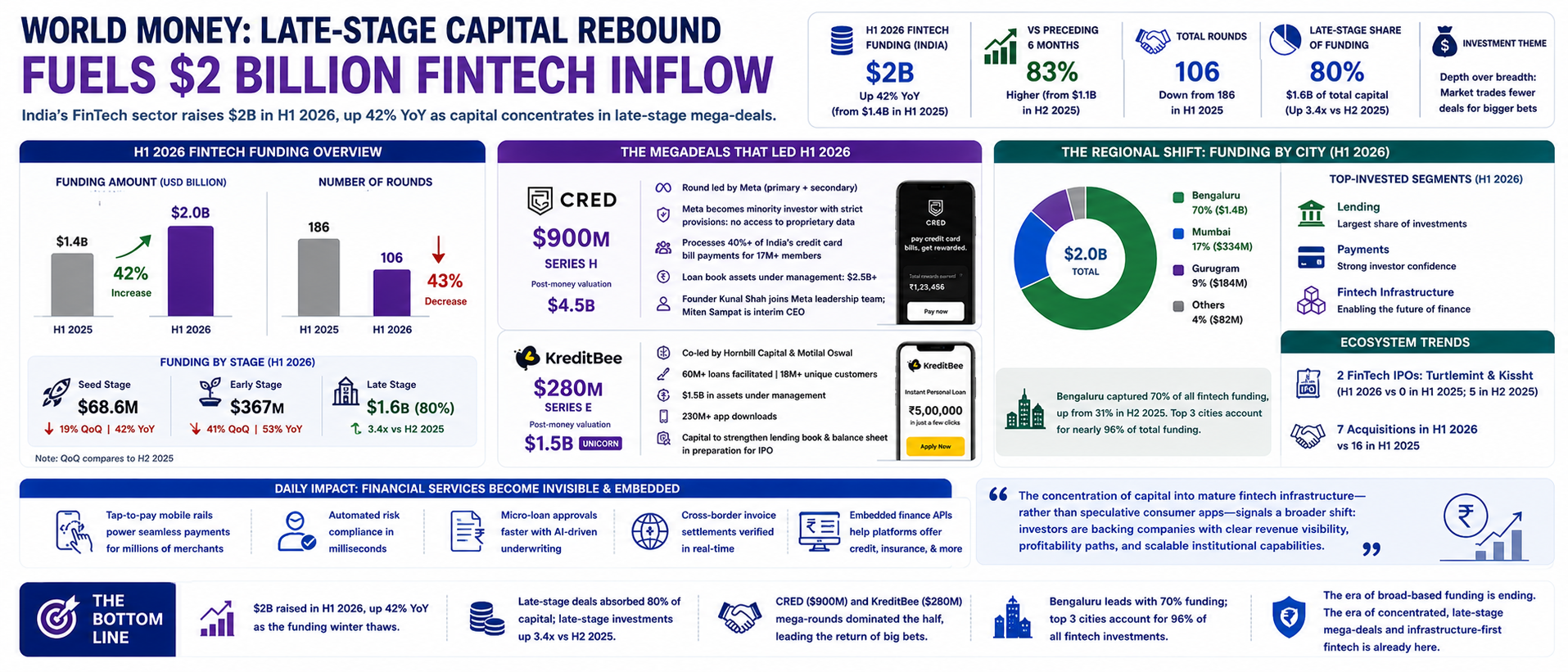
Financial technology is shaking off market caution, relying on late-stage enterprise rounds, tokenized asset settlements, and embedded merchant tools. India's FinTech sector raised $2 billion in the first half of 2026, up 42% year-on-year from $1.4 billion and 83% higher than the preceding six months, according to a Tracxn report. While funding rounds fell to 106 from 186 a year earlier, the amount raised nearly doubled—reflecting a market that has traded breadth for depth. Late-stage companies absorbed 80% ($1.6 billion) of all deployed fintech capital, with late-stage investments increasing 3.4 times compared with the previous half-year. In contrast, seed-stage funding declined 19% sequentially and 42% year-on-year to $68.6 million, while early-stage funding dropped 41% to $367 million.
The Megadeals
The half-year was defined by the return of the mega-round. CRED topped the list with a $900 million Series H round led by Meta, executed through a combination of primary and secondary share purchases at a post-money valuation of $4.5 billion. Meta joins CRED's cap table as a minority investor with strict provisions denying it access to proprietary customer data. The capital lands as CRED commands a dominant slice of India's premium digital finance market, processing over 40% of the country's credit card bill payments for its monthly user base of 17 million members, with loan operations managing over $2.5 billion in assets. Founder Kunal Shah transitions out of his CEO role to join Meta's global leadership team, with Miten Sampat taking over as interim CEO. KreditBee followed with a $280 million Series E round co-led by Hornbill Capital and Motilal Oswal, at a post-money valuation of $1.5 billion, cementing its unicorn status. The digital lender has facilitated over 60 million loans, holds $1.5 billion in assets under management, and serves more than 18 million unique loan customers with over 230 million app downloads. The cash injection will primarily strengthen the firm's lending book and balance sheet in preparation for its IPO.
The Regional Shift
Bengaluru captured 70% ($1.4 billion) of all fintech funding, up sharply from 31% in H2 2025. Mumbai followed with $334 million, while Gurugram raised $184 million. The three cities together accounted for nearly 96% of all fintech funding during the period. The lending, payments, and fintech infrastructure segments continued attracting the largest investments, reflecting sustained investor confidence in businesses addressing large-scale retail and enterprise financial services opportunities. Two FinTech IPOs—Turtlemint and Kissht—were recorded in H1 2026 after none in the year-ago period, though the number was lower than the five seen in H2 2025. Acquisitions remained muted, with seven deals completed compared with 16 in H1 2025.
Daily Routine Impact
Financial services are becoming completely invisible and embedded. In daily commerce, small business merchants are adopting tap-to-pay mobile rails and automated risk compliance tools that evaluate micro-loan applications and verify cross-border invoice settlements in milliseconds. The concentration of capital into mature fintech infrastructure—rather than speculative consumer apps—signals a broader shift: investors are backing companies that can demonstrate clear revenue visibility, profitability paths, and scalable institutional capabilities. As CRED scales toward an eventual IPO and KreditBee prepares for its public listing, the FinTech sector is transitioning from a period of broad-based experimentation to one of disciplined, infrastructure-led expansion.
The Bottom Line
July 2026 marks a decisive shift in India's FinTech landscape. The $2 billion H1 haul—up 42% year-on-year—confirms that the funding winter has thawed, but the recovery is narrowly concentrated. Late-stage companies absorbed 80% of capital, with CRED's $900 million and KreditBee's $280 million rounds dominating the half. Bengaluru captured 70% of all funding, while seed and early-stage startups saw steep declines. The era of broad-based funding is ending. The era of concentrated, late-stage mega-deals and infrastructure-first fintech is already here.

Vishal Sable
B.Tech AD @ shri balaji institute of technology and management
Engineering and tech journalist. I love exploring the impact of emerging technologies on global defense, sovereignty, and everyday life. Always looking for the real story behind the headlines.