Back to News
News AlertWorld of Startup’s
Late-Stage Megarounds Lead Venture Capital Funding Rebound
V
Author
Vishal Sable
Published
July 25, 2026
Reading Time
3 MIN READ
Spread the Word
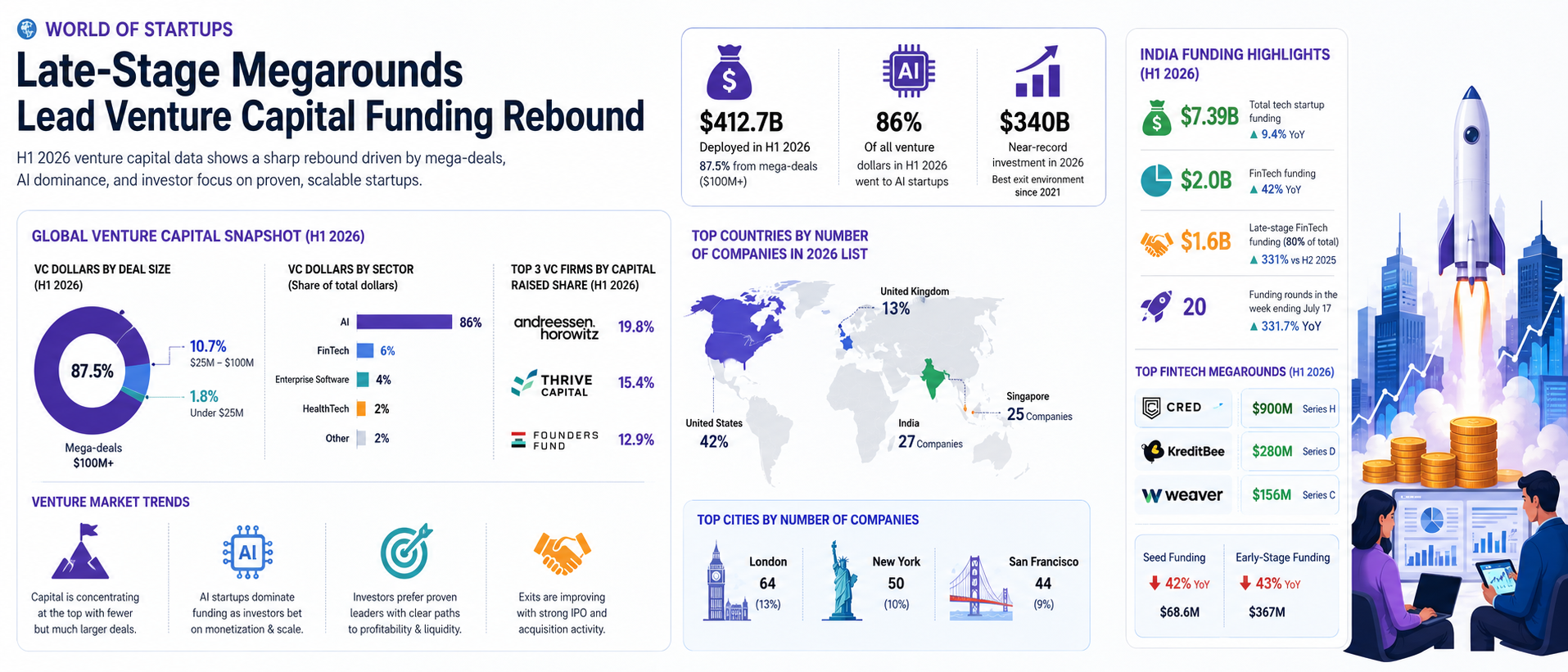
Mid-year startup funding data reveals a sharp, concentrated rebound in venture capital. Global institutional investors are deploying massive checks into late-stage startups that show defensible demand and clear AI monetization. According to the Q2 2026 PitchBook-NVCA Venture Monitor, megadeals of $100 million or more captured 87.5% of the $412.7 billion deployed in H1 2026, with AI accounting for 86% of all venture dollars. The venture market is breaking records by nearly every aggregate metric, though the details are more complicated: three firms—Andreessen Horowitz, Thrive Capital, and Founders Fund—took in 48.1% of all capital raised. The market is setting records at the very top while contracting in almost every other segment underneath it.
In regional hubs like India, weekly funding surged over 330% year-over-year, driven heavily by multi-hundred-million-dollar late-stage checks in B2B commerce and AI developer platforms. Indian startups raised $346.2 million across 20 funding rounds during the week ended July 17, led by large deals at B2B ecommerce platform Udaan and AI startup Emergent. The weekly tally was 51.7% higher than the previous week and 331.7% above the same period last year, with late-stage deals accounting for 85.3% of total capital raised. Indian tech startups raised $7.39 billion in the first six months of 2026, up 9.4% from a year earlier, even as the number of funding rounds plunged 41%, underscoring a sharp shift in investor preference toward larger, late-stage bets over broad-based capital deployment.
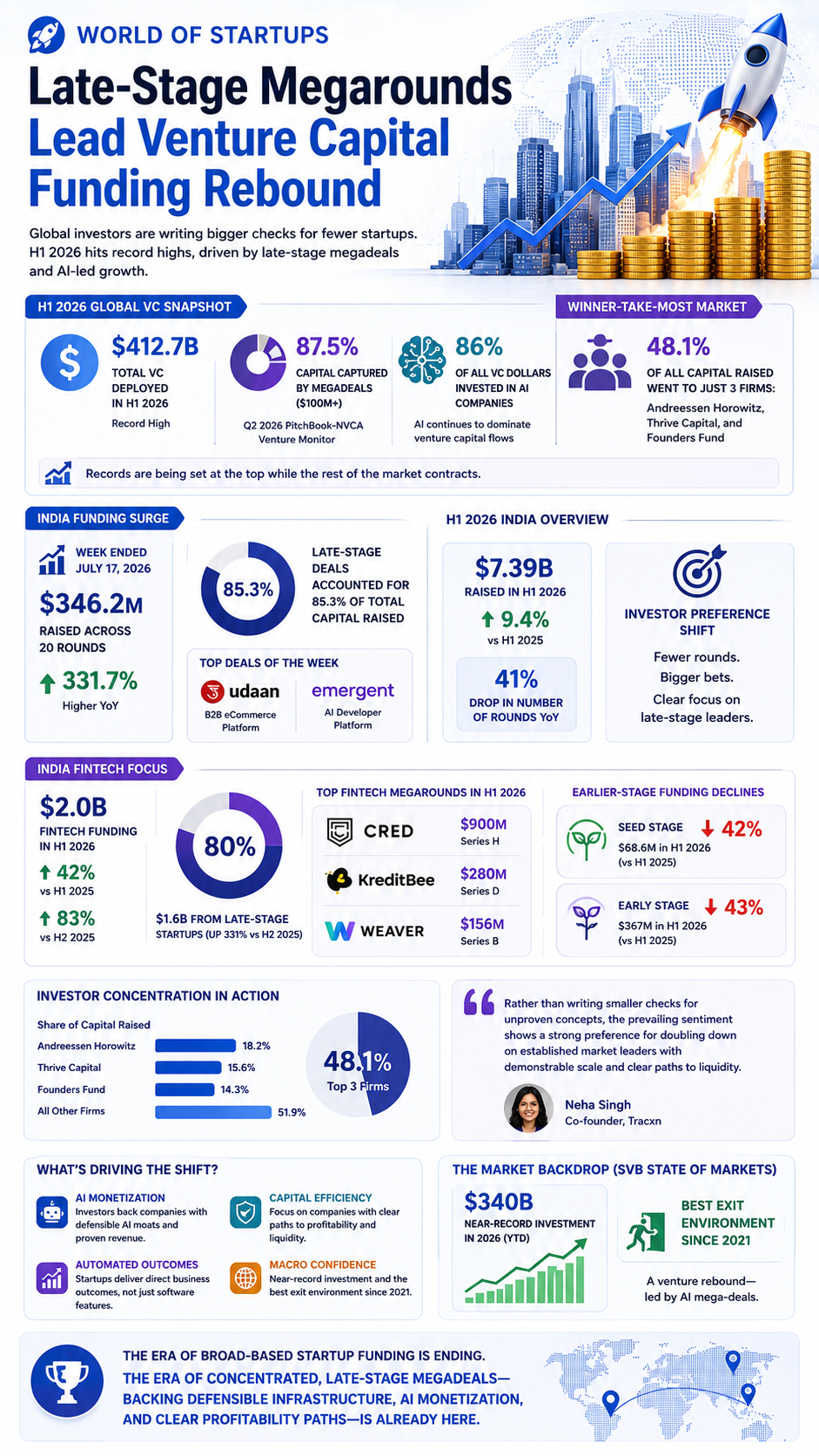
The concentration is even more pronounced in India's fintech sector, which raised $2 billion in H1 2026, up 42% from a year ago and 83% higher than the preceding six months. Late-stage startups accounted for $1.6 billion of that total—80% of all fintech funding—up 331% from H2 2025. CRED topped the list with a $900 million Series H round, followed by KreditBee with $280 million and Weaver with $156 million. In stark contrast, seed-stage funding declined 42% year-on-year to $68.6 million, while early-stage funding dropped 43% to $367 million. As Neha Singh, Co-founder of Tracxn, observed, rather than writing smaller checks for unproven concepts, the prevailing sentiment shows a strong preference for doubling down on established market leaders with demonstrable scale and clear paths to liquidity.
Startups are abandoning generic SaaS models to offer direct, automated business outcomes. Small business owners are utilizing newly funded automated tools to manage logistics, inventory, and customer scheduling without hiring expensive third-party software teams. As the SVB State of the Markets report notes, a near-record $340 billion in investment and the best exit environment since 2021 signal a venture rebound, though heavily concentrated in AI mega-deals. The era of broad-based startup funding is ending. The era of concentrated, late-stage megadeals—backing defensible infrastructure, AI monetization, and clear profitability paths—is already here.