Back to News
News AlertWorld Money
Licensed Fintechs Out-Acquire Traditional Banks in Historic M&A Shift
V
Author
Vishal Sable
Published
August 7, 2026
Reading Time
7 MIN READ
Spread the Word
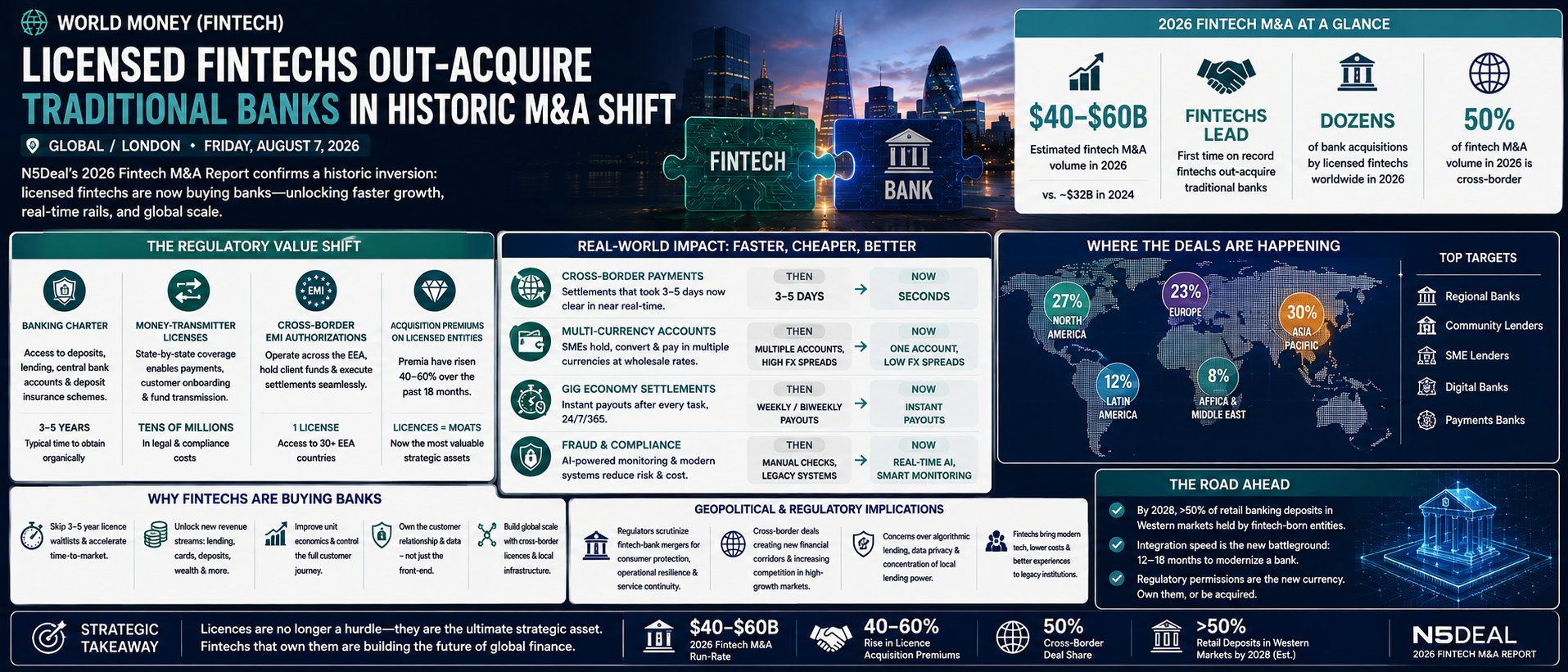
The financial services industry has crossed a historic threshold that redefines the very nature of banking ownership and control. According to the newly released N5Deal 2026 Fintech M&A Report, licensed fintech platforms have, for the first time on record, out-acquired traditional banks in global merger and acquisition activity, signalling a structural reordering of the sector that few analysts predicted even three years ago. Total fintech M&A volume is now pacing toward an estimated $40 to $60 billion for the full year, a figure that rivals the peak deal-making years of the late 2010s but with a crucial difference: the acquirers are no longer cash-rich incumbents swallowing disruptive upstarts, but rather agile, digitally native platforms that have secured their own regulatory licences and are now using them as currency to absorb legacy institutions at discounted valuations. The report documents dozens of transactions where fintechs with banking charters, money-transmitter licences, or cross-border Electronic Money Institution authorisations have purchased regional banks, community lenders, and even mid-tier commercial banks that struggled to adapt to real-time payments, open banking APIs, and the rising cost of legacy mainframe maintenance. This inversion of the traditional M&A power dynamic reflects a broader realisation among strategic buyers that regulatory permissions are not mere compliance burdens but appreciating assets that command premium valuations, often exceeding the software revenue multiples that previously dominated fintech investment theses.
The regulatory value shift at the heart of this trend is profound and multi-layered. Strategic buyers are now prioritising the acquisition of fully operational licences over organic application processes, which can take three to five years and tens of millions of dollars in legal and compliance fees, with no guarantee of approval in increasingly sceptical regulatory environments. A banking charter, for instance, confers not only the ability to take deposits and extend credit but also direct access to payment rails, central bank settlement accounts, and deposit insurance schemes, all of which fintechs previously had to broker through third-party sponsor banks at significant cost and operational friction. Similarly, money-transmitter licences across all fifty US states, or a single cross-border EMI authorisation valid across the European Economic Area, have become coveted assets that allow fintechs to onboard customers, hold client funds, and execute settlements without intermediary oversight, drastically improving both unit economics and user experience. The N5Deal report notes that acquisition premiums for licensed entities have risen by 40 to 60 percent over the past eighteen months, with some bidders offering multiples based primarily on the license portfolio rather than the target's customer base or technology stack, a complete reversal of the pre-2020 era when licences were viewed as tedious prerequisites rather than strategic treasures. This shift has created a two-tier market: fintechs without proprietary licences are increasingly consolidated into those with them, while unlicensed challengers face higher cost of capital, slower time-to-market, and greater vulnerability to sponsor-bank terminations, effectively making regulation the new moat in financial services.
For businesses and individual consumers, the practical consequences of this M&A reorientation are already visible in faster, cheaper, and more integrated financial operations. Cross-border payments that once required three to five business days for correspondent banking settlement now clear in near-real-time, as acquiring fintechs fold their newly purchased licences into unified settlement engines that bypass the SWIFT gpi network altogether for certain corridors, using instead bilateral nostro-vostro arrangements or stablecoin-backed bridges that reduce FX spreads to under 50 basis points. International multi-currency operating accounts, previously the preserve of multinational corporations with dedicated treasury teams, are now offered to small and medium-sized exporters through fintech platforms that aggregate their licensed capabilities across jurisdictions, allowing a Vietnamese coffee exporter to hold euro, dollar, and yen balances simultaneously and convert between them at wholesale rates without manual intervention. Automated gig-economy settlements, where ride-share drivers, delivery couriers, and freelance creatives receive payouts after each completed task rather than on fortnightly cycles, have become the new normal in markets where fintechs have absorbed local banking infrastructure and integrated it with real-time payment schemes like the UK's Faster Payments, India's UPI, or the EU's SEPA Instant. A courier in Berlin can now finish a delivery at 2:00 PM and see the fare credited to their multi-currency wallet by 2:01 PM, with the option to convert instantly to their home currency or spend directly via a linked debit card, all because the fintech that powers their platform now owns the underlying settlement licence rather than renting it from a legacy bank that imposed arbitrary cut-off times and holds.
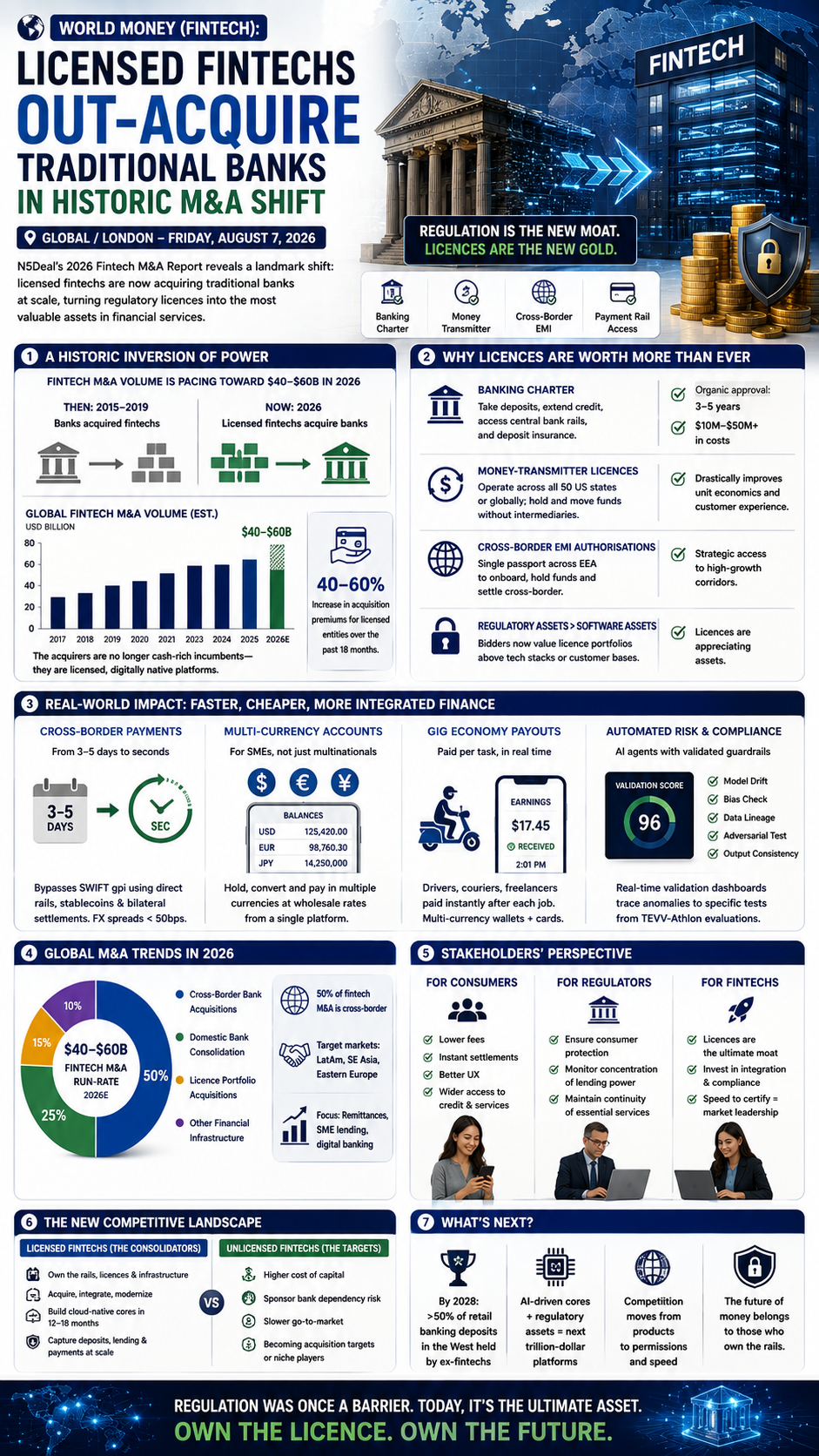
Geopolitically, the M&A shift is prompting regulators to reconsider the boundaries between banking and commerce, as fintechs that acquire traditional institutions gain not only licences but also access to the legacy loan books, mortgage portfolios, and small-business credit relationships that have historically defined community banking. This raises concerns about concentrated control of local lending, algorithmic credit decisions that may lack human discretion, and the potential for fintechs to discontinue unprofitable but socially necessary services like rural branch banking or overdraft protection for low-income customers. Central banks in jurisdictions like the UK, Singapore, and Australia have issued cautious statements noting that they will scrutinise fintech-bank mergers more closely, particularly regarding operational resilience, consumer protection, and the continuity of essential financial services. Simultaneously, however, these same regulators are recognising that fintech ownership can revitalise moribund institutions, bringing modern anti-fraud systems, AI-driven compliance monitoring, and user-friendly digital interfaces that attract younger depositors and reduce the cost-to-income ratios that have plagued traditional banks for decades. The N5Deal report estimates that fully half of the fintech M&A volume in 2026 involves cross-border transactions, where fintechs from the US, UK, and Singapore acquire banks in Latin America, Southeast Asia, and Eastern Europe to gain footholds in high-growth remittance and SME lending markets, effectively creating new financial corridors that bypass the traditional dominance of American and European global banks.
For the broader fintech ecosystem, the message is clear: the era of "move fast and break things" is definitively over, replaced by a race to acquire and integrate regulatory permissions as the primary competitive differentiator. Unlicensed fintechs that once relied on sponsor-bank relationships are now scrambling to either secure their own licences, a costly and uncertain process, or position themselves as attractive acquisition targets for licensed consolidators, leading to a wave of smaller deals that the N5Deal report characterises as "licence hunting" rather than genuine strategic synergy. Meanwhile, the licensed acquirers are investing heavily in integration capabilities, building internal teams of regulatory specialists, compliance engineers, and legacy-system migration experts who can fold a traditional bank's operations into a cloud-native core within twelve to eighteen months, a timeline that has become the industry benchmark for successful post-merger transformation. As the $40 to $60 billion annual run-rate suggests, this trend is far from peaking, with analysts predicting that by 2028, more than half of all retail banking deposits in Western markets will be held by entities that originated as fintechs and later acquired their banking infrastructure, effectively completing a full-circle evolution from disruptor to incumbent. For the everyday customer, this means better interfaces, lower fees, and instant settlements across borders, but it also means that the nostalgic image of the local branch manager who knows your name may soon be a relic, replaced by algorithmic relationship managers and automated credit decisions that are efficient, impartial, and utterly indifferent to human sentiment.

Vishal Sable
B.Tech AD @ shri balaji institute of technology and management
Engineering and tech journalist. I love exploring the impact of emerging technologies on global defense, sovereignty, and everyday life. Always looking for the real story behind the headlines.