Back to News
News AlertWorld Defence Tech
Lockheed Martin Expands AI Defence Engineering; Zulu Defence Advances Autonomous Battlefields
V
Author
Vishal Sable
Published
July 23, 2026
Reading Time
3 MIN READ
Spread the Word
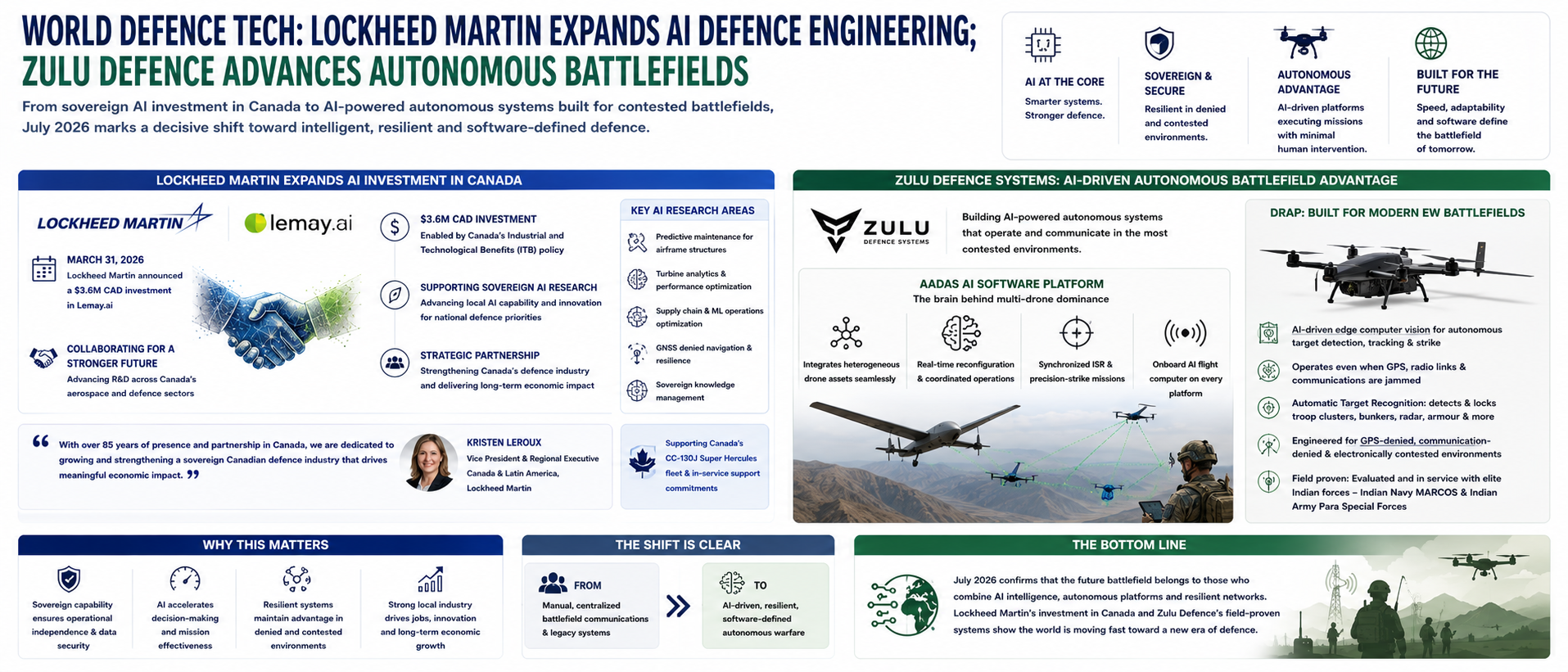
Defense giant Lockheed Martin Canada has expanded its direct capital investment into Ottawa-based artificial intelligence firm Lemay.ai, accelerating the integration of localized AI models into naval battle management suites and aerospace analytics. On March 31, 2026, Lockheed Martin announced a $3.6M CAD investment in the Canadian small-to-medium business, launching a collaborative effort to advance research and development across Canada's aerospace and defence sectors. The project supports AI research in predictive maintenance for airframe structures and turbine analytics, supply chain machine learning operations optimization, Global Navigation Satellite System denied navigation, and sovereign knowledge management. The investment is enabled by Canada's Industrial and Technological Benefits policy, fulfilling economic impact commitments related to Canada's acquisition and in-service support of the CC-130J Super Hercules aircraft fleet. Lemay.ai is a specialized consultancy providing bespoke AI, machine learning, and deep learning solutions in defence and aerospace, having successfully delivered AI solutions to governments, NATO, and defence clients worldwide. Kristen Leroux, vice president and regional executive for Canada and Latin America at Lockheed Martin, stated: "With over 85 years of presence and partnership in Canada, we are dedicated to growing and strengthening a sovereign Canadian defence industry that drives meaningful economic impact".
Concurrently, defense innovators like Bengaluru-based Zulu Defence Systems are advancing AI-powered autonomous battlefield communications, using software-defined mesh radios to maintain secure operational connectivity even under heavy electronic warfare and GPS jamming. At the core of Zulu's ecosystem is the AADAS AI software platform that seamlessly integrates heterogeneous drone assets, enabling real-time reconfiguration, coordinated multi-drone operations, and synchronized intelligence, surveillance, reconnaissance, and precision-strike missions. Each platform is equipped with an onboard AI flight computer, enabling real-time data sharing, adaptive swarm behavior, and edge-based mission execution. This distributed intelligence architecture allows autonomous assets to collaborate, reconfigure dynamically, and make mission-level decisions in real time, ensuring operational effectiveness even in communication-constrained and electronically contested environments.
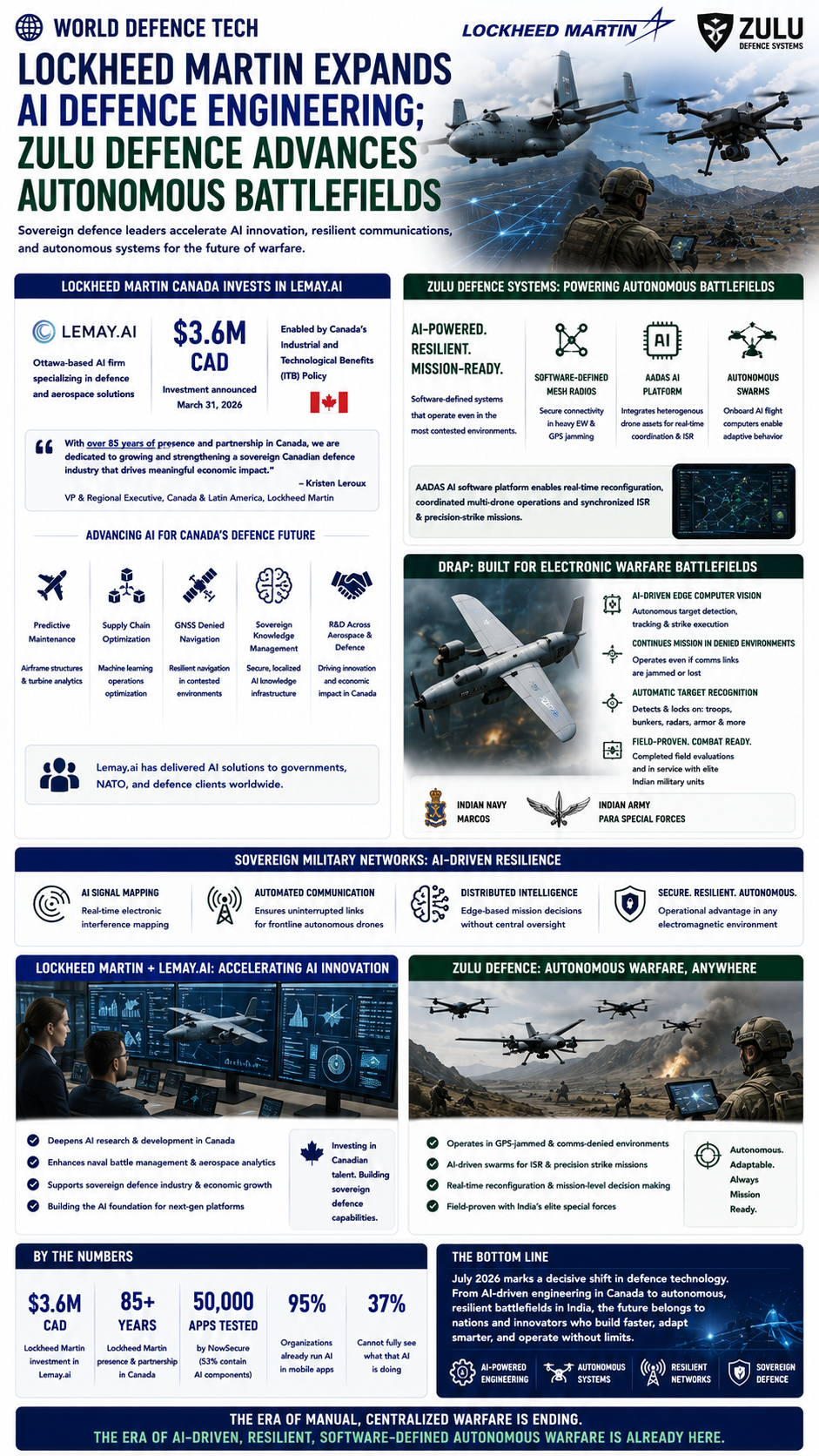
Sovereign military networks are prioritizing resilient, uncrewed platforms. Field commanders are deploying AI-driven signal processors that map electronic interference in real time, guaranteeing automated communication for frontline autonomous drones without manual oversight. Zulu's DRAP (Directed Reconnaissance and Attack Platform) has been engineered specifically for modern electronic warfare battlefields where GPS, radio links, and communications are actively jammed. The platform is equipped with AI-driven edge computer vision, enabling autonomous target detection, tracking, and strike execution with minimal operator intervention. The drone can continue tracking and engaging targets even after communication links are disrupted or jammed—a major advantage in next-generation drone warfare. Built-in Automatic Target Recognition empowers the aircraft to instantly detect, categorise, and lock onto various battlefield assets, ranging from troop clusters and fortified bunkers to radar installations and heavy armour. The platform has already completed field evaluations and entered service with elite Indian military formations, including the Indian Navy MARCOS and Indian Army Para Special Forces. July 2026 confirms that sovereign defense is prioritizing speed and software adaptability—with Lockheed Martin deepening its AI investment in Canada and Zulu Defence demonstrating that autonomous battlefield systems can operate effectively even when GPS and communications are actively jammed. The era of manual, centralized battlefield communications is ending. The era of AI-driven, resilient, software-defined autonomous warfare is already here.

Vishal Sable
B.Tech AD @ shri balaji institute of technology and management
Engineering and tech journalist. I love exploring the impact of emerging technologies on global defense, sovereignty, and everyday life. Always looking for the real story behind the headlines.