Back to News
News AlertWorld Defence Tech
Lockheed Martin Unveils Strigo Modular Suite; L3Harris Advances NGI Interceptor Motor
V
Author
Vishal Sable
Published
August 12, 2026
Reading Time
5 MIN READ
Spread the Word
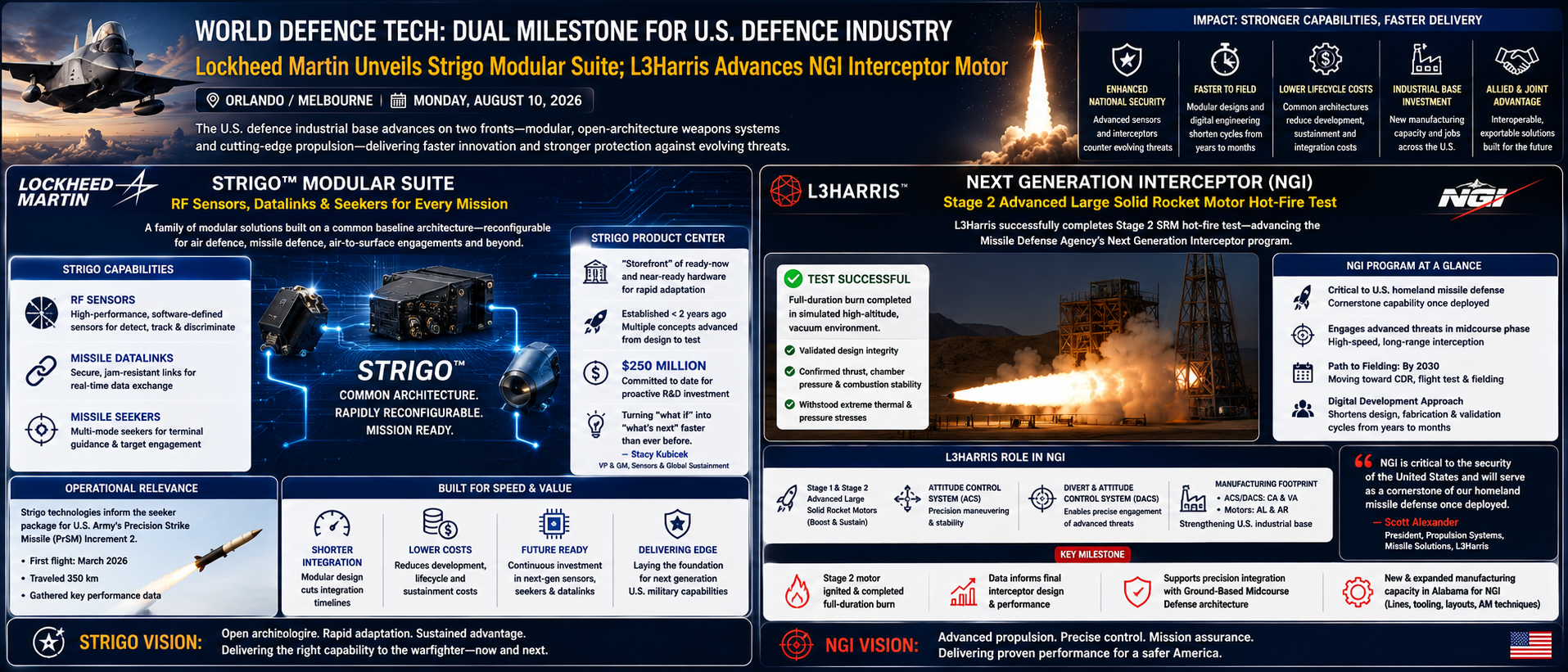
The U.S. defence industrial base has marked a significant dual milestone today, as Lockheed Martin unveiled a new modular sensor and missile technology family while L3Harris successfully completed a critical propulsion test for the nation's next-generation homeland missile interceptor. Together, these announcements underscore an industry-wide push toward faster development cycles, common architectures, and accelerated delivery of advanced capabilities to warfighters facing rapidly evolving threats.
LOCKHEED MARTIN UNVEILS STRIGO SUITE: Modular RF Sensors, Datalinks and Seekers
Lockheed Martin announced the launch of Strigo™, a new family of modular defence solutions encompassing radio-frequency (RF) sensors, missile datalinks and missile seeker technologies built on a common baseline architecture. Leveraging shared hardware and software architectures, Strigo solutions can be reconfigured rapidly for a diverse range of missions—from air defence to missile defence to air-to-surface engagements and beyond.
To support the rapid development of Strigo solutions, Lockheed Martin has established a dedicated product centre that functions as a "storefront" of ready-now and near-ready hardware that can be quickly adapted to evolving customer mission sets. Established less than two years ago, the Strigo Product Center has already advanced multiple concepts from initial design through successful testing. The company has committed $250 million to date to the centre, funding proactive research that develops and produces new RF sensor and missile technologies before formal requirements are even issued.
Stacy Kubicek, vice president and general manager of Lockheed Martin Sensors and Global Sustainment, framed the initiative as a fundamental shift in development philosophy: "By putting proactive research and development at the forefront, the Strigo Product Center lets us test and deploy new solutions at unprecedented speed. That's how we turn 'what if' into 'what's next' faster than ever before".
The Strigo family has already demonstrated operational relevance. Technologies developed through the modular platform have informed aspects of the seeker package for the U.S. Army's Precision Strike Missile (PrSM) Increment 2, which adds a sensor in the missile's nose to locate and track targets during the final phase of flight. Lockheed Martin flew PrSM Increment 2 for the first time in March 2026, travelling 350 kilometres in a flight that gathered performance data.
The modular approach promises to shorten integration timelines while reducing development, lifecycle and long-term sustainment costs. Lockheed Martin will continue investing in new RF sensor, missile seeker and missile datalink technologies to accelerate current munitions efforts while laying the foundation for the next generation of U.S. military capabilities.
L3HARRIS ADVANCES NEXT GENERATION INTERCEPTOR WITH STAGE TWO MOTOR HOT-FIRE TEST
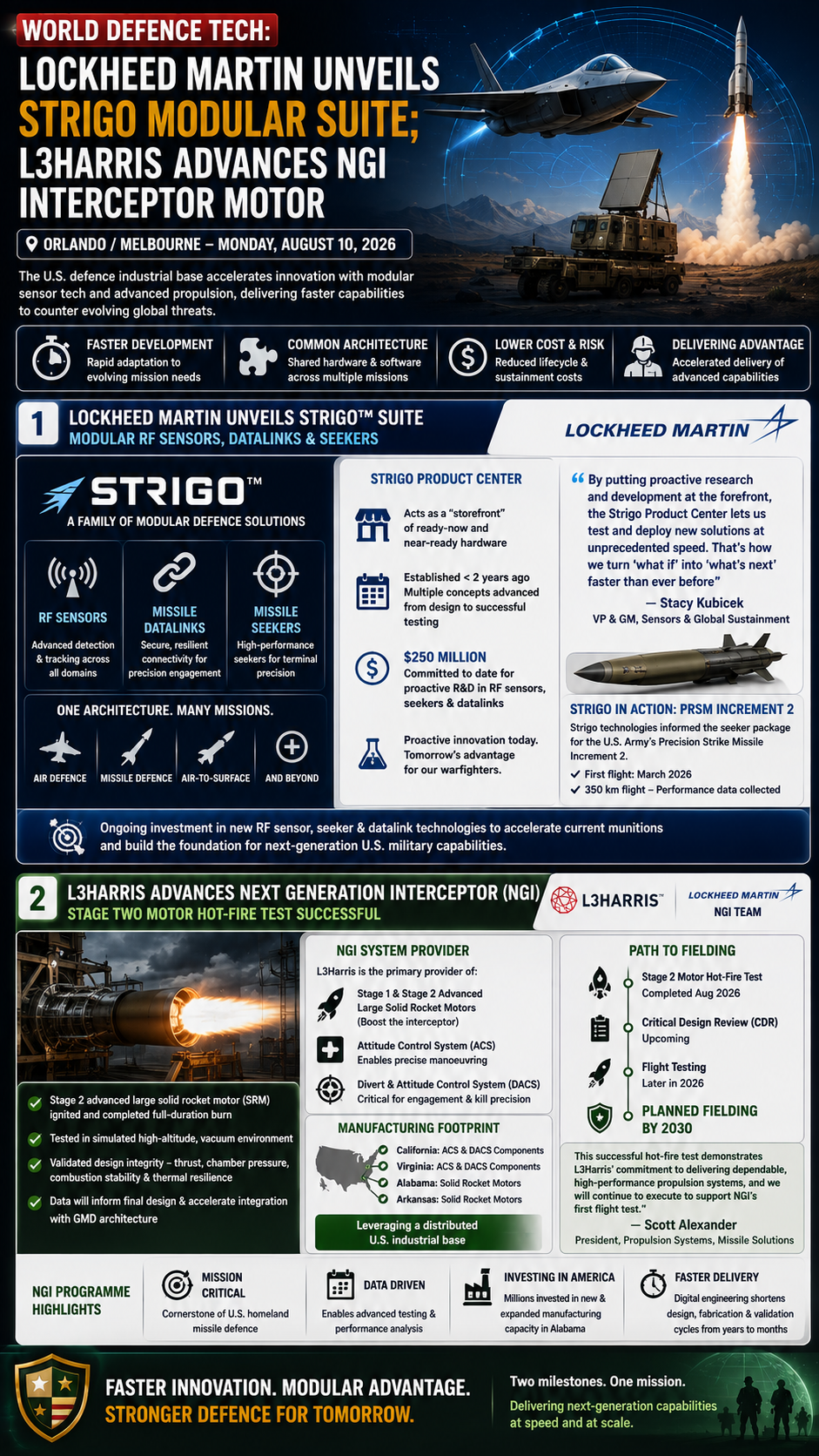
In a parallel milestone for U.S. homeland missile defence, L3Harris Technologies successfully completed a hot-fire test of its stage two advanced large solid rocket motor (SRM) for the Missile Defense Agency's Next Generation Interceptor (NGI) programme. L3Harris conducted the test as part of the Lockheed Martin team advancing the effort to strengthen the nation's homeland missile defence.
The hot-fire test validated the system's design integrity, as the SRM ignited and completed a full-duration burn, providing valuable data to analyse performance characteristics ahead of advanced testing later this year. Engineers conducted the test in a simulated high-altitude, vacuum environment to evaluate system performance in the upper layers of Earth's atmosphere.
Scott Alexander, President of Propulsion Systems, Missile Solutions at L3Harris, underscored the strategic importance of the achievement: "NGI is critical to the security of the United States and will serve as a cornerstone of our homeland missile defense once deployed. This successful hot-fire test demonstrates L3Harris' commitment to delivering dependable, high-performance propulsion systems, and we will continue to execute to support NGI's first flight test".
L3Harris serves as the primary propulsion and control systems provider for NGI, producing both the stage one and stage two advanced large solid rocket motors that boost the missile, as well as the Attitude Control System (ACS) and Divert and Attitude Control System (DACS). The ACS and DACS systems enable precise manoeuvring and engagement capabilities critical to intercepting advanced threats. The company manufactures ACS and DACS components in California and Virginia, and manufactures advanced large solid rocket motors in Alabama and Arkansas, leveraging a distributed industrial base.
The successful Stage 2 motor firing moves the NGI programme toward Critical Design Review, flight testing and planned fielding by 2030. Lockheed Martin confirmed the firing demonstrated thrust, chamber pressure and combustion stability, as well as the motor's ability to withstand the extreme thermal and pressure stresses expected during interceptor missions. Christopher Jewell, Lockheed Martin NGI vice president, described the test as "a significant milestone on the path to the Critical Design Review and confirms our confidence that the NGI motor will meet the demanding performance envelope required for fielding by 2030". The data gathered will directly inform the final interceptor design and accelerate integration with the Ground-Based Midcourse Defence architecture. Lockheed Martin is also investing millions of dollars in new and expanded manufacturing capacity in Alabama for NGI, including production lines, tooling, plant layouts and advanced manufacturing techniques. Both companies are leveraging a digital development approach that can shorten design, fabrication and validation cycles from years to months.

Vishal Sable
B.Tech AD @ shri balaji institute of technology and management
Engineering and tech journalist. I love exploring the impact of emerging technologies on global defense, sovereignty, and everyday life. Always looking for the real story behind the headlines.