Back to News
News AlertWorld Defence Tech
NATO Summit Triggers Massive "Drone Edge" Procurements
V
Author
Vishal Sable
Published
July 18, 2026
Reading Time
4 MIN READ
Spread the Word
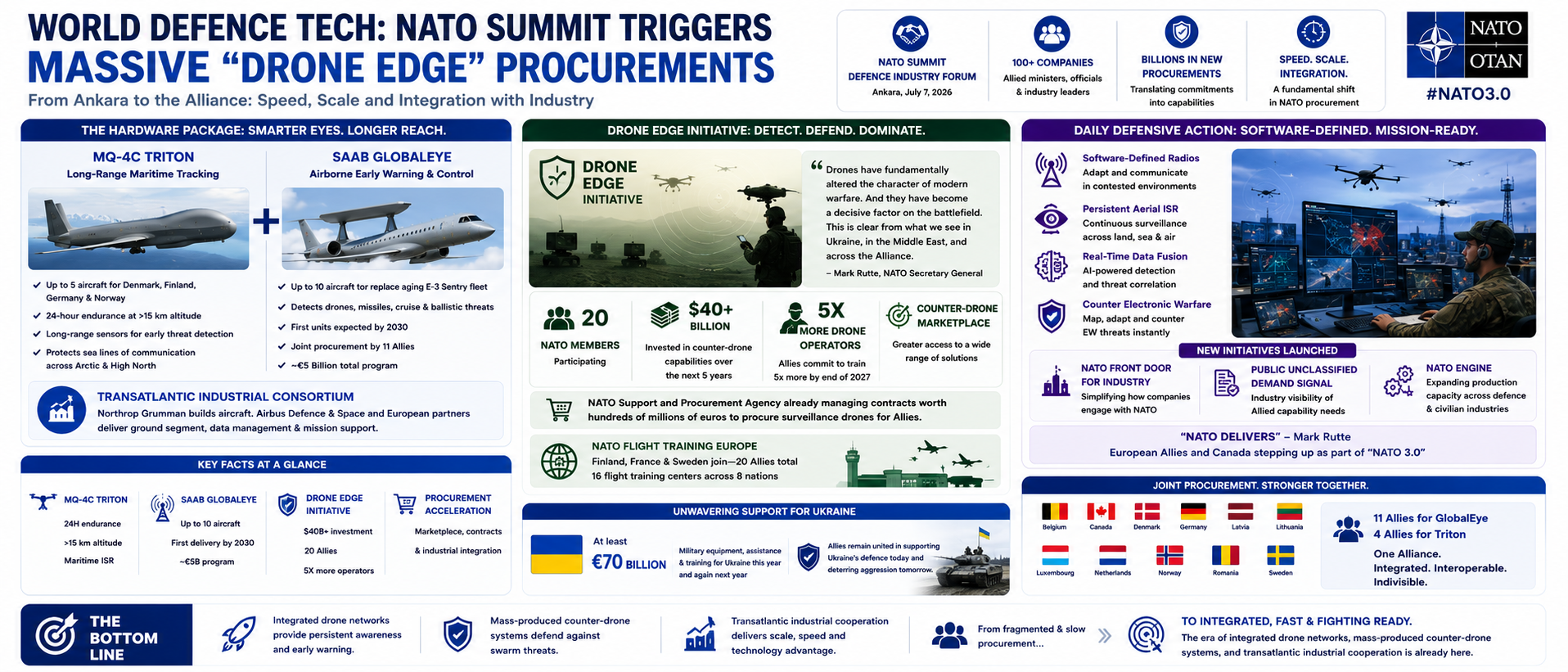
Modern defensive warfare is moving away from slow, manual production cycles to prioritize massive uncrewed tracking networks and counter-drone automation. Live from the NATO Summit Defence Industry Forum in Ankara on July 7, Secretary General Mark Rutte announced billions in new joint military hardware acquisitions, bringing together Allied ministers, senior officials, and representatives from over 100 companies to translate defence investment commitments into concrete capabilities and industrial output. The Forum, included in a NATO summit for the first time, marked a fundamental shift in how the alliance approaches procurement—prioritizing speed, scale, and integration with industry.
The Hardware Package
The strategic package features the purchase of Northrop Grumman MQ-4C Triton uncrewed aircraft to scale long-range maritime tracking, paired with Saab GlobalEye aircraft to modernize airborne early warning networks. Denmark, Finland, Germany, and Norway announced the procurement of up to five Triton high-altitude, long-endurance uncrewed aircraft to enhance NATO's owned Intelligence, Surveillance and Reconnaissance (ISR) Force. Specifically designed for maritime surveillance, the Triton can sustain 24-hour flights at an altitude of more than 15 kilometers, equipped with long-range sensors to detect threats early and protect sea lines of communication across the Arctic and the High North. A transatlantic industrial consortium is being formed to deliver this capability, with Northrop Grumman building the aircraft while Airbus Defence and Space and other European companies provide ground segment, data management, and mission support infrastructure.
Simultaneously, NATO selected the Saab GlobalEye as the alliance's next airborne early warning and control system, with allies jointly deciding to acquire up to 10 aircraft to replace the aging E-3 Sentry surveillance fleet. The GlobalEye provides enhanced detection and tracking of complex threats, including drone swarms, ballistic missiles, and cruise missiles, with the first units expected to be delivered by 2030. The joint procurement scheme includes Belgium, Canada, Denmark, Germany, Latvia, Lithuania, Luxembourg, the Netherlands, Norway, Romania, and Sweden, with the project expected to cost around €5 billion in total. The selection of a European solution came five months after allies walked away from a planned purchase of Boeing E-7 Wedgetail aircraft due to the loss of "strategic and financial foundations".
The Drone Strategy
Crucially, NATO officially launched the Drone Edge Initiative, a major capital deployment program explicitly built to expand drone operator training networks and mass-produce advanced counter-drone systems to secure borders against coordinated swarm threats. Rutte framed the initiative in stark terms: "Drones have fundamentally altered the character of modern warfare. And they have become a decisive factor on the battlefield. This is clear from what we see in Ukraine, in the Middle East, and across the Alliance". Twenty NATO members are participating in the initiative, investing over $40 billion in counter-drone capabilities over the next five years. Allies are also committing to train five times as many drone operators in their armed forces by the end of 2027. To accelerate procurement, NATO is developing a counter-drone marketplace to enable greater access to a wide range of solutions, with the NATO Support and Procurement Agency already managing contracts worth hundreds of millions of euros to procure surveillance drones for Allies. Finland, France, and Sweden joined the NATO Flight Training Europe project, bringing the total number of participating Allies to 20, with 16 flight training centers across eight nations.
Daily Defensive Action
Geopolitical safety is pivoting heavily into software-defined networks. Field commands are deploying software-defined radios and persistent aerial eyes to map local radio environments, instantly countering electronic warfare threats before ground units deploy. The Summit also launched two additional initiatives: the NATO Front Door for Industry, a new platform to simplify how companies engage with NATO, and the release of NATO's first public unclassified demand signal to give industry greater visibility of Allied capability requirements. Rutte also unveiled the NATO Engine, aimed at expanding production capacity by connecting defence and civilian manufacturing lines across the Alliance. At the Forum's conclusion, Rutte declared that the message from Ankara was clear: "NATO delivers"—with European Allies and Canada assuming greater responsibility for their security as part of what he termed "NATO 3.0". Allies also reaffirmed unwavering support for Ukraine, pledging to provide at least €70 billion in military equipment, assistance, and training for Ukraine this year and again next year. July 2026 marks a decisive shift in NATO defense strategy. The era of fragmented, slow-moving procurement is ending. The era of integrated drone networks, mass-produced counter-drone systems, and transatlantic industrial cooperation is already here.

Vishal Sable
B.Tech AD @ shri balaji institute of technology and management
Engineering and tech journalist. I love exploring the impact of emerging technologies on global defense, sovereignty, and everyday life. Always looking for the real story behind the headlines.