Back to News
News AlertWorld Defence Tech
Naval R&D Collaborations & Next-Gen Satellite Communications Contracts
V
Author
Vishal Sable
Published
August 2, 2026
Reading Time
4 MIN READ
Spread the Word
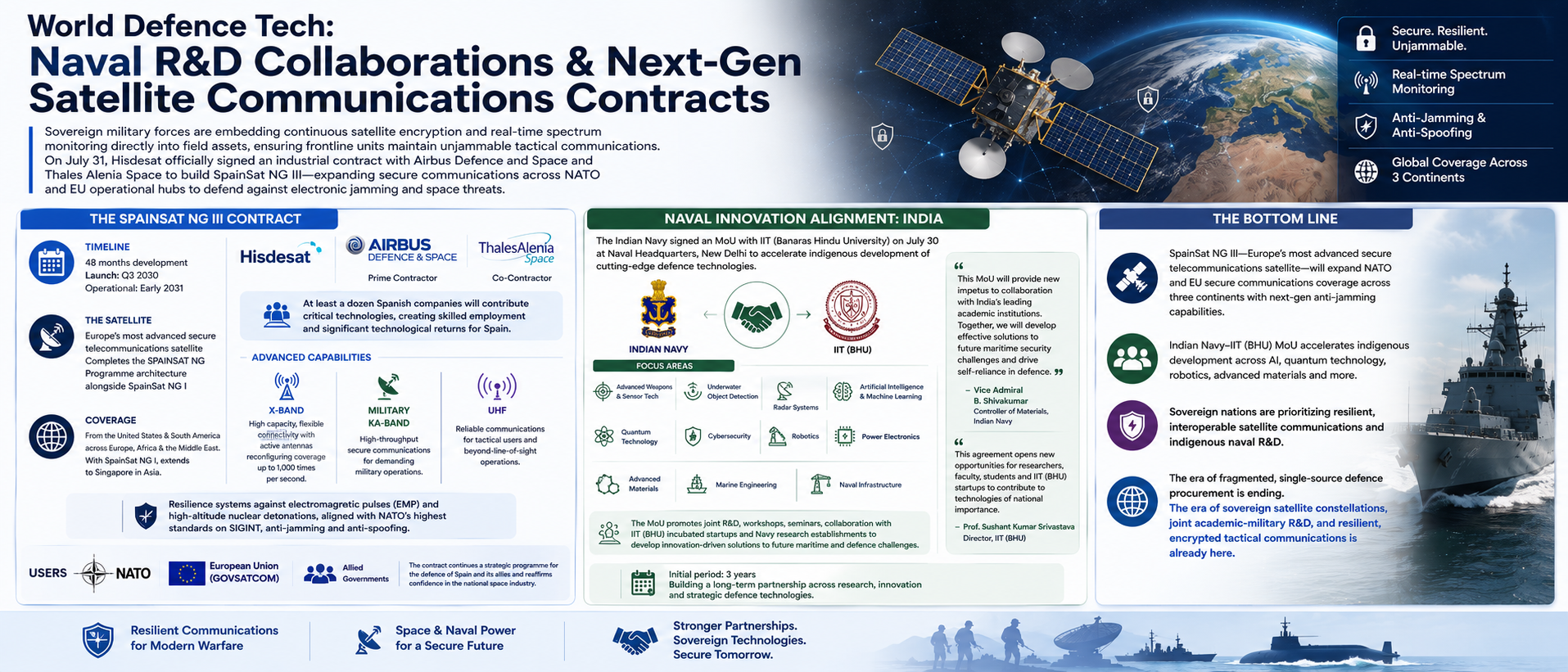
Sovereign military forces are embedding continuous satellite encryption and real-time spectrum monitoring directly into field assets, ensuring frontline units maintain unjammable tactical communications. On July 31, Hisdesat officially signed an industrial contract with Airbus Defence and Space and Thales Alenia Space to build SpainSat NG III. The secure communications satellite will expand military Ka, X, and UHF band coverage across NATO and EU operational hubs to defend against electronic jamming and space threats.
The SpainSat NG III Contract
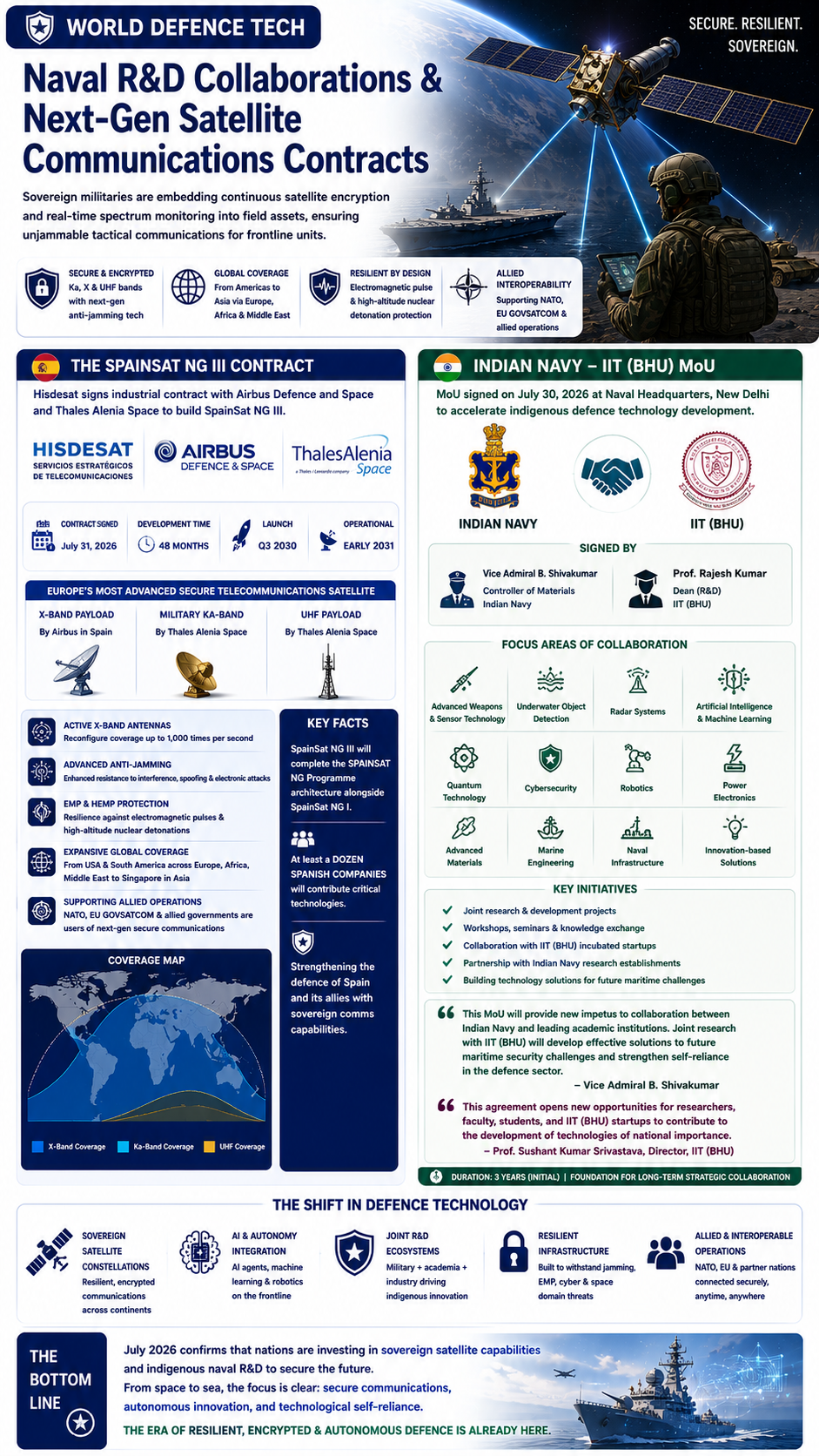
With a development timeline of 48 months, SpainSat NG III is scheduled for launch in the third quarter of 2030 and will become operational in early 2031. The satellite is billed as "Europe's most advanced secure telecommunications satellite" and will complete the SPAINSAT NG Programme architecture alongside SpainSat NG I—the largest space project driven by Spanish industry. Hisdesat has designated Airbus Defence and Space as the prime contractor, with Thales Alenia Space as co-contractor. At least a dozen Spanish companies will contribute critical technologies, creating skilled employment and significant technological returns for the country.
SpainSat NG III will offer advanced capabilities across X-band, military Ka-band, and UHF, incorporating next-generation technologies that improve operational flexibility, increase available capacity, and reinforce protection against interference and electronic threats. Airbus in Spain will be responsible for the X-band payload, while Thales Alenia Space in Spain will handle the UHF and military Ka-band payloads. The satellite's coverage area will span from the United States and South America through Europe, Africa, and the Middle East. Combined with SpainSat NG I, the system's joint capability will extend to Singapore in Asia.
Developed by Airbus in Spain, the satellite will incorporate active X-band antennas capable of reconfiguring their coverage up to 1,000 times per second. SpainSat NG-III will also carry resilience systems against electromagnetic pulses and high-altitude nuclear detonations, in line with NATO's most demanding standards on signals intelligence, anti-jamming, and anti-spoofing. NATO, the European Union through its GOVSATCOM programme, and various allied governments are already users of these new-generation secure communications services. Hisdesat noted that the contract "continues a strategic programme for the defence of Spain and its allies" and reaffirms confidence in the national space industry, which "is already an international reference in the field of secure satellite communications".
Naval Innovation Alignment
In India, the Indian Navy signed a Memorandum of Understanding (MoU) with IIT (Banaras Hindu University) at Naval Headquarters in New Delhi on July 30 to accelerate the indigenous development of cutting-edge defense technologies. The agreement was signed by Vice Admiral B. Shivakumar, Controller of Materials, Indian Navy, and Professor Rajesh Kumar, Dean (Research and Development), IIT (BHU).
Under the agreement, joint research and development will be conducted in areas including advanced weapons and sensor technology, underwater object detection, radar systems, artificial intelligence, machine learning, quantum technology, cybersecurity, robotics, power electronics, advanced materials, marine engineering, and naval infrastructure. The MoU will also promote joint workshops and seminars, collaborative research and development projects, collaboration with IIT (BHU) incubated startups, and research collaborations with Indian Navy research establishments to develop innovation-based solutions to future maritime and defense challenges.
Vice Admiral Shivakumar stated that this MoU will provide new impetus to collaboration between the Indian Navy and the country's leading academic institutions, expressing confidence that joint research with IIT (BHU) will develop effective solutions to future maritime security challenges and provide new impetus to self-reliance in the defence sector. Professor Sushant Kumar Srivastava, Director of IIT (BHU), stated that the agreement will provide new opportunities for researchers, faculty, students, and IIT (BHU) startups to contribute to the development of technologies of national importance. The agreement, initially spanning a three-year period, will provide a strong foundation for long-term collaboration across research, innovation, and strategic defense technologies.
The Bottom Line
July 2026 confirms that sovereign nations are prioritizing resilient, interoperable satellite communications and indigenous naval R&D. SpainSat NG III—"Europe's most advanced secure telecommunications satellite"—will expand NATO and EU secure communications coverage across three continents with next-generation anti-jamming capabilities. In India, the Indian Navy-IIT (BHU) MoU accelerates indigenous development across AI, quantum technology, robotics, and advanced materials. The era of fragmented, single-source defence procurement is ending. The era of sovereign satellite constellations, joint academic-military R&D, and resilient, encrypted tactical communications is already here.

Vishal Sable
B.Tech AD @ shri balaji institute of technology and management
Engineering and tech journalist. I love exploring the impact of emerging technologies on global defense, sovereignty, and everyday life. Always looking for the real story behind the headlines.