Back to News
News AlertWorld of Startup’s
NVIDIA Reports $65.5B in Non-Marketable Securities as Future AI Deals Come Into Focus
V
Author
Vicky Galfat
Published
November 18, 2026
Reading Time
9 MIN READ
Spread the Word

NVIDIA reported $65.5 billion in non-marketable securities in its latest quarterly filing. The leadership transition raises questions about the company's future AI investments, financing arrangements and support for infrastructure partners.
What Happened?
Nvidia is facing questions about the future of its startup investment strategy following the resignation of co-founder and former CEO Jensen Huang. The concerns intensified after the company disclosed $65.5 billion in non-marketable securities in its third-quarter fiscal 2027 financial results, released on November 17, 2026. The disclosure highlights the scale of Nvidia's investments in businesses outside the public markets, while its leadership transition raises questions about whether the company will continue supporting startups at the same pace. TechCrunch's investment analysis
Huang's resignation was accepted by Nvidia's board on November 11 and announced publicly on November 12. Chief Financial Officer Colette Kress was appointed interim CEO while the board began searching for a permanent replacement. Huang's departure ended his 33-year leadership of the company and created uncertainty around decisions previously associated with his involvement, including Nvidia's expanding investments in artificial intelligence startups and computing infrastructure. Nvidia's SEC Form 8-K filing
However, Nvidia's first major governance action following the transition focused on a different issue: national security. On November 17, the company announced a new board-level committee responsible for overseeing national security policies, export-control compliance and global trade risks. The development places greater emphasis on regulatory oversight as Nvidia faces increased scrutiny surrounding advanced AI chip exports and its international business relationships. Nvidia's official committee announcement
What Does the Source Say?
The $65.5 billion figure requires an important financial distinction. Nvidia's third-quarter balance sheet reports $65.528 billion under non-marketable securities, compared with $22.251 billion at the end of its previous fiscal year. These are securities that are not traded on public markets. The figure should not automatically be described as cash invested exclusively in startups because the accounting category is broader than a dedicated startup investment fund. Nvidia's Q3 FY2027 financial statements
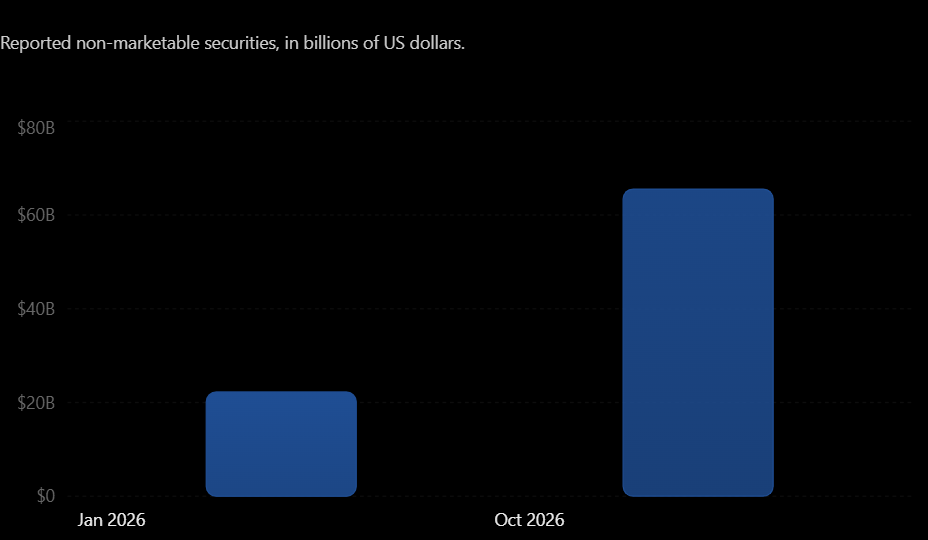
The company's cash-flow statement provides another important number. Nvidia reported purchasing approximately $58.1 billion in equity securities during the first nine months of fiscal 2027, compared with approximately $5 billion during the corresponding period of the previous fiscal year. These purchases include equity securities beyond just private startup investments. Nvidia's Q3 FY2027 financial statements
According to TechCrunch, Nvidia has invested in nearly 350 startups over approximately three years, based on PitchBook data. Its portfolio includes major AI developers such as OpenAI and Anthropic, alongside AI infrastructure providers, cloud computing businesses and robotics companies. This investment activity has helped Nvidia develop relationships across the broader AI ecosystem. TechCrunch's report on Nvidia's investment portfolio
The company's strategy extends beyond buying equity. Nvidia has also participated in financing arrangements and guarantees supporting AI infrastructure development. TechCrunch reported that Nvidia disclosed $118 billion in guarantees, including a $105 billion backstop associated with OpenAI's planned $500 billion Ohio data centre project. These figures describe financial commitments and guarantees, not equivalent amounts of completed cash investment. TechCrunch's investment and financing report
The national security committee is chaired by board director Suzanne Nora Johnson, with Stephen C. Neal and John O. Dabiri serving as members. It will meet at least quarterly and work with independent legal, national security and global trade compliance experts. Nvidia's existing National Security Team and Global Trade Compliance Team will report to the committee, while also reporting to interim CEO Colette Kress for day-to-day operations. Nvidia's official committee announcement
Importantly, this is a corporate governance and compliance initiative, not an announcement that Nvidia has invested in a new national security technology startup. The distinction matters when evaluating the company's first major move after Huang's departure. TechCrunch's coverage
What Is Still Unknown?
The biggest unanswered question concerns the future of NVentures, Nvidia's corporate venture capital arm. The company has not announced a complete replacement investment strategy following Huang's resignation. It remains unclear whether the company will maintain its previous investment frequency, reduce the size of individual investments or concentrate more heavily on established businesses. TechCrunch's investment analysis
Another uncertainty involves how much influence Huang personally had over individual investment decisions. Investors interviewed by TechCrunch suggested that many significant startup investment decisions were closely associated with Huang. However, this does not establish that every investment required his personal approval or that the company's investment operations cannot continue without him. TechCrunch's reporting on Huang's departure and startup funding
The company has also not disclosed a detailed breakdown of the $65.5 billion non-marketable securities balance by individual startup, investment category or valuation methodology in the cited announcement. Consequently, readers cannot use that single figure to determine how much Nvidia has invested specifically in early-stage AI companies or how much of the reported increase comes from new purchases rather than valuation changes. Nvidia's Q3 FY2027 financial statements
Finally, the effectiveness of the new national security committee remains untested. Its announcement establishes responsibilities and reporting arrangements, but does not demonstrate that Nvidia has already resolved its export-control risks or completed any investigation into the circumstances surrounding Huang's departure. Nvidia's committee announcement
Why Does It Matter?
Nvidia's investment activity has become an important part of the AI startup financing ecosystem. Young companies developing AI models, computing infrastructure and robotics frequently require substantial financial resources before generating consistent revenue. Nvidia's participation can provide capital and strengthen commercial relationships with businesses that may eventually become customers or partners within its technology ecosystem. TechCrunch's reporting on Nvidia's startup investments
A change in investment priorities could therefore affect more than Nvidia's financial portfolio. If the company becomes more selective, startups that previously expected Nvidia's participation may need to seek additional funding from traditional venture capital firms, other technology companies or infrastructure financiers. This could make fundraising more difficult for businesses that depend heavily on Nvidia's financial and technical ecosystem. TechCrunch's startup funding analysis
The national security committee introduces another important dimension. Advanced AI chips are strategically significant because they support large-scale computing, AI model development and data-centre infrastructure. Restrictions on where these chips can be sold, deployed or accessed can influence Nvidia's international business operations. Stronger board-level oversight could help the company manage regulatory exposure while maintaining relationships with international customers. Reuters' reporting on the committee
There is also a wider corporate governance question. Nvidia's transition demonstrates how leadership decisions at a major technology company can affect businesses that depend on its investment capital, products and strategic partnerships. For investors and startup founders, understanding the company's new decision-making structure may become just as important as tracking its financial performance.
Our Analysis
Nvidia's situation presents two connected but different challenges: maintaining its influence across the AI startup ecosystem and strengthening its corporate governance.
The $65.5 billion non-marketable securities balance demonstrates the scale of Nvidia's exposure to privately traded investments. However, the increase from $22.25 billion should not be interpreted entirely as fresh startup funding. The company's own reporting shows that equity purchases and changes in investment values both matter when assessing the growth of its holdings. This distinction is important because the headline portfolio figure alone cannot establish how aggressively Nvidia will invest in the future. Nvidia's financial results
Colette Kress's comments provide an early indication of how the financial strategy could evolve. During the November 17 earnings call, she said Nvidia would continue providing financing assistance to strong customers but would rigorously evaluate future investments, commitments and guarantees as the market matures. She also said the company intended to return excess free cash flow, after strategic uses, to shareholders. This suggests a more explicit emphasis on evaluating capital allocation rather than assuming that previous investment levels will continue indefinitely. TechCrunch's coverage of the earnings call
The national security committee may be equally significant for Nvidia's longer-term business strategy. Export-control compliance is not simply a legal responsibility for a company selling advanced computing hardware internationally. It also affects customer relationships, market access and the ability to operate across different regulatory environments. Giving these responsibilities direct board-level oversight could strengthen accountability and make risk management a more visible part of corporate decision-making. Nvidia's official committee announcement
Our assessment is that Nvidia does not necessarily need to abandon its startup investment strategy to become more cautious. A more selective approach could preserve investments in strategically important companies while reducing exposure to businesses with uncertain financial models or heavy dependence on continuous external financing.
The next important indicators will be the size and frequency of new NVentures investments, the company's future disclosures about equity holdings, its financing commitments to AI infrastructure providers and the practical results of its new compliance oversight structure.
Ultimately, Nvidia's challenge is not simply replacing Jensen Huang. It is maintaining the investment ecosystem and strategic influence built during his leadership while establishing a more accountable approach to capital allocation and national security.
Sources and References
NVIDIA Announces CEO Transition
NVIDIA Corporation Form 8-K
NVIDIA Announces Financial Results for Third Quarter Fiscal 2027
NVIDIA Board of Directors Establishes National Security and Export Control Oversight Committee
Nvidia’s Startup Stakes Ballooned to $65B, but Huang’s Exit Puts Future Deals in Doubt
Jensen Huang’s Departure Blasts Big Hole in AI Startup Funding, VCs and Founders Say
Nvidia's First Big Move After Jensen Huang's Exit Targets National Security
Nvidia Board Forms Committee for National Security and Export Control Oversight

Vicky Galfat
University of Mumbai/BCA
Learning, building, and exploring the world of technology one project at a time.