Back to News
News AlertWorld Defence Tech
Oracle and NATO Allies Drive the Sovereign Defense Cloud Standard
V
Author
Vishal Sable
Published
July 28, 2026
Reading Time
4 MIN READ
Spread the Word
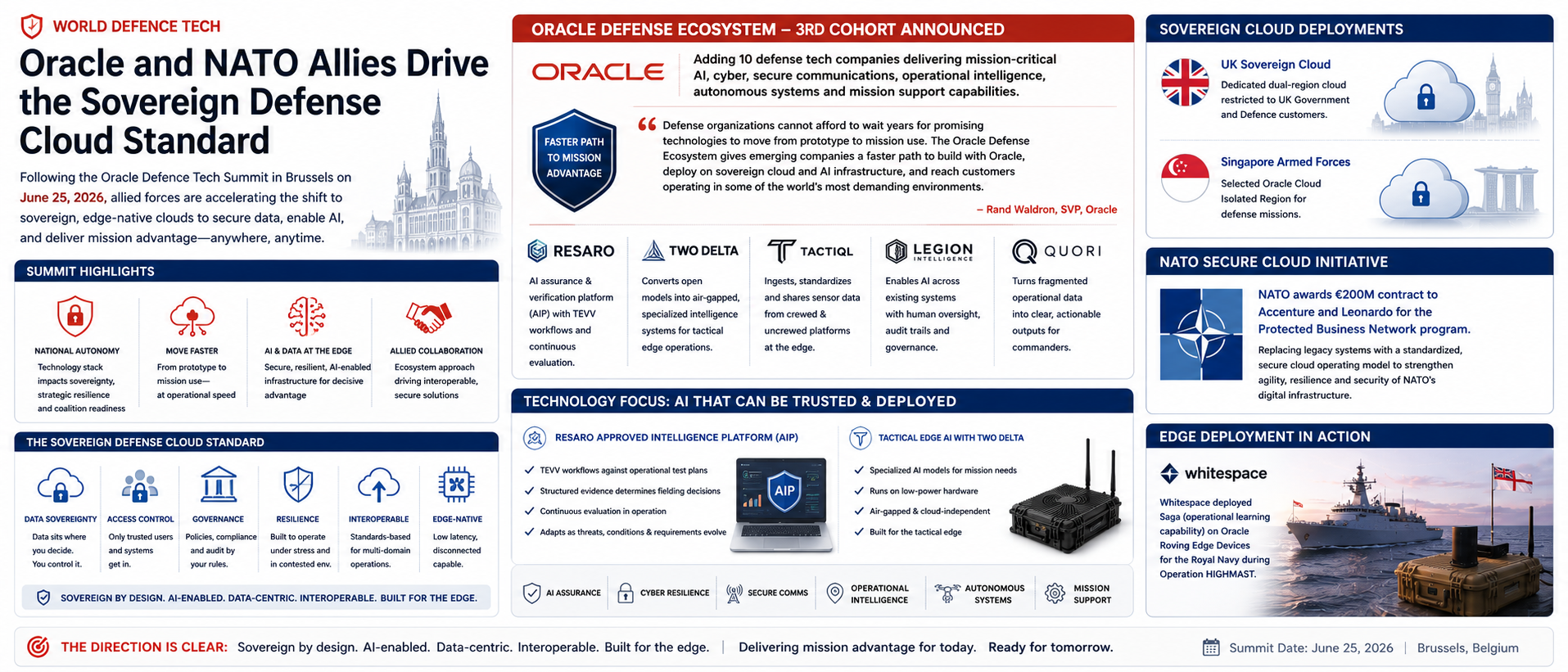
Defense technology is prioritizing total data sovereignty and edge-native resilience over generic cloud platforms. Following high-level briefings at the Oracle Defence Tech Summit in Brussels on June 25, 2026, allied forces are aggressively deploying sovereign defense clouds. The event brought together defense leaders, public sector decision makers, and defense technology startups to address what organizers called one of the most urgent questions facing the sector: how to move critical technology from promising concept to operational advantage, faster.
The Latest News
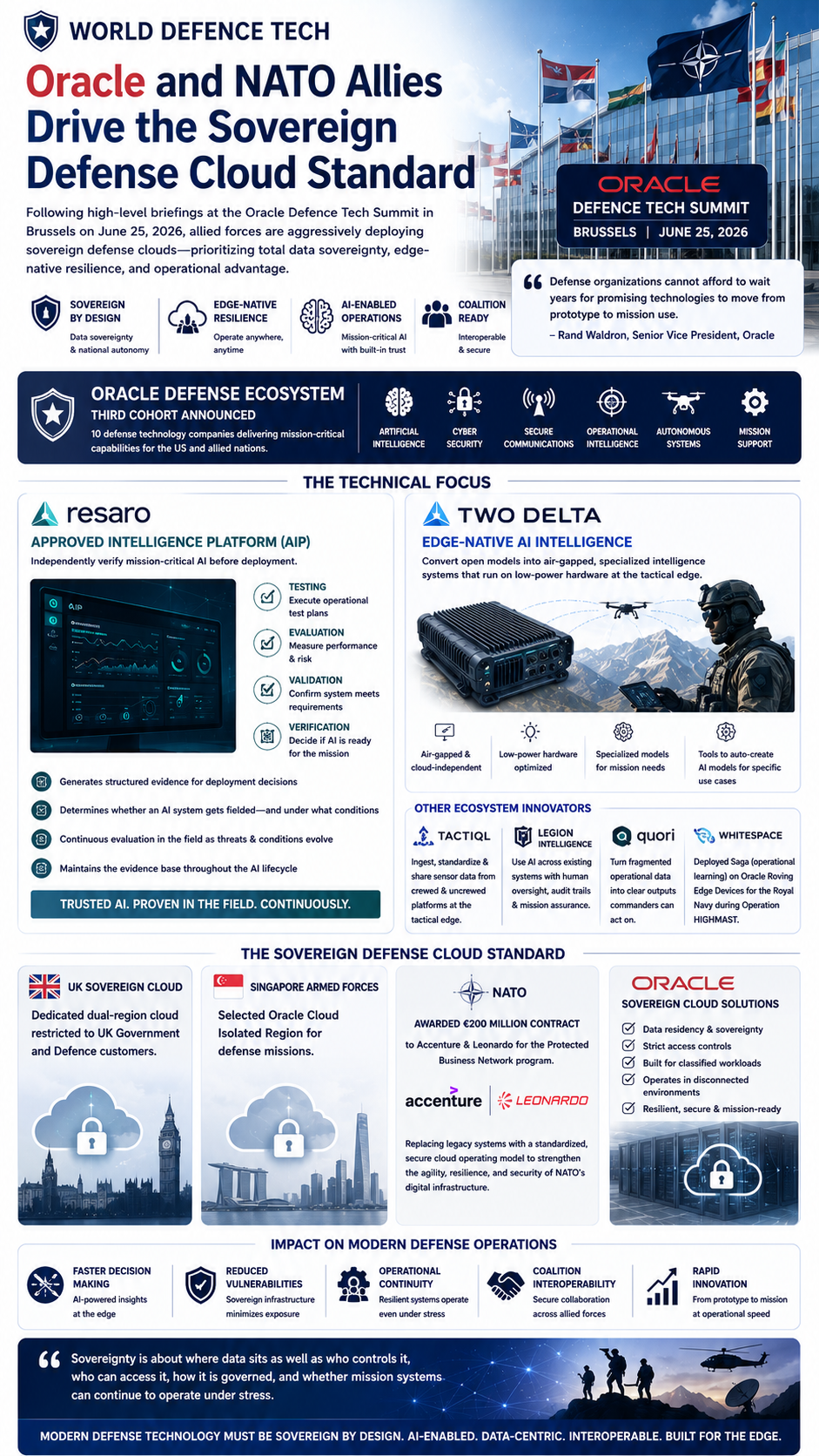
The summit underscored that defense organizations cannot treat cloud, AI, and data infrastructure as generic IT decisions—rather, the technology stack affects national autonomy, strategic vulnerabilities, coalition readiness, and the ability to respond when conditions change. Oracle announced the third cohort of its Oracle Defense Ecosystem, adding 10 defense technology companies delivering mission-critical AI, cyber, secure communications, operational intelligence, autonomous systems, and mission support capabilities for the US and allied nations. "Defense organizations cannot afford to wait years for promising technologies to move from prototype to mission use," said Rand Waldron, senior vice president at Oracle. "The Oracle Defense Ecosystem gives emerging defense and dual-use companies a faster path to build with Oracle, deploy on sovereign cloud and AI infrastructure, and reach customers operating in some of the world's most demanding environments".
The Technical Focus
Systems like Resaro's Approved Intelligence Platform (AIP) are now being integrated to independently verify mission-critical AI before deployment. The platform runs Testing, Evaluation, Validation and Verification (TEVV) workflows against operational test plans and produces structured evidence that determines whether an AI system gets fielded—and under what conditions. Defense agencies, government bodies, and critical infrastructure operators use AIP to generate the deployment evidence that determines whether an AI system gets fielded—and under what conditions. The platform does not exit at deployment; it runs continuous evaluation as systems operate, maintaining the evidence base as conditions, threats, and requirements evolve.
Meanwhile, platforms like Two Delta are converting open models into air-gapped, specialized intelligence systems capable of running on low-power hardware at the tactical edge without external cloud connectivity. The company is developing tools that automatically create specialized AI models for specific use cases. The ecosystem also includes Tactiql, which builds software to make sensor data from crewed and uncrewed platforms easier to ingest, standardize, and share at the tactical edge; Legion Intelligence, which helps defense and national security teams use AI across existing systems with human oversight and audit trails; and Quori, which turns fragmented operational data into clear outputs commanders can act on.
The Sovereign Defense Cloud Standard
NATO and allied nations are moving aggressively toward sovereign cloud infrastructure. Oracle has already deployed sovereign cloud solutions for multiple defense customers, including the UK Sovereign Cloud—a dedicated dual-region cloud restricted to UK Government and Defence customers—and the Singapore Armed Forces' selection of Oracle Cloud Isolated Region for defense missions. NATO itself has awarded a €200 million contract to Accenture and Leonardo for the Protected Business Network program, which will replace legacy systems with a standardized, secure cloud operating model designed to strengthen the agility, resilience, and security of NATO's digital infrastructure.
Building on earlier momentum, ecosystem member Whitespace recently deployed Saga, its operational learning capability, on Oracle Roving Edge Devices to support classified workloads for the Royal Navy during Operation HIGHMAST, bringing sovereign AI capabilities directly to the mission edge. As the summit's organizers noted, sovereignty is about where data sits as well as who controls it, who can access it, how it is governed, and whether mission systems can continue to operate under stress. The Oracle Defence Tech Summit showed the direction modern defense technology must take: it must be sovereign by design, AI-enabled, data-centric, interoperable, and built for the edge.

Vishal Sable
B.Tech AD @ shri balaji institute of technology and management
Engineering and tech journalist. I love exploring the impact of emerging technologies on global defense, sovereignty, and everyday life. Always looking for the real story behind the headlines.