LATEST NEWS
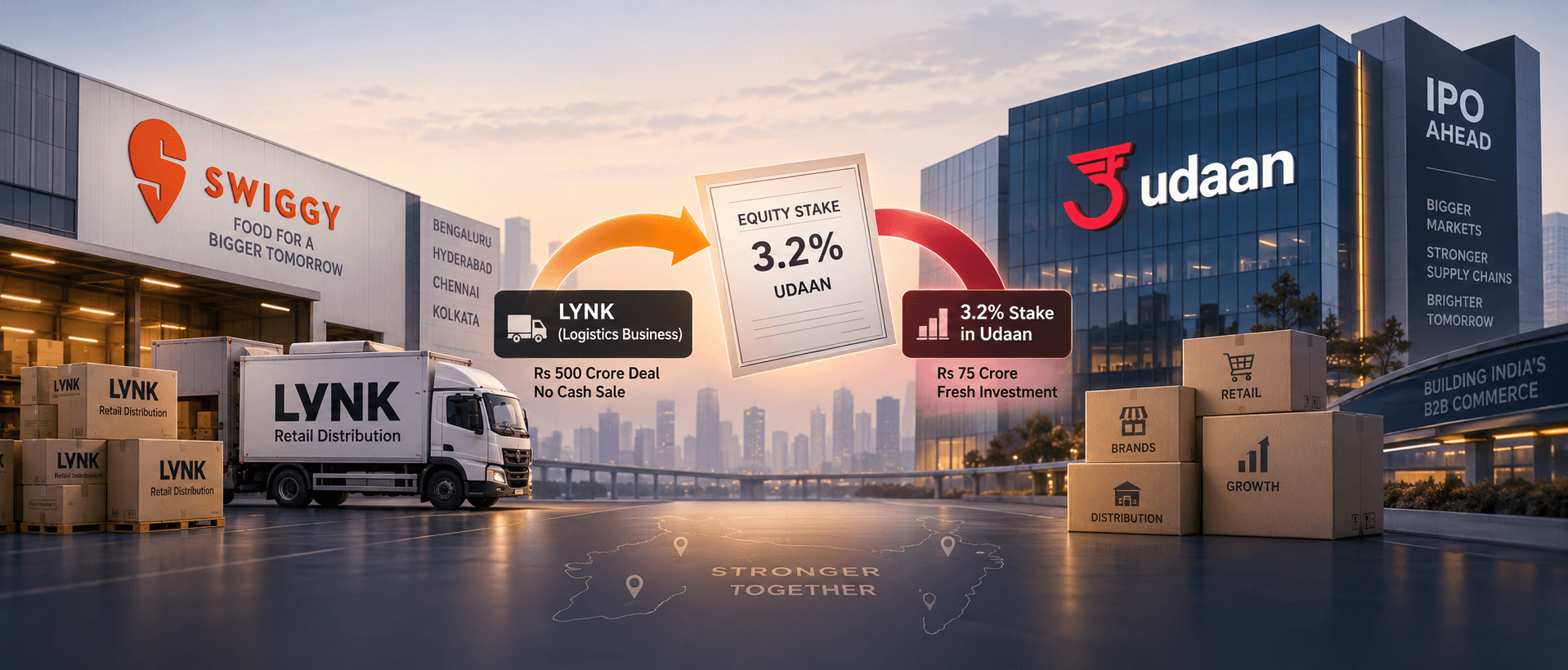
Swiggy Didn't Sell Its B2B Arm for Cash — It Bought Into the Company Buying It
September 9, 2026 5M
Back to News
News AlertWorld of Startup’s
"Physical AI" and Humanoid Robotics Capture Early-Stage Venture Dominance
V
Author
Vishal Sable
Published
August 22, 2026
Reading Time
8 MIN READ
Spread the Word
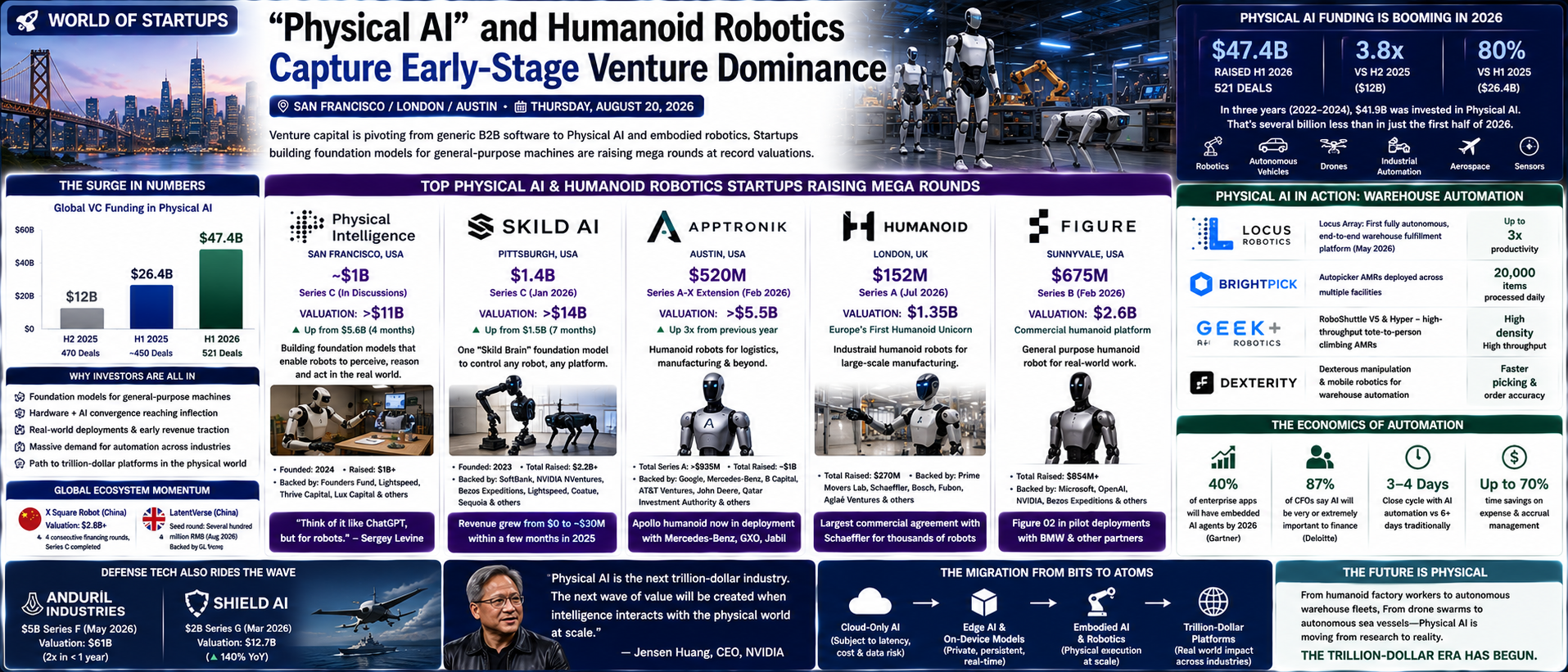
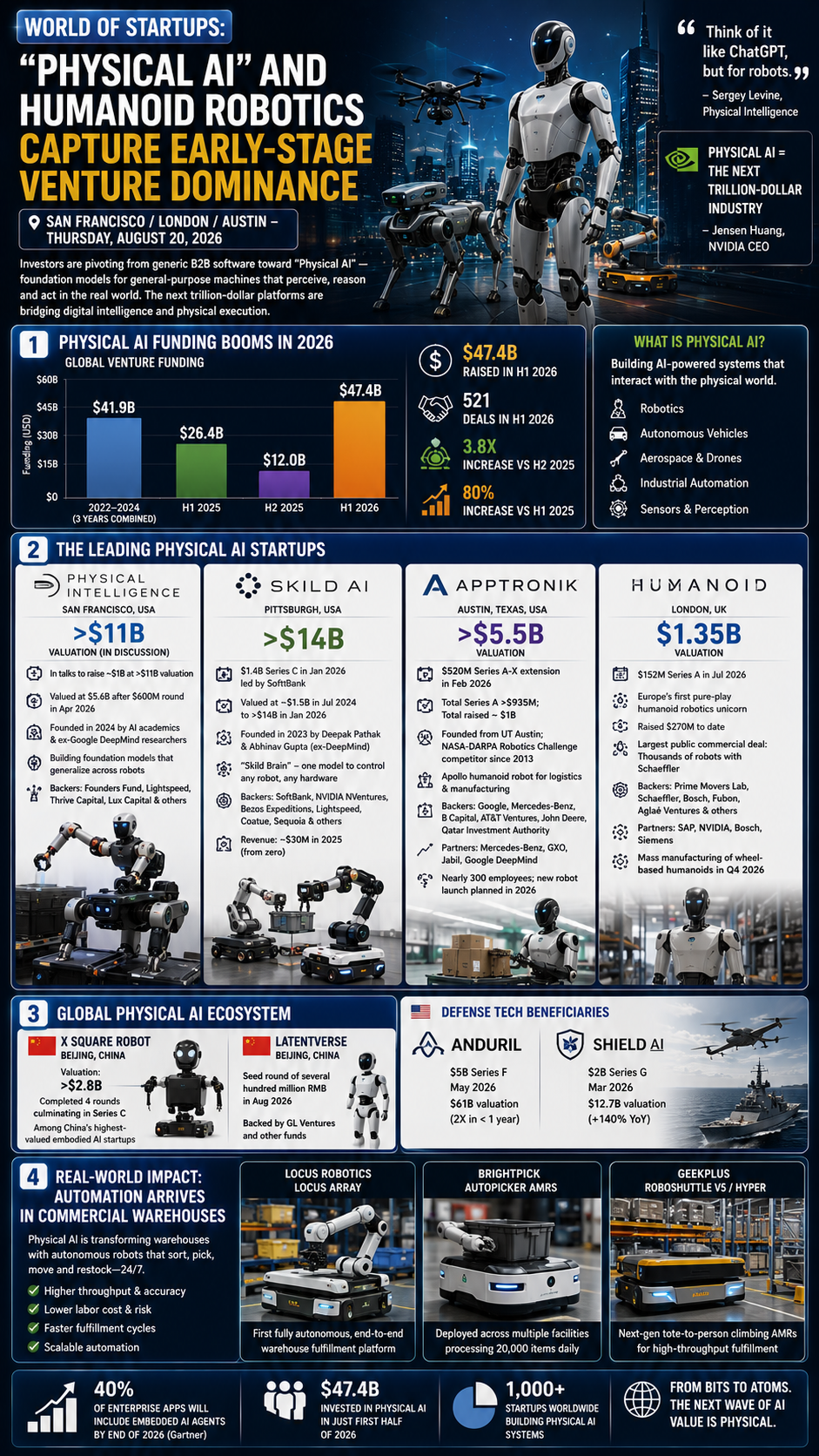
The venture capital landscape has undergone a decisive structural shift as investors pivot decisively from generic B2B software toward "Physical AI" and embodied robotics. Startups building foundation models for general-purpose machines—capable of perceiving, reasoning, and acting in the physical world—are securing massive early-stage rounds at valuations that would have been unthinkable for hardware-focused companies just two years ago. The migration reflects a broader recognition that the next trillion-dollar technology platforms will be those that bridge the gap between digital intelligence and physical execution.
THE HARDWARE MIGRATION: Billions Flow into Physical AI
Venture funding to physical AI companies is booming in 2026 at an unprecedented scale. In the first half of 2026 alone, global venture funding in the space totaled $47.4 billion across 521 deals. That represents an almost fourfold increase compared to the second half of 2025, when physical AI startups raised $12 billion across 470 deals, and an 80% jump from the $26.4 billion raised in the first half of 2025. To put this in perspective, in the three years spanning 2022 to 2024 combined, venture investors put a total of $41.9 billion into physical AI companies—still several billion less than what has been raised in just the first half of 2026 alone. The category encompasses robotics, autonomous vehicles, aerospace, drones, industrial automation, and sensors.
The surge is being driven by a handful of multibillion-dollar megadeals, with robotics foundation model startups commanding particular attention. Physical Intelligence, the two-year-old San Francisco robotics startup founded by AI academics and former Google DeepMind researchers, is in discussions to raise about $1 billion in new funding at a valuation exceeding $11 billion. If completed, the round would effectively double the company's valuation in just four months, following a $600 million haul that valued it at $5.6 billion. Co-founder Sergey Levine has described the company's ambition simply: "Think of it like ChatGPT, but for robots". The company has raised over $1 billion across three rounds in under two years and counts Founders Fund, Lightspeed Venture Partners, Thrive Capital, and Lux Capital among its backers.
SKILD AI: From Zero to $14 Billion in Record Time
Perhaps no company better exemplifies the Physical AI frenzy than Skild AI. Founded in 2023 by Deepak Pathak and Abhinav Gupta, the company emerged from stealth in July 2024 with a $300 million Series A that valued it at $1.5 billion. A Series B followed, pushing valuation to around $4.5 billion, and then came the Series C. In January 2026, Skild AI raised $1.4 billion in a Series C round led by SoftBank, with participation from NVIDIA's NVentures, Bezos Expeditions, Lightspeed, Coatue, and Sequoia Capital, catapulting its valuation to over $14 billion. That represented the largest reported robotics AI funding round to date and tripled the company's valuation in just seven months. Including its seed round of approximately $14.5 million, Skild has now raised more than $2.2 billion in total funding.
The company's revenue trajectory helps explain the investor enthusiasm: Skild went from zero revenue to approximately $30 million within a few months during 2025. Skild's fundamental bet is that a single, hardware-agnostic foundation model—the "Skild Brain"—can control any robot without custom training for each platform. In April 2026, the company bolstered this vision by acquiring Zebra Technologies' Robotics Automation business (formerly Fetch Robotics), bringing warehouse-focused assets and fleet management software into its portfolio. The Skild Brain is designed to operate quadrupeds, humanoids, tabletop arms, and mobile manipulators, handling everything from household chores like cleaning and loading a dishwasher to physically demanding challenges such as navigating slippery terrain.
APPTRONIK: Humanoid Robotics at Scale
In the humanoid robotics segment, Apptronik has emerged as a dominant force. The University of Texas at Austin spinout, which has been working on humanoid robots since competing in the NASA-DARPA Robotics Challenge in 2013, announced a $520 million Series A-X extension round in February 2026. The extension followed a $415 million oversubscribed initial Series A raised in 2025, bringing Apptronik's total Series A funding to over $935 million and total capital raised to nearly $1 billion. The round valued the company at more than $5.5 billion—triple its valuation from the previous year. Investors included Google, Mercedes-Benz, B Capital, AT&T Ventures, John Deere, and the Qatar Investment Authority.
The company's humanoid robot, Apollo, is designed to collaborate with humans in logistics and manufacturing, handling physically demanding tasks such as transporting components, sorting, and kitting, with future planned expansion into retail, healthcare, and eventually the home. Apptronik has established partnerships with Mercedes-Benz, GXO Logistics, and Jabil, and maintains a strategic partnership with Google DeepMind to build next-generation humanoid robots powered by Gemini Robotics. The company now employs nearly 300 people and plans to unveil a new robot in 2026.
EUROPE'S FIRST HUMANOID UNICORN: Humanoid
The Physical AI wave has also reached Europe. Humanoid, a UK-based AI and robotics company building industrial humanoid robots, announced a $152 million Series A financing in July 2026 at a $1.35 billion post-money valuation, becoming Europe's first pure-play humanoid robotics unicorn. The round was led by Prime Movers Lab, with participation from Schaeffler, Bosch, Fubon Financial Holding Venture Capital, and Aglaé Ventures. The company has now raised $270 million to date and has secured major partnerships with SAP, NVIDIA, Bosch, and Siemens.
Notably, Humanoid recently signed the industry's largest publicly announced commercial agreement with Schaeffler for the large-scale deployment of thousands of humanoid robots in manufacturing environments. Founder and CEO Artem Sokolov described the achievement: "In just two years, we've gone from an idea to becoming Europe's first pure-play humanoid robotics unicorn, partnered with some of the world's leading industrial companies". The new capital will fund the development and launch of its next-generation humanoid robotics platform and begin mass manufacturing of wheel-based humanoid robots in Q4 2026.
THE BROADER ECOSYSTEM: Global Momentum
The Physical AI surge is a global phenomenon. China's X Square Robot completed four consecutive financing rounds culminating in a Series C, bringing its valuation to over $2.8 billion and positioning the company among China's highest-valued embodied AI startups. In August 2026, LatentVerse, a Beijing-based embodied foundation model company founded by researchers from Tsinghua University's Institute for Interdisciplinary Information Sciences, completed a seed round of several hundred million RMB with backing from GL Ventures and other funds.
The defense tech sector has also been a major beneficiary of the Physical AI pivot. Anduril Industries raised $5 billion in May 2026 at a $61 billion valuation—double its valuation from less than a year earlier. Shield AI landed a $2 billion Series G round in March 2026, with its valuation jumping to $12.7 billion. These defense-focused physical AI companies are building autonomous systems that operate in the real world, from drone swarms to autonomous sea vessels, further validating the thesis that the next wave of AI value creation lies in the physical domain.
DAILY ROUTINE IMPACT: Automation Arrives in Commercial Warehouses
For businesses and logistics operators, the Physical AI wave is already translating into tangible operational changes. Startups are deploying autonomous mobile robots and modular micro-manipulators across commercial warehouses, automating package sorting, localized inventory restocking, and repetitive mechanical handling. Locus Robotics launched Locus Array in May 2026, a system described as the first fully autonomous, end-to-end warehouse fulfillment platform, combining mobile robots, picking arms, and AI perception in one fleet. Brightpick has deployed its Autopicker autonomous mobile robots across multiple facilities, with one system processing 20,000 items daily. Geekplus introduced RoboShuttle V5 and RoboShuttle Hyper, next-generation tote-to-person climbing AMR solutions designed for high-throughput warehouse fulfillment.
The economics are compelling. Gartner forecasts that 40% of enterprise applications will include embedded task-specific AI agents by the end of 2026. As warehouse robotics deployments accelerate, the automation of physical tasks is no longer a futuristic vision but a present reality—one that is reshaping how goods are sorted, stored, and shipped across global supply chains.
The convergence of massive venture capital, technical breakthroughs in foundation models, and proven commercial deployments signals that Physical AI has moved decisively from research curiosity to mainstream investment thesis. As Nvidia CEO Jensen Huang has declared, physical AI is "the next trillion-dollar industry". With $47.4 billion already deployed in the first half of 2026 and a pipeline of startups racing to build the "brains" for everything from humanoid factory workers to autonomous warehouse fleets, the migration from bits to atoms is well underway.

Vishal Sable
B.Tech AD @ shri balaji institute of technology and management
Engineering and tech journalist. I love exploring the impact of emerging technologies on global defense, sovereignty, and everyday life. Always looking for the real story behind the headlines.