Back to News
News AlertWorld of Startup’s
Prevention-First Cyber Platforms and AI Infrastructure Draw Billions
V
Author
Vishal Sable
Published
July 27, 2026
Reading Time
3 MIN READ
Spread the Word
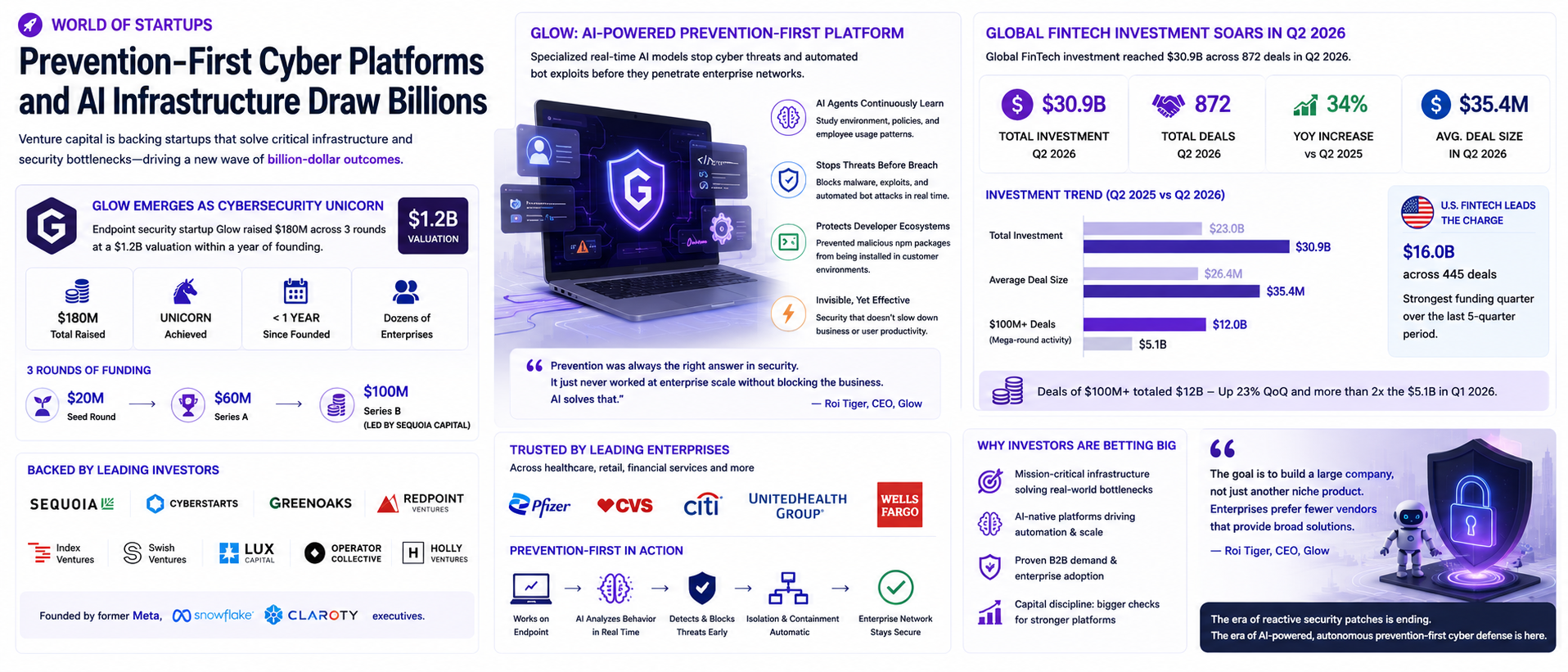
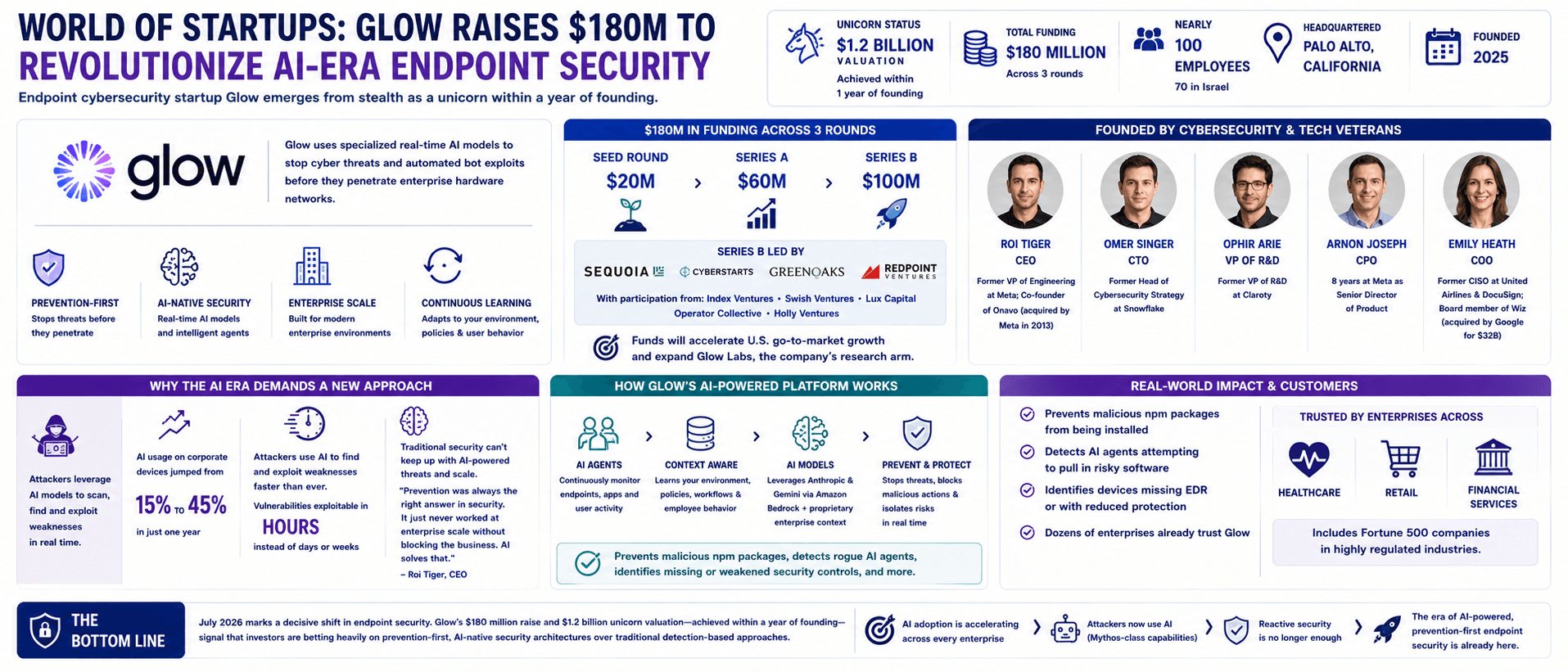
Venture capital is heavily favoring startups that solve critical infrastructure and security bottlenecks. Endpoint security startup Glow emerged from stealth on July 22 with $180 million in funding across three rounds—a $20 million seed, a $60 million Series A, and a $100 million Series B—at a $1.2 billion valuation, becoming a unicorn within a year of its founding. The Series B was led by Sequoia Capital, Cyberstarts, Greenoaks, and Redpoint Ventures, with participation from Index Ventures, Swish Ventures, Lux Capital, Operator Collective, and Holly Ventures. Founded by former Meta, Snowflake, and Claroty executives, Glow uses specialized real-time AI models to stop cyber threats and automated bot exploits before they penetrate enterprise hardware networks. "Prevention was always the right answer in security. It just never worked at enterprise scale without blocking the business. AI solves that," said CEO Roi Tiger. The platform uses AI agents that continuously study the organization's work environment, security policies, and employee usage patterns, and has already prevented malicious npm packages from being installed in customer environments while detecting AI agents attempting to pull in such software.
Meanwhile, FinTech Global data reveals that global FinTech investment in Q2 2026 reached $30.9 billion across 872 deals, a 34% surge compared to the $23 billion raised in Q2 2025. Average deal sizes jumped to $35.4 million as institutional investors concentrate capital into proven B2B platforms. US FinTech companies captured $16 billion across 445 deals in Q2, making it the strongest funding quarter over the last five-quarter period. Deals of $100 million or more totaled $12 billion, up 23% quarter-over-quarter and more than double the $5.1 billion in mega-round activity seen in Q1. The shift reflects a broader market discipline: investors are backing proven infrastructure rather than spreading smaller chips across speculative ventures. Early-stage cybersecurity startups are also benefiting—Glow said it already works with dozens of enterprises, including Fortune 500 companies in healthcare, retail, and financial services.
Early-stage startups are replacing reactive security patches with continuous background AI. In everyday office environments, autonomous security models actively isolate malicious software threats on local devices before they can disrupt corporate networks. Glow's prevention-first architecture ensures security becomes invisible to end users while remaining effective against AI-speed attacks. "The goal is to build a large company, not just another niche product," Tiger said, noting that enterprises prefer to work with fewer vendors that provide broad solutions rather than purchasing a long list of dedicated products. July 2026 confirms that cybersecurity investment is pivoting sharply toward prevention-first, AI-native architectures. The era of reactive security patches is ending. The era of AI-powered, autonomous prevention-first cyber defense is already here.