Back to News
News AlertWorld Defence Tech
Satellite Constellations & Defense-Tech Expansion
V
Author
Vishal Sable
Published
August 9, 2026
Reading Time
4 MIN READ
Spread the Word
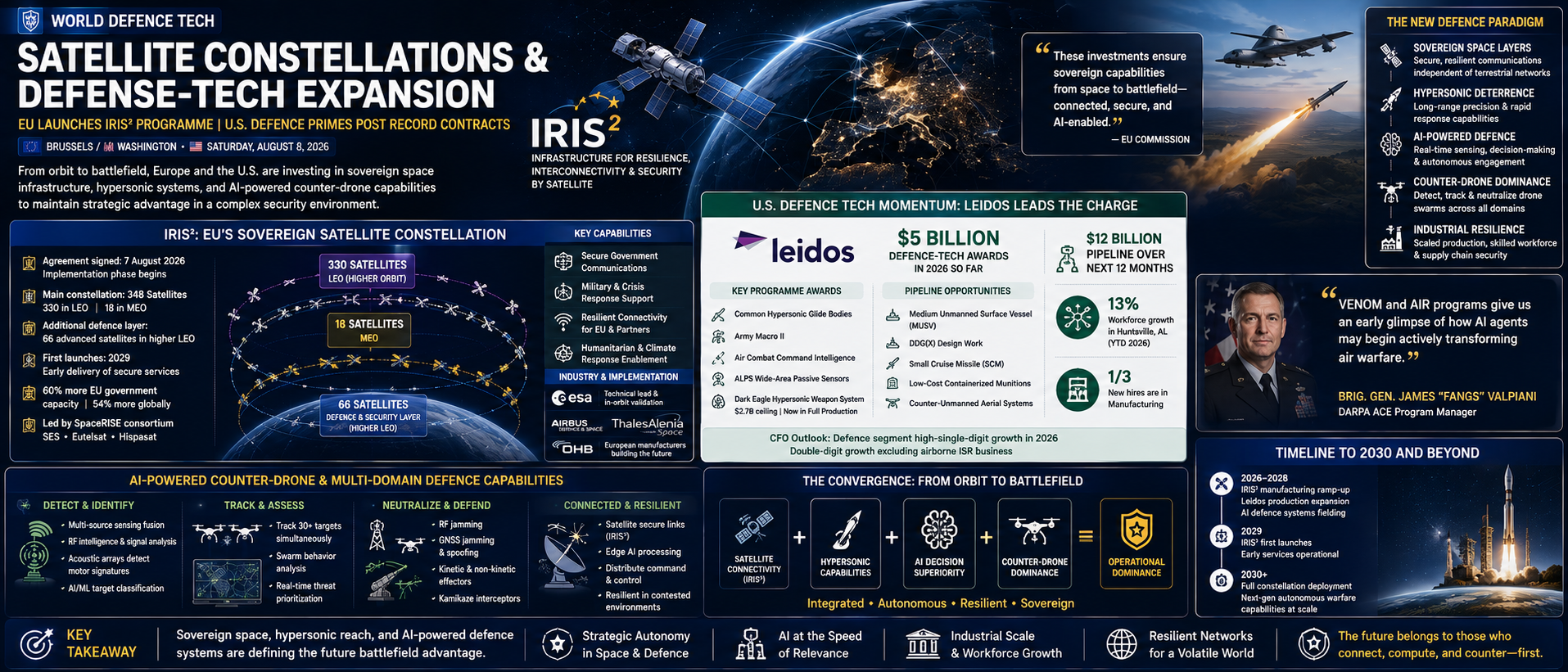
The global defence landscape is being reshaped from orbit to battlefield as the European Union locks in its sovereign satellite architecture and American defence primes post record contract volumes, with both hemispheres racing to deploy AI-powered countermeasures against the proliferating drone threat. The European Commission and the SpaceRISE consortium concluded negotiations on 7 August and signed an implementation agreement to roll out IRIS², the EU's flagship secure satellite constellation, moving the programme from planning to full-scale deployment after negotiations that began in January 2026. The agreement expands the main constellation to 348 satellites, comprising 330 satellites in higher Low Earth Orbit (LEO) and 18 in Medium Earth Orbit (MEO), with additional optional elements that can be deployed to support specific missions if required. The revised schedule brings first launches forward to 2029 and enables early delivery of sovereign, secure, and accredited European connectivity services. To respond to a deteriorating security environment, the Commission is expanding IRIS²'s governmental capacity beyond original plans, adding a dedicated layer of 66 advanced satellites in higher LEO specifically for defence, security, and emergency services. This reinforcement will increase secure governmental communications capacity by 60% within the EU and 54% worldwide, significantly expanding Europe's ability to support operations during crises. Defence and security applications are the primary drivers of these changes, though the system will also support humanitarian responses to climate-related pressures, displacement, and environmental degradation. ESA plays a key role in technical implementation, overseeing the constellation's development, qualification, and in-orbit validation, with the SpaceRISE consortium—comprising SES, Eutelsat, and Hispasat—and European manufacturers including Airbus Defence and Space, Thales Alenia Space, and OHB committed to delivering the required infrastructure.
While Europe secures its orbital sovereignty, American defence-technology momentum shows no signs of abating. Leidos has secured $5 billion in defence-technology awards so far in 2026, Chief Executive Officer Tom Bell told analysts during the company's second-quarter earnings call on 4 August. The work spans hypersonic systems, military intelligence, identification technology, and passive wide-area sensors. Specific programmes cited include Common Hypersonic Glide Bodies, Army Macro II, Air Combat Command Intelligence, and ALPS wide-area passive sensor production. The Dark Eagle long-range hypersonic weapon programme alone shifted to full-production status with Leidos at a $2.7 billion ceiling, moving from an other-transaction authority mechanism to a formal Federal Acquisition Regulation contract. Looking ahead, management has identified a $12 billion pipeline of defence-technology opportunities over the next 12 months, including follow-on work and potential new production contracts for the Navy's Medium Unmanned Surface Vessel, DDG(X) design work, Small Cruise Missile, and Low-Cost Containerized Munitions. Counter-unmanned aerial systems represent another significant growth vector, with Bell noting Leidos has capabilities for detecting unmanned aircraft and producing non-kinetic effects against them. The company is expanding its workforce in Huntsville, Alabama, to support expected increases in defence production, with employment there rising 13% since the start of the year, one-third of whom are manufacturing personnel. Chief Financial Officer Chris Cage said the broader Defence segment should post high-single-digit growth in 2026, with double-digit growth expected when excluding the airborne intelligence, surveillance, and reconnaissance business.
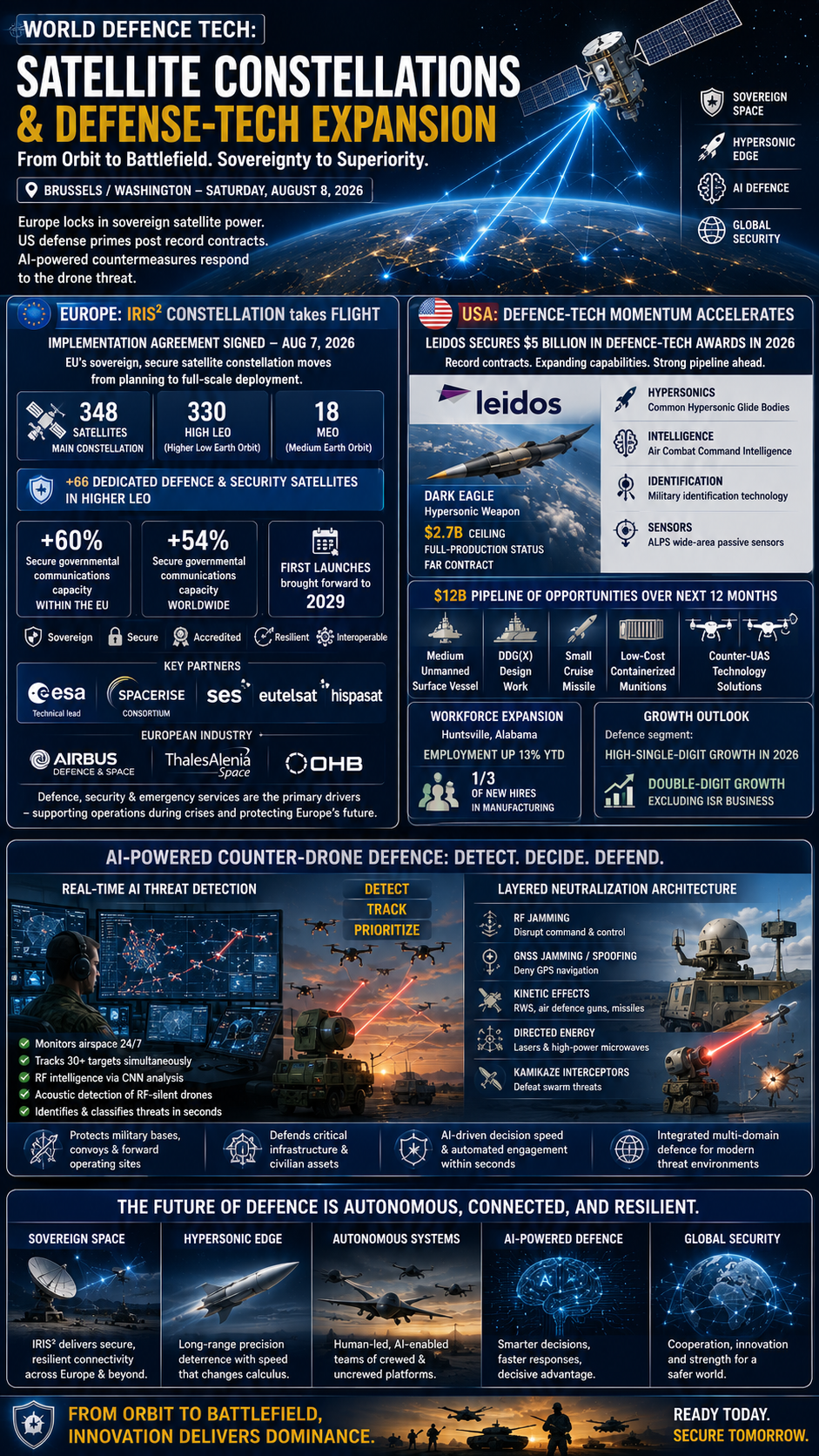
For military commanders and defence operators on the ground, these strategic investments translate into increasingly automated and AI-driven defensive capabilities deployed in real time. Military commands are deploying real-time AI signal processors to monitor airspace and neutralize hostile drone swarms before they reach ground targets, integrating multi-source sensing with machine learning to identify and engage aerial threats within seconds. Modern counter-drone platforms can track more than 30 targets simultaneously in swarm scenarios, using RF intelligence modules that analyse drone communication signals through convolutional neural networks, while acoustic arrays detect motor harmonic signatures of even RF-silent drones. Layered neutralization architectures combine RF jamming, GNSS jamming and spoofing, remote-controlled weapon stations, air defence guns, and kamikaze interceptors to provide comprehensive protection for both military installations and civilian critical infrastructure. The convergence of satellite-enabled connectivity, hypersonic strike capabilities, and AI-driven air defence reflects a broader shift toward distributed, autonomous, and sensor-rich warfare, where the ability to detect, track, and neutralise threats across multiple domains in near-real-time has become the decisive operational advantage. As the first IRIS² launches approach 2029 and Leidos continues to expand its production footprint, the message from both sides of the Atlantic is clear: the future of defence lies in sovereign space infrastructure, hypersonic production at scale, and AI-powered countermeasures that can outthink and outpace the drone swarms of tomorrow.

Vishal Sable
B.Tech AD @ shri balaji institute of technology and management
Engineering and tech journalist. I love exploring the impact of emerging technologies on global defense, sovereignty, and everyday life. Always looking for the real story behind the headlines.