Back to News
News AlertWorld Money
The Dollar Is Under Pressure. Is the World Looking for a New Safe Haven?
T
Author
Tushar Shrivas
Published
September 1, 2026
Reading Time
4 MIN READ
Spread the Word
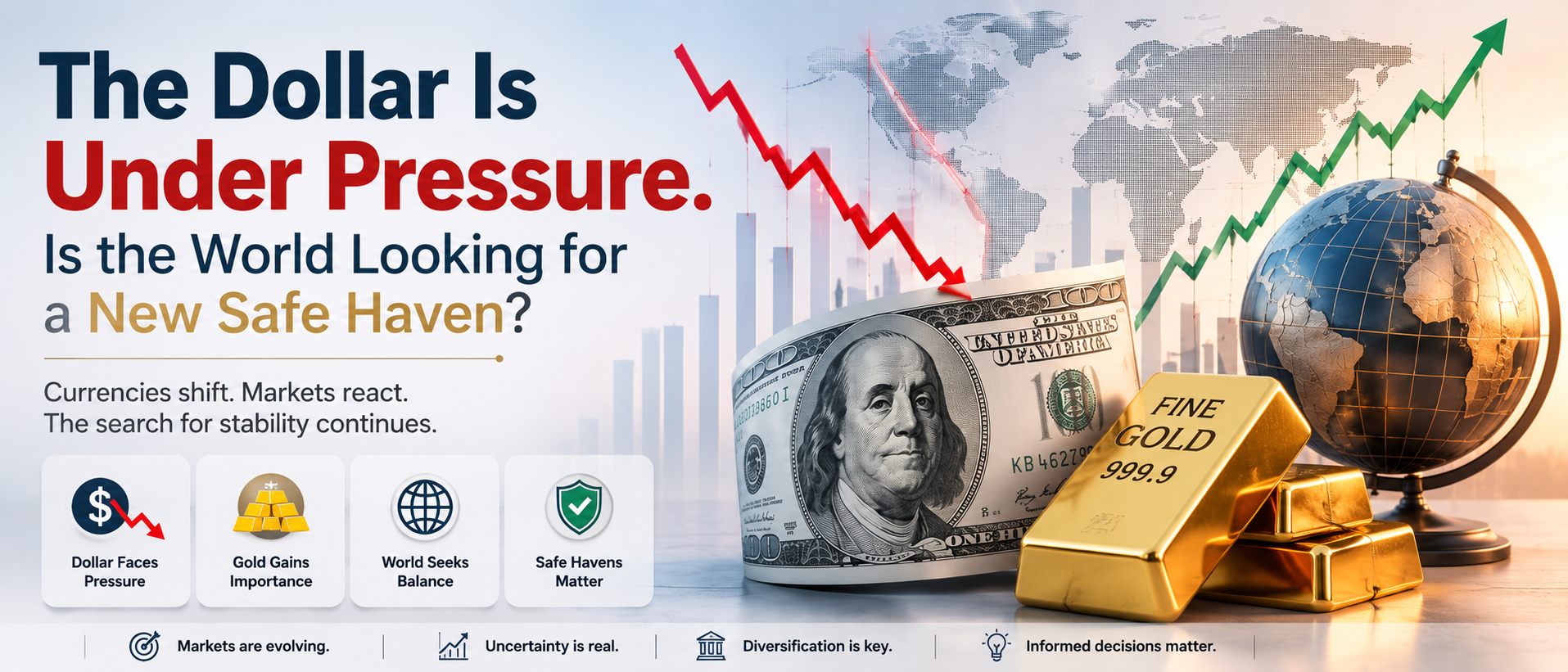
The global money story is getting complicated.
The U.S. dollar remains dominant, but investors and central banks are increasingly eyeing alternatives — especially gold. Meanwhile, the yen is under pressure, and the rupee is being pulled between oil prices, U.S. rates and RBI intervention.
Gold has sent the clearest signal: Reuters reported it rose around 10% in August to roughly $4,400 an ounce, as central-bank demand accelerated.
So is the world actually moving away from the dollar — or is it still too important to replace?
The Dollar Still Dominates
It's easy to see a weaker dollar and assume its global role is fading. The data says otherwise.
The Dollar Still Dominates
It's easy to see a weaker dollar and assume its global role is fading. The data says otherwise.
The IMF's latest COFER data shows the U.S. dollar accounted for 57.13% of global foreign-exchange reserves in Q1 2026 — actually up from 56.42% the previous quarter. Despite years of talk about de-dollarization, the dollar remains overwhelmingly dominant.
Reuters' Dollar Dominance Tracker shows central banks gradually diversifying toward the euro, renminbi, and gold — but no single alternative has seriously challenged the dollar.
Why Central Banks Are Buying So Much Gold
Reuters reported that central-bank gold purchases hit 289 tonnes in Q2 — more than five times the prior quarter, and a record for any second quarter. A World Gold Council survey found 45% of central banks planned to keep increasing gold holdings.
China alone bought a net 20 tonnes in July, pushing its reserves to a record 2,377.5 tonnes.
Gold doesn't replace the dollar in everyday payments. Instead, it works as a reserve asset outside any single country's financial system — useful when geopolitical and monetary uncertainty rises.
What's Driving Gold Right Now
Several forces are moving together: shifting U.S. rate expectations, volatile oil prices, and Fed policy signals.
Reuters reported on August 31 that the dollar held near a two-week high after hawkish comments from Fed Chair Kevin Warsh boosted September rate-hike bets, while the yen slipped past 160 per dollar.
Lower rate expectations typically support gold, since holding a non-yielding asset costs less — but a firmer dollar works against it. Geopolitical uncertainty keeps demand for defensive assets high, which is why gold has stayed resilient either way.
Japan and India: Currencies Under Strain
Japan's bond yields have surged to multi-year highs, and the yen remains weak despite a rare joint U.S.-Japan intervention in August.
India tells a similar story. On August 31, Reuters reported the rupee closed at 95.1625 per dollar — its strongest since August 5 — helped by equity inflows and RBI intervention, gaining 0.2% for the month. High oil prices and Fed rate-hike bets, though, keep pressuring it.
Currencies rarely move in isolation: rates, oil, and central-bank intervention all interact at once.
Is De-Dollarization Really Happening?
Yes — just not as dramatically as headlines suggest. Central banks are diversifying and gold is gaining ground, but the dollar's 57.13% reserve share still dwarfs the euro's 20.03% and the renminbi's 1.99%.
A reserve currency needs deep, liquid markets and global trade acceptance — advantages that don't disappear overnight, which is why de-dollarization looks gradual, not sudden.
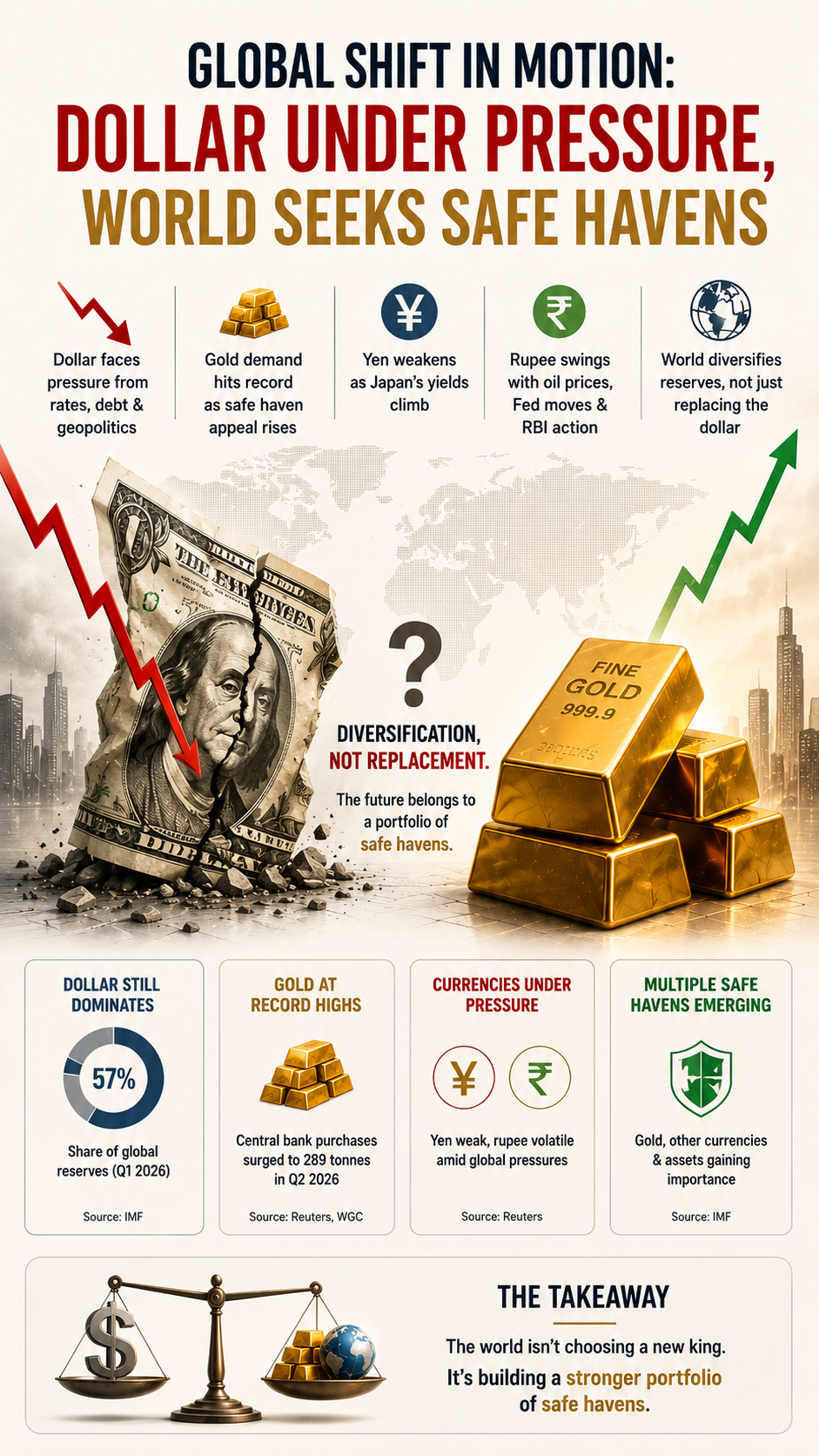
Maybe It's Not One New King
The future may not be about replacing the dollar with one new currency. Central banks increasingly want a mix: dollars for liquidity, gold for diversification, other currencies for balance, and possibly digital assets like dollar-backed stablecoins, which the IMF says are expanding dollar access in emerging markets.
So the real question isn't "Is the dollar dying?" It's: if the world wants more options, is the answer a portfolio of safe havens rather than a single replacement?
FAQ
What is de-dollarization?
Reducing reliance on the U.S. dollar in reserves and trade.
Reducing reliance on the U.S. dollar in reserves and trade.
Is the dollar still the top reserve currency?
Yes — 57.13% of global reserves in Q1 2026, per the IMF.
Yes — 57.13% of global reserves in Q1 2026, per the IMF.
Why are central banks buying gold?
For diversification and as a hedge against currency, inflation, and geopolitical risk.
For diversification and as a hedge against currency, inflation, and geopolitical risk.
Why does oil affect the rupee?
India imports most of its energy, so pricier oil raises dollar demand and pressures the rupee.
India imports most of its energy, so pricier oil raises dollar demand and pressures the rupee.
Is gold replacing the dollar?
Not yet — its reserve role is growing, but the dollar remains dominant.
Not yet — its reserve role is growing, but the dollar remains dominant.
---
Sources
Reuters — Central banks spearhead renewed gold rush
IMF — Currency Composition of Official Foreign Exchange Reserves, Q1 2026
Reuters — Dollar Dominance Tracker
Reuters — Dollar and global markets, August 31, 2026
Reuters — Japan bond yields and yen
Reuters — Yen intervention and market outlook
Reuters — Indian rupee and RBI support
Reuters — Indian rupee, oil and Fed pressure
IMF — Stablecoins and Emerging Markets

Tushar Shrivas
B.Tech CS@ Shri Balaji Institute of Technology & Management
I write at Metaplugs — breaking down the latest in tech, economics, and business into simple, impactful stories for everyday readers. Passionate about software testing and global finance.