LATEST NEWS
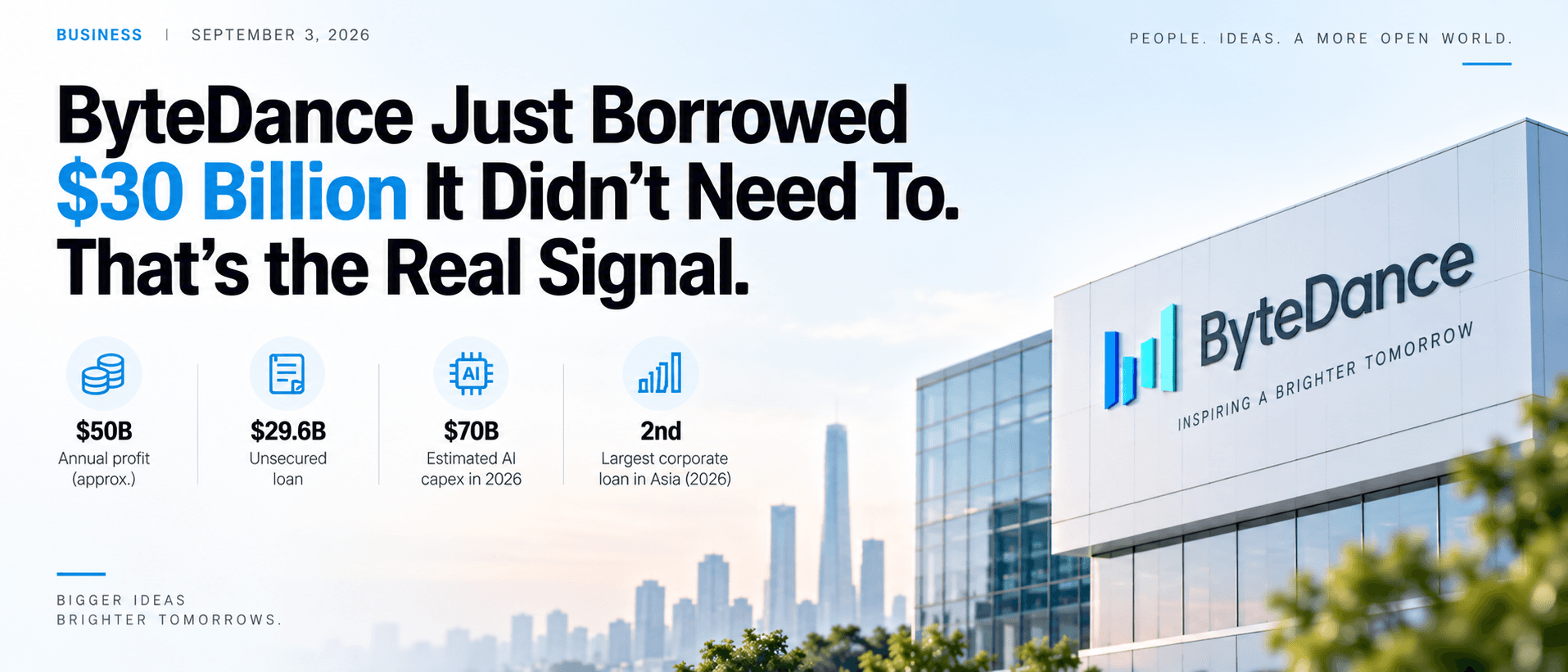
ByteDance Just Borrowed $30 Billion It Didn't Need To. That's the Real Signal.
September 8, 2026 4M
Back to News
News AlertWorld AI Tech
The Hourglass Economy: Why AI Is Squeezing the Middle Out of Industrial Hardware
V
Author
Vishal Sable
Published
April 7, 2026
Reading Time
19 MIN READ
Spread the Word

Hourglass Economy 2026: AI Squeezes $70Bn Industrial Shift Bain warns $70Bn migrating from control hardware to AI software. Kyndryl Foundation expands skilling to 13 countries. Inside Industry 4.0's profit revolution.
Welcome to the Hourglass – Where Industrial Profits Flow to the Ends, Not the Middle
For decades, industrial automation followed a simple pyramid: a broad base of sensors and field devices, a thick middle layer of control hardware (PLCs, DCSs, SCADA systems), and a narrow top of enterprise software. The profit sat in the middle—the "brains" that told machines what to do.
April 2026 marks the official collapse of that model.
Bain & Company has released a landmark report—Industrial Automation: From Control to Intelligence—warning that the traditional industrial control layer is being "squeezed" into irrelevance. Economic value is migrating decisively toward top-layer AI software and bottom-layer smart IoT devices, leaving the middle hardware layer starved of margin.
This is the Hourglass Economy. And by 2030, more than 80% of industry profit pools will sit at the two ends of the stack, bypassing the control hardware that built the Industrial Revolution.
The numbers are staggering. AI-enabled solutions alone will unlock nearly $70 billion in new market value—a 22% growth surge—by 2030. Nearly half of all industrial automation revenue will rely on AI-enabled offerings.
But with disruption comes displacement. The same forces squeezing hardware profits are squeezing middle‑skill jobs. And today, the Kyndryl Foundation announced a major expansion of its AI and cybersecurity skilling grants to 13 countries, including India, aiming to train thousands for the new economy.
This is your technical briefing on the profit migration, the jobs at risk, and the skilling infrastructure being built to catch the displaced.
Bain’s Hourglass – How AI and IoT Are Redefining Industrial Profit
The industrial automation industry is undergoing a structural shift that Bain describes as moving "from control to intelligence." Traditional programmable logic controllers (PLCs), distributed control systems (DCSs), and SCADA systems—the workhorses of factory automation—have reached their limits. Incremental production gains from upgraded control hardware now appear limiting compared to the new value creation that industrial AI promises.
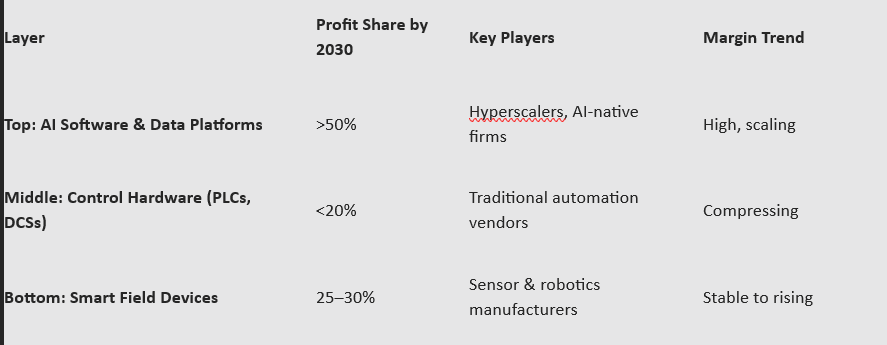
The old profit "pyramid" is morphing into an hourglass shape, with the middle control layer squeezed from both sides:
Top layer (AI software & data platforms): More than half of industry spending will flow here. Software scales fast, carries high margins, and compounds in value as data and use cases accumulate. Hyperscalers and AI‑native players are expanding aggressively into industrial software.
Bottom layer (smart field devices): An additional 25–30% of spending will go to connected sensors, actuators, robots, and machine vision systems. These are no longer passive endpoints—with embedded intelligence and edge computing, they generate data and execute decisions autonomously.
Middle layer (traditional control hardware): Remains essential but is becoming harder to scale and differentiate. New entrants are compressing margins by shifting value away from these core controls.
By 2030, more than 80% of industry profit pools will sit at the two ends of this hourglass. Adrien Bron, leader of Bain's Advanced Manufacturing & Services practice, notes: "What's changing is not just the technology, but where economic value is created in the market."
The $70 Billion AI Upside
AI-enabled solutions alone could unlock up to $70 billion in new market value by 2030, representing 22% growth. Bain analysis identifies three use cases driving a disproportionate share of this upside: adaptive robotics, predictive maintenance, and knowledge-based systems. Much of that value is expected to materialize within the next one to five years.
Companies already orchestrating data, software, and smart devices at scale are seeing measurable results: productivity gains of 30% to 50% , maintenance cost reductions of up to 35% , and longer asset lifetimes.
The Incumbent Squeeze
The stakes are rising. Legacy advantages are eroding faster than many incumbents expect. Competition is intensifying from both ends of the stack—hyperscalers and AI‑native players from above, aggressive hardware competitors from below. Meanwhile, switching costs are falling as software decouples from hardware and interoperability improves. Bain's warning is stark: "The risk is not overnight disruption—it's gradual irrelevance."
Enter the Kyndryl Foundation.
Today, April 7, 2026, the Foundation announced the expansion of its global grant program to 13 countries, introducing France and Mexico as new markets and reinforcing its long‑term commitment to advancing cybersecurity and AI skills development worldwide.
Global Reach, Local Impact
The latest grant portfolio supports both existing multi‑year grantees and new organizations working on cybersecurity training, AI literacy, digital inclusion, and workforce readiness. The program is expected to reach well over 100,000 people worldwide through independent, nonprofit‑led initiatives.
Selected 2026 grant recipients include:
Article 1 (France – new market): Will integrate AI‑powered tools into its mentoring platform, expand AI‑literacy training for 4,000 students, deliver workshops for 200 participants, and train 120 mentors.
Labouratoria (Mexico – new market): Will train 200 under‑ and unemployed individuals in foundational cybersecurity and job‑readiness skills
Generation: You Employed (UK): Will run train‑and‑place boot camps for 400 people over two years.
Fundación Cibervoluntarios (Spain): Plans to train 10,000 young people in cybersecurity and ethical hacking through 400 sessions.
JEDI (Canada – returning grantee): Will support IT and cybersecurity training for about 60 Indigenous students in New Brunswick, with internship and job placement pathways.
CLACK (Japan): Will offer "Be Pro Cybersecurity" courses for 700 students from economically disadvantaged families in Tokyo and Osaka.
Czechitas (Czechia): Will certify 110 individuals in cybersecurity tracks, train 1,000 in courses, and reach 50,000 through awareness programming.
Additional programs are running in Poland, Hungary, India, Brazil, Costa Rica, and the United States.
Una Pulizzi, President of Kyndryl Foundation, stated: "As we enter the third year of Kyndryl Foundation grants program, our focus is on deepening impact and strengthening digital skills development in the communities in which we operate. We are proud to help create more pathways for individuals to enter meaningful careers in cybersecurity and AI."
India Focus: 50,000 Students, 30,000 Youth
India, as the world's third‑largest unicorn hub and a nation facing acute AI‑driven workforce disruption, is a central pillar of Kyndryl's skilling strategy. In February 2026, Kyndryl announced an expanded social impact commitment to train 50,000 students and 30,000 youth with AI skills across the country.
The programs include:
Government school AI education: A pilot in Varanasi and Ayodhya targeting PM SHRI and Navodaya schools, introducing age‑appropriate AI education for 50,000 students while upskilling 1,000 teachers across 100 schools in two years.
Rural AI ecosystem: A three‑tiered initiative with Head Held High Foundation to build India's first rural AI ecosystem, aiming to enable 30,000 youth through mobile‑first, multilingual AI literacy sessions and community mapping.
Civil servant upskilling: Training programs for government employees to build AI readiness across the public sector.
These initiatives are part of Kyndryl's broader $2.25 billion investment commitment announced in August 2025, focused on supporting national digital and skilling priorities.
The Workforce Reality – Jobs Being Squeezed and Jobs Being Created
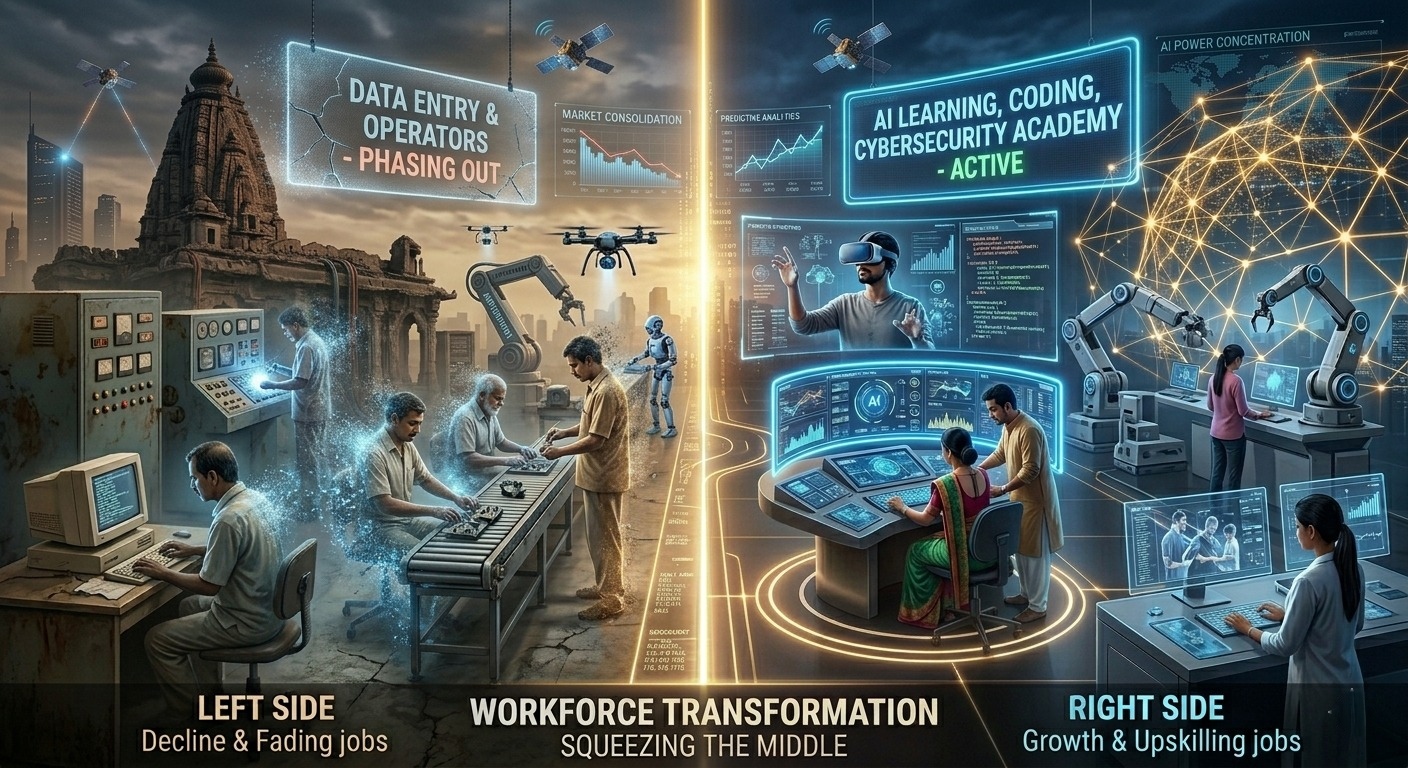
The hourglass economy is not just a hardware phenomenon. It is a labor phenomenon.
According to a recent report by construction scheduling platform Planera, released April 7, 2026, white‑collar occupations are facing the greatest threat of automation displacement. Roles dominated by routine, structured processes are the most exposed to rapid disruption.
Most vulnerable jobs in 2026 include:
Cashiers and checkout clerks (self‑service tills, digital payments)
Data entry clerks (machine learning systems, OCR tools)
Telemarketers and call center agents (conversational AI)
Bookkeeping and payroll clerks (automated accounting platforms)
Travel agents (AI‑powered recommendation engines)
Warehouse pickers (robotics systems)
Bank tellers (digital banking platforms)
Routine software testers (automated testing frameworks)
The report notes: "Automation does not eliminate entire professions overnight; it targets specific tasks within them. The impact is less about job elimination and more about task reallocation. Workers will need to transition toward higher‑value activities within their fields."
Meanwhile, the global technology industry shed 244,671 jobs in 2025 alone, with over 30,000 additional layoffs recorded in the first six weeks of 2026. This "Great Decoupling"—where corporate productivity and valuation soar even as headcounts are pruned—is most visible in legacy giants like Intel (33,900 role reductions) and Microsoft (19,215 layoffs).
The displacement is particularly acute in the Global South. The catastrophic slump in Indian IT stocks—hitting their worst level in nearly six years in February 2026—reflects a market pricing in the obsolescence of the traditional "people‑as‑a‑service" model. When generative AI can perform Tier‑1 support, basic code auditing, and data entry at near‑zero marginal cost, the geographic advantage of Bangalore or Pune evaporates. Industry veterans warn that the IT and BPO services landscape as we know it will effectively disappear within five years.
Yet the picture is not uniformly bleak. The Planera report also identifies resilient professions that rely on human judgment, creativity, and interpersonal skills—roles that AI cannot easily replicate. Manufacturers leveraging AI for "institutional memory" and upskilling are lowering downtime costs compared to those struggling to hire their way out of the talent gap. The workforce crisis is not about replacement—it is about augmentation. As one analysis notes, manufacturers are turning to AI not to replace workers but to augment novice technicians, turning them into experts via AI‑guided workflows.
Hannover Messe 2026 – Where the Hourglass Takes Center Stage
The hourglass economy thesis will be formally debated on the global stage later this month. Hannover Messe 2026 (April 20–24), the world's largest industrial trade fair, will feature a keynote panel titled "From Pyramid to Hourglass: How AI is Reshaping Industrial Automation Profit Pools," hosted by Bain & Company.
The discussion will explore how industrial automation is shifting from executing predefined control logic to orchestrating data and workflows that enable industrial AI. The core question: Which partners will help shape the "brain of the future factory"?
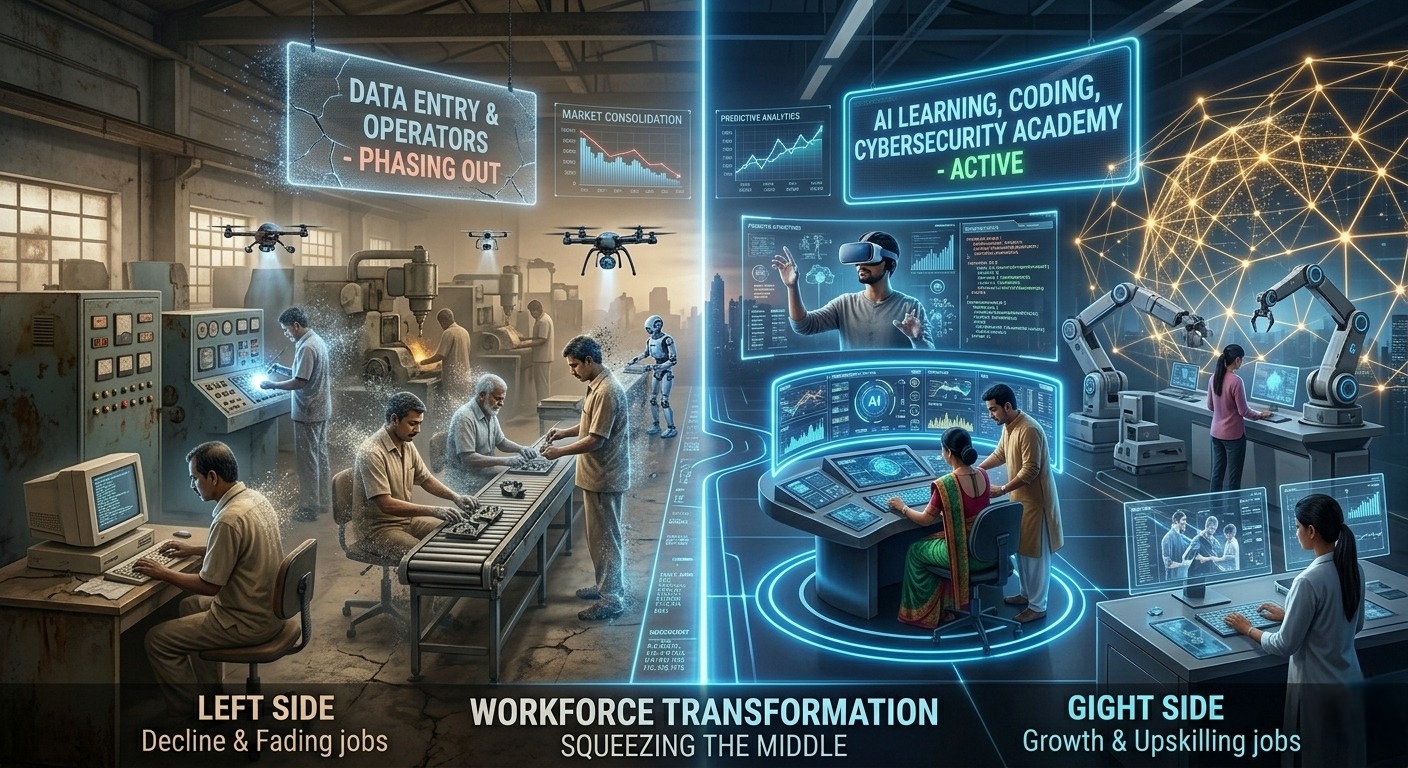
The hourglass economy is not a prediction. It is already underway.
For industrial enterprises, the implications are immediate:
Reallocate R&D budgets away from incremental control hardware improvements and toward AI software and data platforms.
Embrace smart field devices as profit centers, not cost centers—embedded intelligence and connectivity are now margin drivers.
Prepare for vertical‑specific competition. Nearly 60% of incremental industry growth toward 2030 is expected to come from vertical‑specific offerings that embed process knowledge, data semantics, and regulatory requirements.
For workers, the path forward is clear but unforgiving: upskill or be squeezed. Kyndryl's global grant expansion—reaching over 100,000 people across 13 countries—represents exactly the kind of public‑private infrastructure needed to bridge the hourglass's widening gaps.
For investors, the monetization vectors are unmistakable:
Industrial AI software (high margins, rapid scaling)
Smart IoT device manufacturers (25–30% of profit pool)
Vertical‑specific AI solutions (60% of incremental growth)
Skilling and workforce development platforms (the $70 billion human infrastructure)
The pyramid served the 20th century. The hourglass serves the 21st. The only question is which side of the squeeze you choose to be on.

Vishal Sable
B.Tech AD @ shri balaji institute of technology and management
Engineering and tech journalist. I love exploring the impact of emerging technologies on global defense, sovereignty, and everyday life. Always looking for the real story behind the headlines.