Back to News
News AlertWorld Defence Tech
The Industrial Shift to "Software-Defined" Field Warfare
V
Author
Vishal Sable
Published
July 15, 2026
Reading Time
3 MIN READ
Spread the Word
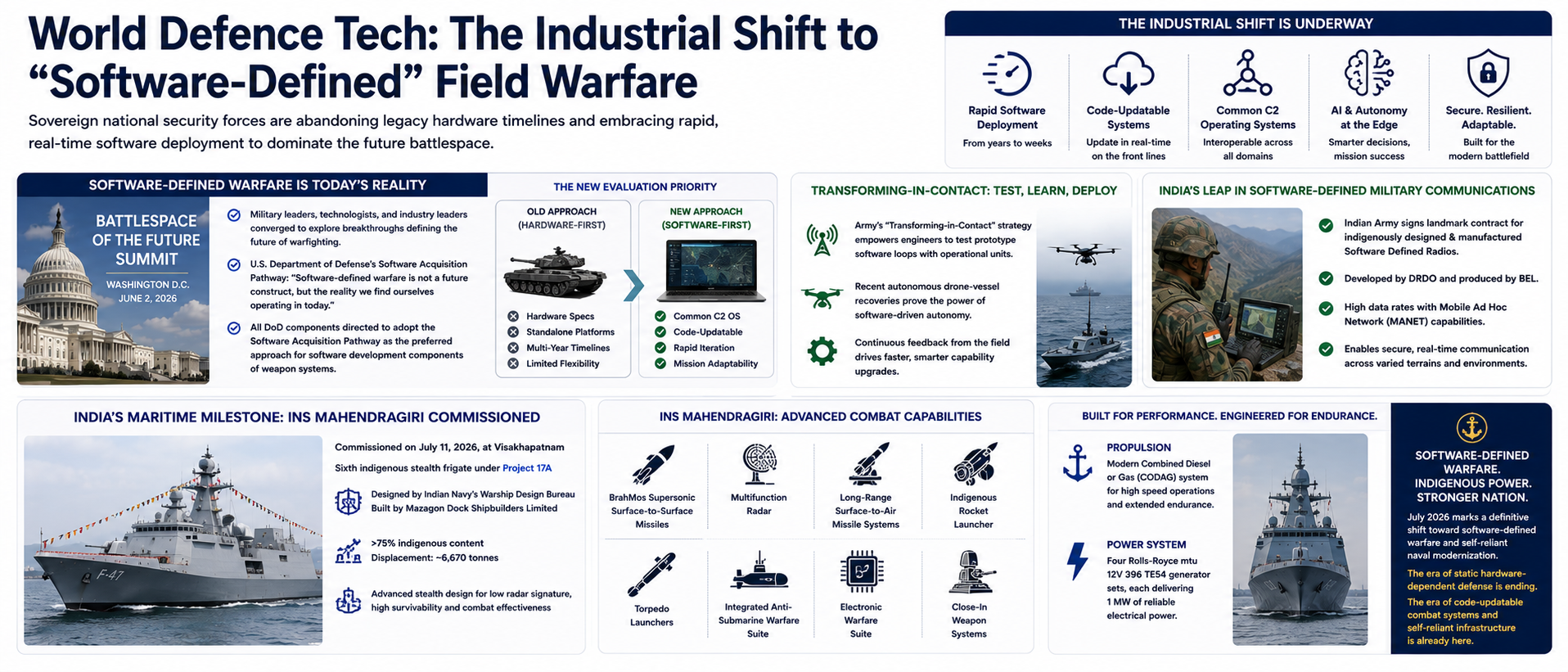
Sovereign national security forces are radically altering their tech pipelines, abandoning old multi-year hardware timelines to prioritize rapid, real-time software deployment. At the recent Battlespace of the Future summit in Washington D.C. on June 2, military leaders, technologists, and industry leaders converged to explore breakthroughs defining the future of warfighting . The shift is being driven by the U.S. Department of Defense's Software Acquisition Pathway, which recognizes that "software-defined warfare is not a future construct, but the reality we find ourselves operating in today" . Rather than evaluating unmanned autonomous vehicles solely on standalone hardware specs, global commands are strictly prioritizing common command-and-control operating systems that can be code-updated directly on the front lines.
The success of autonomous systems—highlighted by recent drone-vessel recoveries—has prompted initiatives like the Army's "Transforming-in-Contact" strategy, giving engineers direct permission to test prototype software loops right alongside active operational units. The Department of Defense has directed all components to adopt the Software Acquisition Pathway as the preferred approach for software development components of weapon systems . India has also made significant strides in software-defined military communications: the Indian Army signed a landmark contract for its first indigenously designed and manufactured Software Defined Radios, developed by DRDO and produced by BEL, equipped with high data rates and Mobile Ad Hoc Network capabilities to enable secure, real-time communication across varied terrains .
Concurrently, India's modern maritime defense push hit a milestone with the commissioning of the new stealth frigate INS Mahendragiri on July 11 at Visakhapatnam . Designed by the Indian Navy's Warship Design Bureau and constructed by Mazagon Dock Shipbuilders Limited, the warship is the sixth indigenous stealth frigate under the Project 17A programme. With over 75% indigenous content and a displacement of approximately 6,670 tonnes, INS Mahendragiri incorporates advanced stealth technologies designed to minimize radar detection, enhance survivability, and improve combat effectiveness . The frigate is equipped with BrahMos supersonic surface-to-surface missiles, a multifunction radar, long-range surface-to-air missile systems, an indigenous rocket launcher, torpedo launchers, an integrated anti-submarine defence system, an electronic warfare suite, and close-in weapon systems . The warship is powered by a modern Combined Diesel or Gas propulsion system, enabling high-speed operations and extended endurance , and features four Rolls-Royce mtu 12V 396 TE54 generator sets, each providing 1 MW of reliable electrical power . July 2026 marks a definitive shift toward software-defined warfare and indigenous naval modernization. The era of static hardware-dependent defense is ending. The era of code-updatable combat systems and self-reliant naval infrastructure is already here.

Vishal Sable
B.Tech AD @ shri balaji institute of technology and management
Engineering and tech journalist. I love exploring the impact of emerging technologies on global defense, sovereignty, and everyday life. Always looking for the real story behind the headlines.