The 32-Gigawatt Deficit: Why Elon Musk is Launching AI Data Centers Into Orbit
The Launch That Broke Physics: Why the New Tesla Roadster Is Officially a "Flying Car"
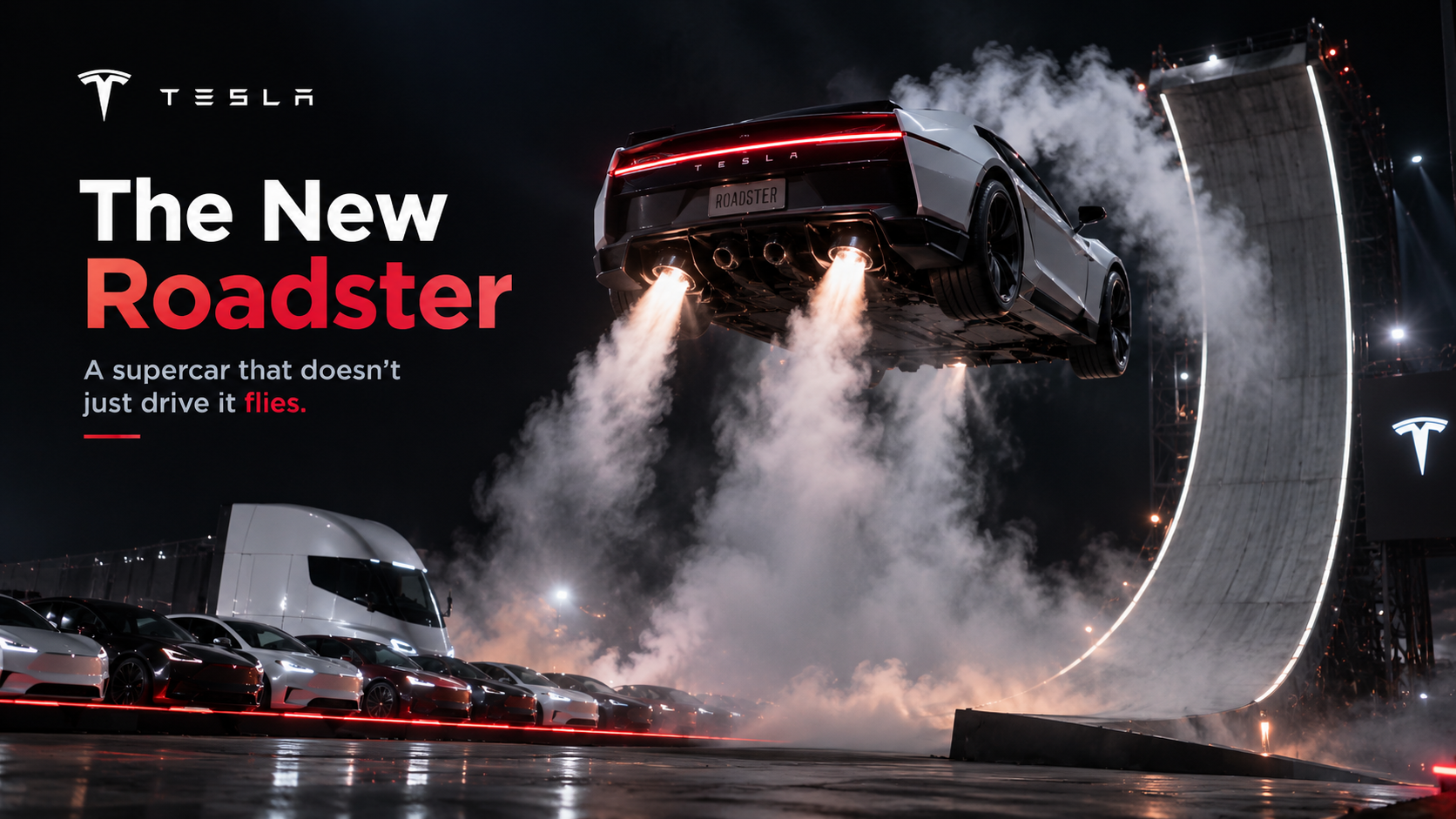
The new 2026 Tesla Roadster uses SpaceX high-pressure gas thrusters to drive upside down and flip mid-air, though production is pushed to 2028.
For nine years, the automotive industry waited for Tesla to finally release the second-generation Roadster. But when Elon Musk finally debuted the highly anticipated electric supercar, he didn't just break acceleration records—he literally broke the laws of terrestrial driving. In a jaw-dropping demonstration that looked like pure science fiction, the 2026 Tesla Roadster didn't just drive; it drove upside down, performed a mid-air barrel roll, and proved that the era of the flying car has officially arrived.
On October 15, 2026, after almost a decade of delays and a two-week weather postponement, Tesla officially unveiled the redesigned Roadster at a SpaceX test facility in McGregor, Texas. The livestream, which kicked off at 7:55 p.m. Central Time, was pure automotive theater. To the shock of the crowd, the new Roadster climbed a massive, curved ramp, stuck to the top completely upside down, jumped off, executed a mid-air flip, and landed perfectly on its wheels. In a follow-up stunt, the vehicle vaulted 8 to 10 feet into the air, performing a full barrel roll over an entire fleet of parked Tesla vehicles before safely touching down. As Musk declared to the stunned audience, "Flying cars are real".
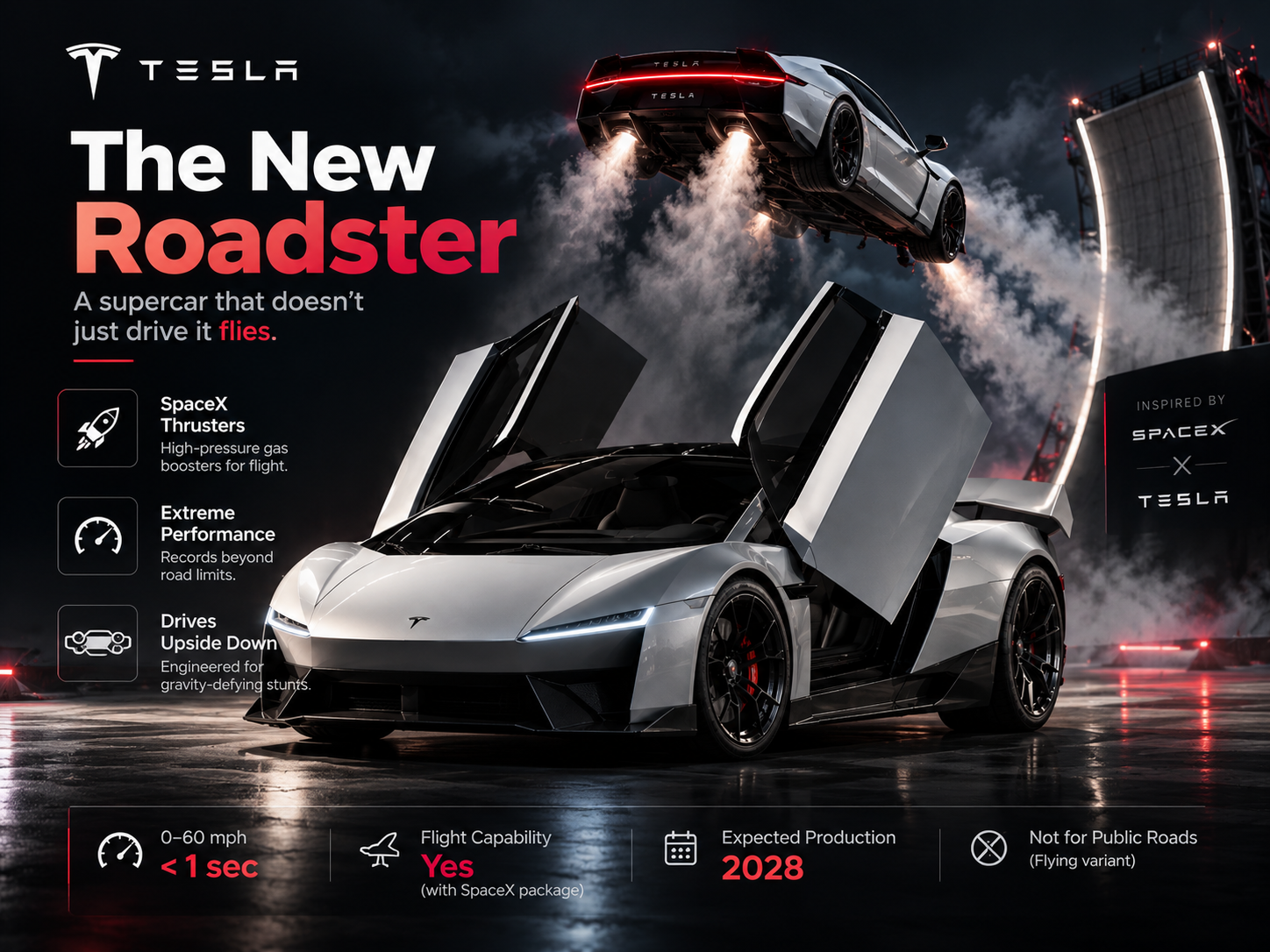
The Deeper Explanation How exactly is a production car achieving aerial acrobatics? The answer lies in the highly anticipated integration of SpaceX technology. Musk has teased a "SpaceX package" for the Roadster since 2018, and this event finally showcased the hardware in action.
The vehicle achieves these gravity-defying maneuvers by utilizing ultra high-pressure air tanks acting as rocket-like thrusters, allowing it to propel itself completely off the ground. These high-pressure gas boosters are what enable the car to maintain its grip on an upside-down ramp and execute mid-air flips. However, this unprecedented capability comes with major regulatory asterisks. Tesla’s own website explicitly notes that this "flying model" is not approved for public road use. Instead, buyers who put down a $5,000 reservation deposit will be securing the standard, non-flying version of the supercar.
Why It Matters For the broader technology and automotive sectors, this stunt fundamentally shifts the baseline of what an electric performance flagship can be. By successfully integrating aerospace thrusters into a consumer supercar chassis, Tesla is no longer competing with Ferrari or Porsche on simple 0-60 sprint times; they are creating an entirely new category of extreme novelty engineering.
For industry analysts tracking Tesla's long-term hardware promises, this event provides both relief and caution. While the sheer spectacle of the aerial Roadster dominates the headlines, the actual timeline for consumer delivery remains frustratingly distant. Despite the Roadster nameplate being essential to Tesla's heritage—the original Roadster was the company's very first production car—Musk stated that the new generation is targeted for production in 2028. This means the vehicle that was first revealed as a prototype in 2017 will have taken over a full decade to hit the streets.
The Horizon Elon Musk has successfully delivered on his wildest promise yet: merging Tesla's automotive engineering with SpaceX's rocket technology to build a car that actually flies. But as the hype settles, a massive question remains. With production pushed to 2028 and the flying variant completely banned from public roads, is the new Roadster a legitimate consumer product, or just the most expensive, elaborate marketing stunt in automotive history?

Saumya Dawande
B.Tech AIML @ oriental institute of science technology bhopal
Engineering and tech journalist. I love exploring the impact of emerging technologies on global defense, sovereignty, and everyday life. Always looking for the real story behind the headlines.