LATEST NEWS
Swiggy Didn't Sell Its B2B Arm for Cash — It Bought Into the Company Buying It
September 9, 2026 5M
Back to News
News AlertWorld of Startup’s
The Physical AI Revolution Is Here
V
Author
Vishal Sable
Published
June 29, 2026
Reading Time
18 MIN READ
Spread the Word
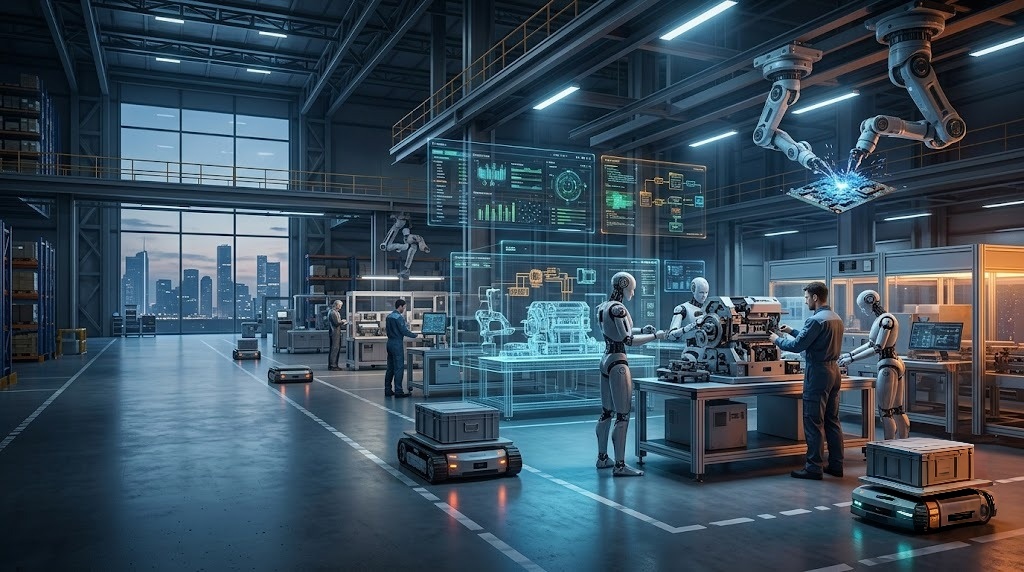
The global startup landscape has undergone a profound transformation in mid-2026. The era of generic web apps and consumer-facing chatbots is fading, replaced by a relentless focus on companies rooted in deep physical mechanics, supply chain integration, and enterprise data control. Venture capital is no longer spraying across hundreds of hopefuls—it is concentrating on startups that solve real-world labor shortages, automate physical workflows, and build defensible intellectual property. Two announcements this month capture this shift perfectly. Jack Technology, a global leader in industrial sewing equipment, has partnered with Siemens to deploy industrial AI and humanoid robotics directly onto apparel assembly lines—a sector historically resistant to automation. Meanwhile, German startup Neura Robotics has raised up to $1.4 billion in one of the largest private investments in humanoid robotics history, backed by a who's who of tech and industrial giants. Together, these developments signal that the "build era" of startup innovation has arrived—and it is being built in factories, not data centers.
The Jack Technology-Siemens Partnership: AI and Humanoids Enter the Apparel Industry
The textile and apparel industry is one of the world's most labor-intensive sectors, employing millions across complex global supply chains. Yet it has largely been left out of the digital transformation that has reshaped automotive and electronics manufacturing. That is changing, and changing fast. On June 11, 2026, Siemens announced a new collaboration with Jack Technology Co., Ltd., a Chinese manufacturer of industrial sewing equipment that serves customers in more than 160 countries. The partnership brings together low-code application development, advanced product engineering, and intelligent automation to support more flexible, responsive, and software-driven production environments. At the heart of this transformation is a suite of Siemens technologies that Jack Technology is deploying across its operations. The company will implement Siemens' new industrial AI orchestration software, Intelligence Center X, starting with Mendix for agentic low-code development, and Designcenter software for advanced product engineering—both from the Siemens Xcelerator portfolio. These tools are designed to streamline product development, reduce complexity, and support new applications for AI and humanoid robotics in sewing workshops. Siemens will also provide specialized technical training to support the development of a dedicated digital platform for the sewing equipment industry. The operational benefits are substantial. Jack Technology expects the integration to shorten development cycles, improve product quality, optimize production workflows, reduce costs, and increase overall manufacturing efficiency by up to 30 percent. The collaboration reflects a broader shift across the apparel manufacturing sector, as companies adopt software-driven engineering, agentic low-code development, and AI-enabled automation to modernize operations and improve responsiveness to evolving market demands. In a landmark development, 2,000 humanoid robots designed for clothing manufacturing were ordered this year, marking the first large-scale deployment of this technology in the sector.
Neura Robotics: The $1.4 Billion Bet on Physical AI
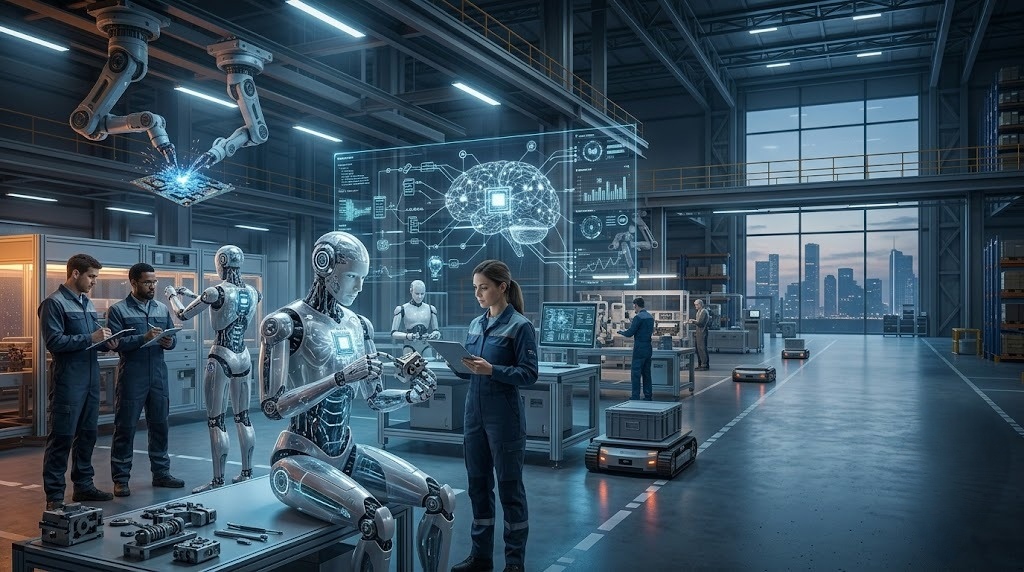
If the Jack Technology-Siemens partnership represents the application of physical AI to a specific industry, Neura Robotics represents the platform on which that future is being built. On June 10, 2026, the German startup announced a landmark Series C financing round of up to $1.4 billion, making it the largest private investment in a full-stack robotics company ever. The round was backed by a coalition of global leaders across AI, robotics, compute, manufacturing, and industrial infrastructure, including Tether, Qualcomm Technologies, Amazon, NVIDIA, Bosch, Schaeffler, imec.xpand, the European Investment Bank, Lingotto Horizon, and InterAlpen Partners. The funding values Neura Robotics at approximately $7 billion—a staggering jump from its €120 million valuation in January 2025. The company, founded in 2019 by David Reger in Metzingen, Germany, builds AI-powered humanoid robots designed to work safely alongside humans using advanced sensors and machine learning. Its flagship products include the 4NE-1 humanoid robot and the Neuraverse platform, which serves as the software backbone for its robotic systems. The company has already booked over €1 billion in orders. What makes Neura different is its vision of an open Physical AI ecosystem. Unlike traditional robotics companies focused on isolated machines or narrow industrial automation, Neura combines robotics, AI, sensors, edge compute, and large-scale learning infrastructure into one unified platform architecture designed for global deployment. The Neuraverse is a shared intelligence database where robots continuously exchange skills, capabilities, and learnings across deployments. The company is also expanding its global network of NEURA Gyms—specialized large-scale training environments combining real-world sensor interaction, simulation, and multimodal learning pipelines to create one of the largest real-world robotics data infrastructures globally.
The Physical AI Supercycle: By the Numbers
The Neura Robotics round is not an isolated event. It is part of a broader Physical AI supercycle that has fundamentally reshaped the venture capital landscape in 2026. According to data shared at the MassRobotics Founders & Funders Capital Forum on June 10, 2026, robotics venture activity spiked into Q1 2026, reaching **$10 billion in invested capital** for the quarter—driven by mega-rounds from leaders like Saronic ($1.8 billion), Shield AI ($1.5 billion), and Skild AI ($1.4 billion). The scale of capital deployment is unprecedented. Last year, the robotics and physical AI segment comprised $27.6 billion across 1,009 deals, according to PitchBook. AI-enabled manufacturing startups secured an unprecedented 56 percent share of all manufacturing venture capital in early 2026. Industrial robotics companies (461 firms) and Defense & Security robotics (435 firms) lead the ecosystem by a wide margin, backed closely by an accelerating Robotics Software & AI sector (300 companies). The investment thesis is driven by an undeniable macroeconomic reality. A $60 trillion global market is plagued by aging demographics, big manufacturing skills gaps, and over 1 million unfilled factory roles in the United States alone. Reshoring catalysts—large global supply chain pressures hitting a four-year high, combined with geopolitical tension and tariffs—have forced manufacturers to immediately automate newly designed facilities. As J.P. Morgan's Yvonne McCague noted, automation is no longer optional.
Founder Realities: The New Rules of Investor Selectivity
The flood of capital into physical AI and industrial automation has not lowered the bar for founders. If anything, it has raised it dramatically. The current market environment is highly selective, and investors are strictly rewarding founders who focus on three critical pillars: cutting manual labor costs, building rigid intellectual property, and setting up automated compliance frameworks early. The shift in investment criteria is stark. According to the MassRobotics forum, seed and Series A rounds still focus on total addressable market, team expertise, and building early credibility as true roboticists. But later rounds—Series E and F—are dominated by metrics. Investors are no longer betting on vision alone; they are demanding proof of operational efficiency, customer traction, and clear paths to profitability. Perhaps nowhere is this selectivity more visible than in the due diligence process for AI and deep-tech startups. According to a June 2026 analysis by Times Now, on top of the usual financial, legal, and compliance checks, investors are now taking a closer look at technology, data, and governance risks. For AI startups, investors are adding product and IP validation, customer and revenue validation, employee or market feedback, and checks around data sourcing, privacy, and governance. As one legal expert put it, "AI due diligence is more intensive than other sectors. The best thing founders can do is get legally organised early—clean IP, solid contracts, and GDPR compliance will make you far more attractive to investors". This focus on IP protection is non-negotiable. As Penningtons Manches Cooper's fintech roundtable noted in June 2026, "Founders should address IP protection from the outset, it is one of the first issues investors will interrogate, and one of the most damaging to leave unresolved". Investors want to ensure that if a founder leaves six months after a Series A, they do not take the IP with them—employment contracts should have "IP Clawback" terms.
The Global Landscape: From India to Germany
The physical AI revolution is truly global. While Germany's Neura Robotics captures headlines with its $1.4 billion round, startups across the world are securing significant funding to address local and global industrial challenges. In India, the robotics ecosystem is rapidly maturing. Integra Robotics, a Bangalore-based deep-tech robotics firm, raised a $1.12 million pre-Series A round led by India Accelerator and Finvolve, with participation from GrowthCap Ventures. The company's unique approach combines human oversight with machine autonomy, creating a compounding data advantage for increasingly autonomous robotic systems. Meanwhile, Reliance-backed **Addverb Technologies** is seeking to raise more than $100 million to cement its role as India's top maker of robots, targeting global growth and a future IPO. Canada's Maneva AI raised a $27 million Series A led by U.S. Venture Partners to help manufacturers operate more efficiently. The company's computer vision tech feeds live footage from factory floor cameras to its AI agents, which work on NVIDIA edge devices to react or reinforce tasks and behaviors based on the information they take in. The funding will be used to expand its AI capabilities, enter new industries and geographies, and roll out new agent capabilities. Italy's Sintropy raised a €1 million seed round for its IoT AI-powered sensors and AI platform that helps companies manage and reduce energy usage. And THEKER Robotics secured an $85 million Series A to build robotic brains meant to adapt and learn in industrial settings. Even in humanoid robotics, the competition is intensifying. China's Linkerbot, the global market leader in highly dexterous robotic hands for humanoids, is seeking a $6 billion valuation in its next financing round, double the valuation from its just-closed funding. And Foundation Future Industries, a humanoid robotics startup, is aiming to build robots for defense as well as industrial work, with founder Sankaet Pathak telling Reuters the company eventually wants its machines to identify targets autonomously.
Conclusion: The Build Era Has Arrived
Taken together, these developments paint a coherent picture of the startup landscape in mid-2026. The era of "growth at all costs" is over. The era of profitable, defensible, infrastructure-driven innovation has begun. Investors are backing companies that solve real-world labor shortages with AI-enabled robotics, that build rigid intellectual property moats, and that automate compliance frameworks from day one. The Jack Technology-Siemens partnership demonstrates that even the most labor-intensive industries—like apparel manufacturing—are ripe for transformation. The Neura Robotics funding round proves that capital is flowing to platforms that can scale physical AI across multiple industries and geographies. The through-line is clear. In 2024, startups were about disruption. In 2025, they were about consolidation. In 2026, they are about efficiency, intellectual property, and physical automation. The companies and founders that succeed will be those that can cut manual labor costs, build defensible IP, and deploy AI into the real world—not just onto screens. The "gold rush" of fleeting valuations is over. The "build era" of lasting, profitable enterprises has just begun.

Vishal Sable
B.Tech AD @ shri balaji institute of technology and management
Engineering and tech journalist. I love exploring the impact of emerging technologies on global defense, sovereignty, and everyday life. Always looking for the real story behind the headlines.