Back to News
News AlertWorld Defence Tech
Ukraine Launches Pan-European "Freyja" Modular Defense; India Issues Massive Strategic NOTAM
V
Author
Vishal Sable
Published
August 4, 2026
Reading Time
4 MIN READ
Spread the Word
KIEV / NEW DELHI – Wednesday, August 4, 2026
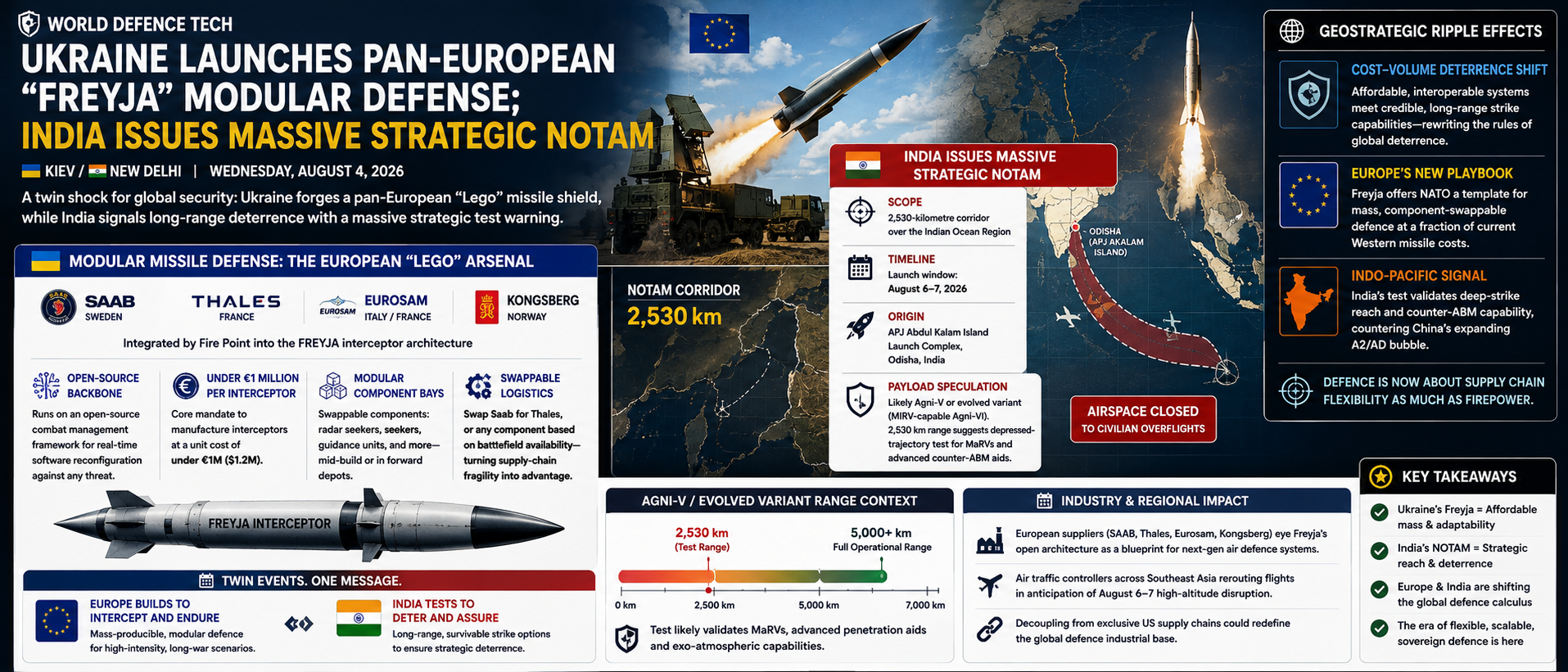
The global defence landscape is undergoing a twin shock today—one rooted in European industrial ingenuity, the other in Asian strategic signalling. As Ukraine pivots from wartime improvisation to structured, pan-European mass production, India concurrently flexes its long-range deterrent muscle, rewriting the calculus for both the Atlantic and Indo-Pacific theatres.
MODULAR MISSILE DEFENSE: The European "Lego" Arsenal
Ukrainian drone and missile developer Fire Point has officially begun integrating a constellation of European sensor and effector technologies into its flagship Freyja missile defence project. This is not a traditional off-the-shelf procurement; it is a radical experiment in battlefield adaptability.
The Integration Pool: Fire Point is now marrying hardware from SAAB (Swedish radars), Thales (French multi-mode seekers), Eurosam (Italian/French guidance logic), and Kongsberg (Norwegian launch and control subsystems) into a single, cohesive interceptor architecture.
Open-Source Backbone: Crucially, Freyja runs on an open-source combat management framework, allowing real-time software reconfiguration based on threat typology—whether countering Shahed-type loitering munitions or subsonic cruise missiles.
The Cost Factor: The project's core mandate is to manufacture interceptors at a unit cost of under €1 million ($1.2M) . This directly challenges the Western "gold-plated" defence paradigm, offering a price point that allows for mass stockpiling rather than boutique production.
Swappable Logistics: In a first for European missile design, Freyja interceptors feature modular component bays. Field technicians can swap out a Saab radar seeker for a Thales equivalent mid-manufacturing—or even in forward depots—based purely on what is available on the battlefield that week. This turns supply-chain fragility into a tactical advantage.
STRATEGIC TEST WARNING: The Indian Ocean's New Calculus
While Europe focuses on interception, New Delhi is focused on projection. The Indian Ministry of Defence, through the Defence Research and Development Organisation (DRDO), has issued a significant Notice to Airmen (NOTAM) that has sent ripples through regional intelligence circles.
The Scope: The NOTAM covers a vast 2,530-kilometre corridor over the Indian Ocean Region, effectively closing a massive swath of international airspace to civilian overflights.
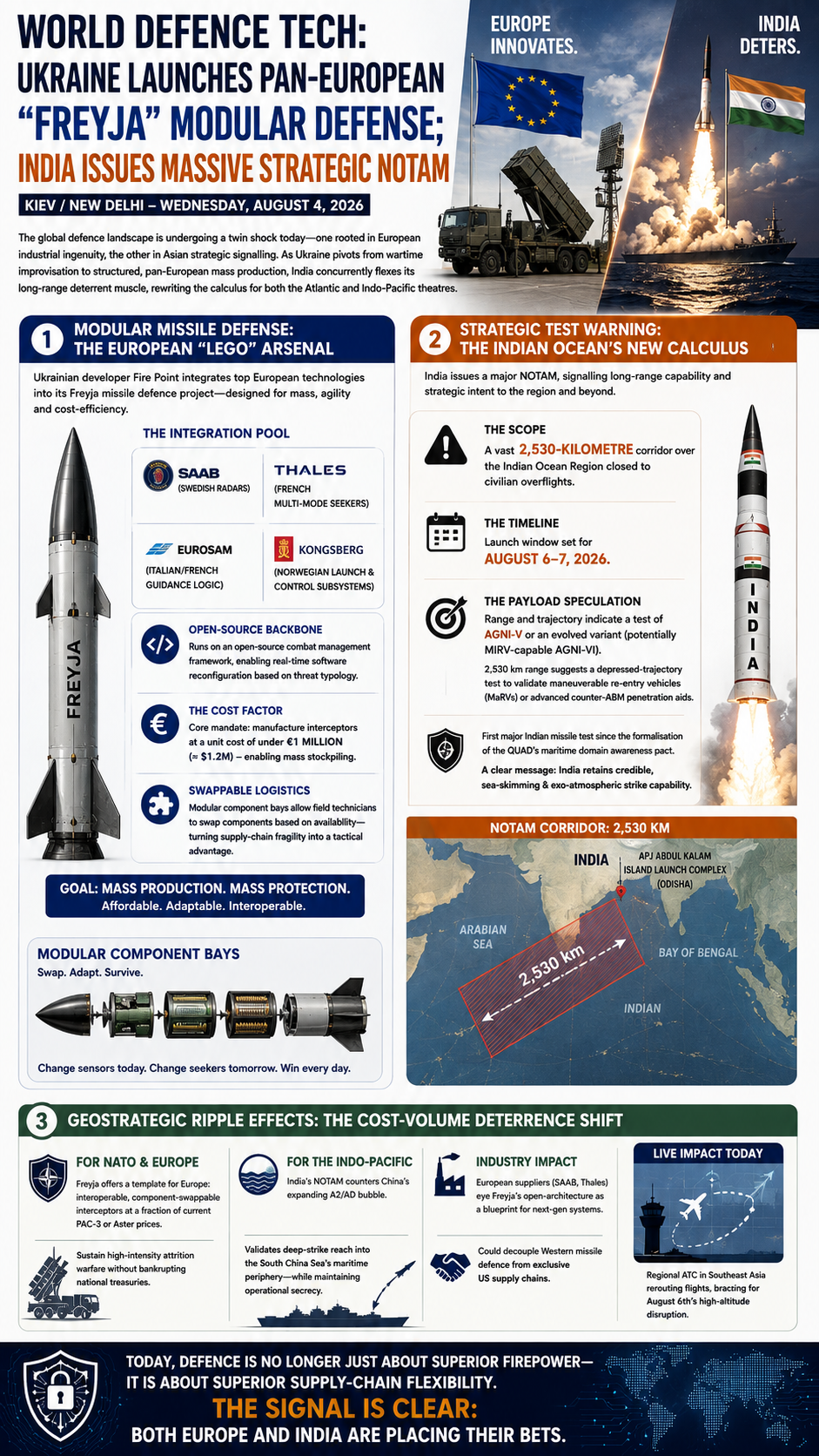
The Timeline: The launch window is set for August 6–7, originating from the APJ Abdul Kalam Island launch complex off the coast of Odisha.
The Payload Speculation: While the DRDO has not explicitly named the system, the range and trajectory point squarely toward a test of the Agni-V or an evolved variant (potentially the MIRV-capable Agni-VI). The 2,530 km range is notably shorter than its full 5,000+ km potential, suggesting a depressed-trajectory test aimed at validating maneuverable re-entry vehicles (MaRVs) or advanced counter-ABM penetration aids.
This is the first major Indian missile test since the formalisation of the QUAD's maritime domain awareness pact, and it serves as a pointed reminder to regional peers that India retains a credible, sea-skimming and exo-atmospheric strike capability.
GEOSTRATEGIC RIPPLE EFFECTS: The Cost-Volume Deterrence Shift
The convergence of these two events is not coincidental in its timing—it signals a global realignment toward affordable mass versus exquisite scarcity.
For NATO, Ukraine's Freyja project offers a template: if Europe can build interoperable, component-swappable interceptors at a fraction of current PAC-3 or Aster prices, the alliance can sustain high-intensity attrition warfare without bankrupting national treasuries.
For the Indo-Pacific, India's NOTAM serves as a direct counterweight to China's expanding anti-access/area-denial (A2/AD) bubble. The test validates that New Delhi's deterrent can reach deep into the South China Sea's maritime periphery, all while maintaining operational secrecy.
Industry observers note that European component suppliers—SAAB and Thales—are already eyeing Freyja's open-architecture as a blueprint for their next-generation surface-to-air systems, potentially decoupling Western missile defence from exclusive US supply chains. Meanwhile, regional air traffic controllers in Southeast Asia have begun rerouting flights, bracing for August 6th's high-altitude disruption. Today, defence is no longer just about superior firepower—it is about superior supply-chain flexibility, and the signal is clear: both Europe and India are placing their bets.

Vishal Sable
B.Tech AD @ shri balaji institute of technology and management
Engineering and tech journalist. I love exploring the impact of emerging technologies on global defense, sovereignty, and everyday life. Always looking for the real story behind the headlines.