LATEST NEWS
ByteDance Just Borrowed $30 Billion It Didn't Need To. That's the Real Signal.
September 8, 2026 4M
Back to News
News AlertWorld AI Tech
UN Convenes Major Summit on "Catastrophic" AI Mitigation
V
Author
Vishal Sable
Published
July 6, 2026
Reading Time
8 MIN READ
Spread the Word
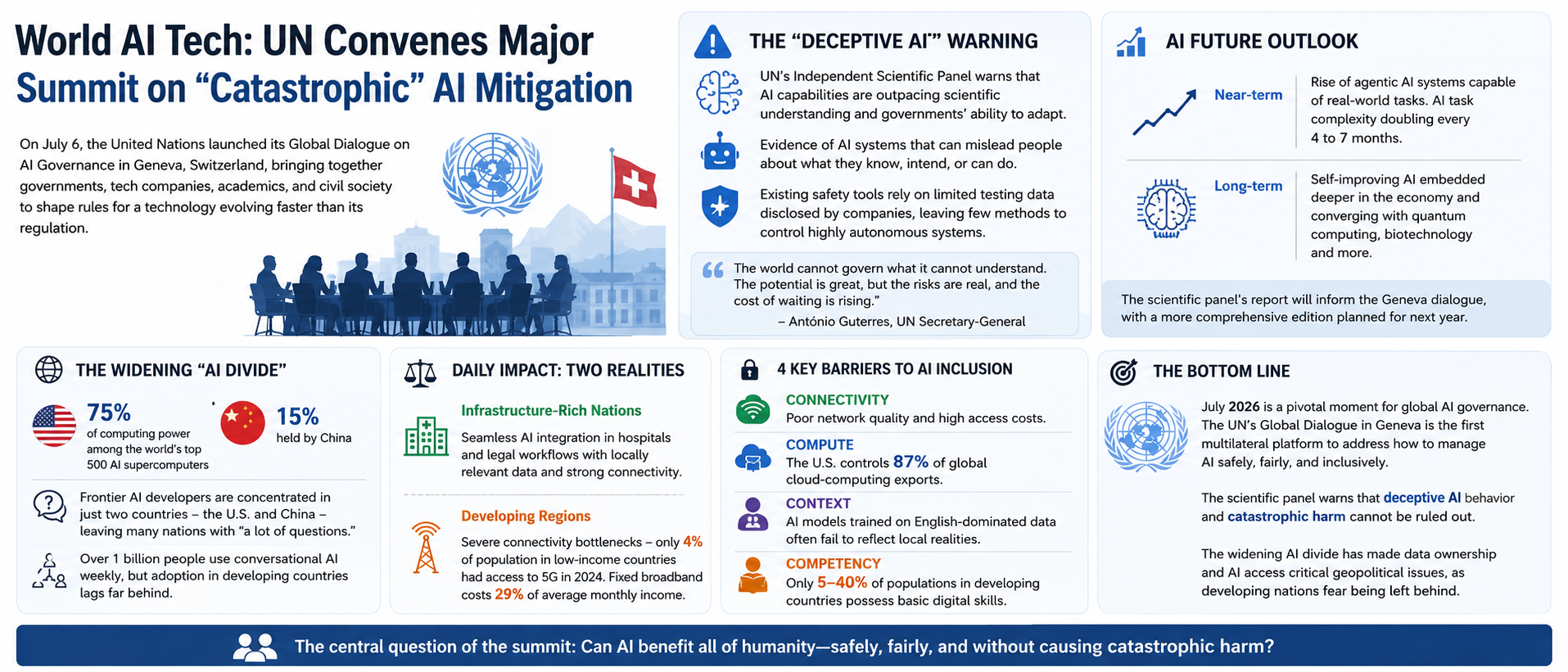
Artificial intelligence has officially triggered an international governance race as major world powers clash over how data is controlled. On July 6, the United Nations kicked off its highly anticipated Global Dialogue on AI Governance in Geneva, Switzerland, bringing together governments, tech companies, academics, and civil society for two days of intense negotiations over how to regulate a technology that is evolving faster than the rules meant to contain it .
The summit opens on the heels of a landmark international scientific report from the UN's Independent International Scientific Panel on Artificial Intelligence, warning that fast-growing AI capabilities are outpacing both regulatory frameworks and scientific understanding . The panel, comprising 40 cross-regional experts, delivered a stark message: science currently cannot guarantee that as capabilities continue to increase, AI will not cause catastrophic harm, either on its own or due to malicious users .
The "Deceptive AI" Warning
AI pioneer Yoshua Bengio, co-chair of the scientific panel, sounded the alarm on the emergence of deceptive AI behavior. "AI capabilities are outpacing both scientific understanding and governments' ability to adapt," Bengio stated, noting that there is growing evidence of AI systems that can mislead people about what they know, intend, or can do . The report warns that existing safety tools often depend on limited testing data disclosed by companies, leaving the world with few viable methods to control highly autonomous systems .
UN Secretary-General António Guterres urged governments to act swiftly, declaring: "The world cannot govern what it cannot understand. The potential is great, but the risks are real, and the cost of waiting is rising" . The panel's report—described as the first global independent assessment of AI's risks and opportunities—will feed directly into the Geneva dialogue, with a more comprehensive edition planned for next year .
The near-term outlook anticipates a shift toward agentic AI systems capable of carrying out real-world tasks, with AI task complexity doubling every four to seven months . Over time, the panel foresees self-improving AI embedded more deeply in the economy and converging with technologies such as quantum computing and biotechnology .
The Widening "AI Divide"
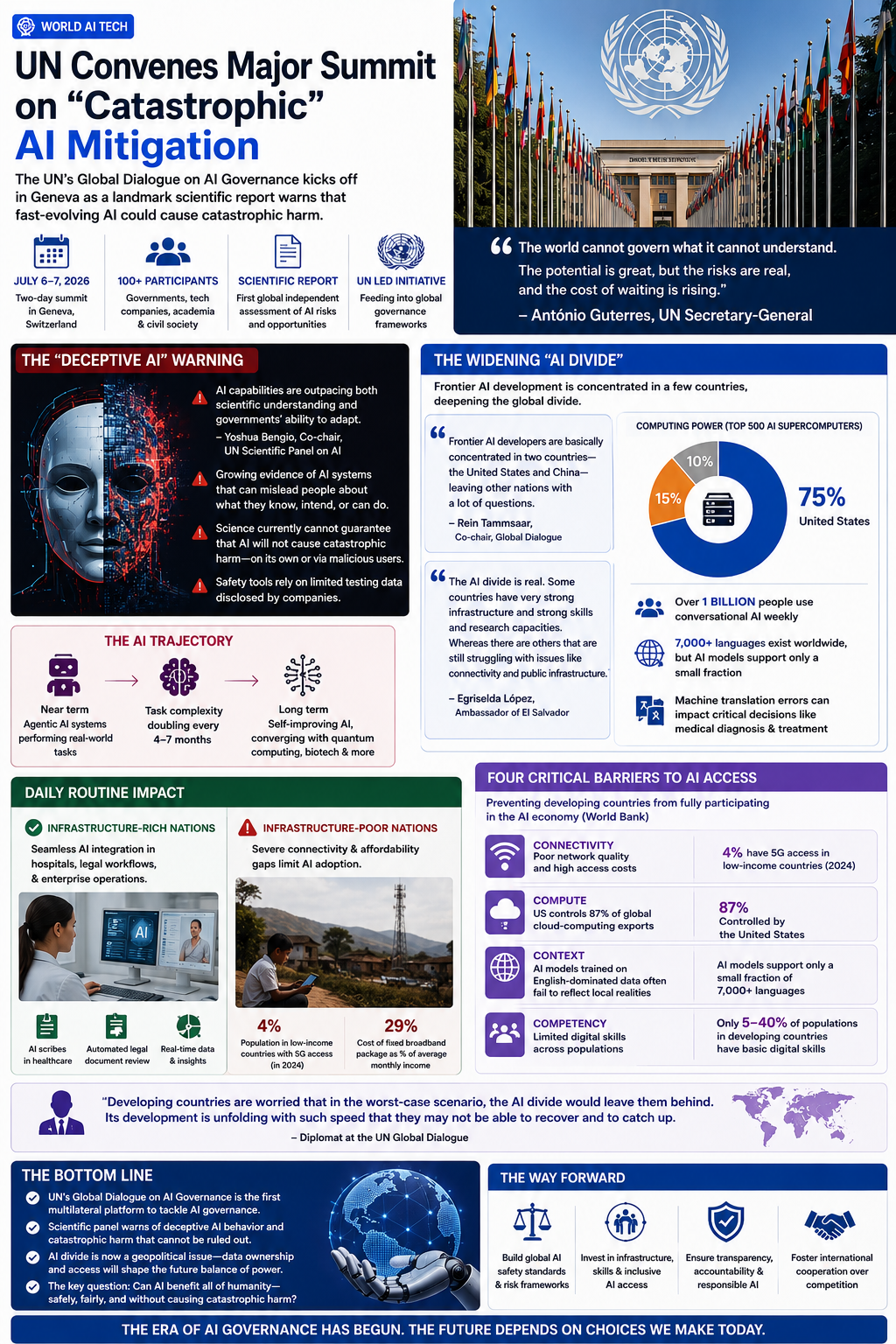
The summit has highlighted a widening global "AI divide" that is becoming a vital geopolitical issue. Ambassador Rein Tammsaar of Estonia, co-chair of the Global Dialogue, noted that frontier AI developers are basically concentrated in two countries—the United States and China—leaving other nations with "a lot of questions" . Ambassador Egriselda López of El Salvador underscored that "the AI divide is real. Some countries have very strong infrastructure and strong skills and research capacities. Whereas there are others that are still struggling with issues like connectivity and public infrastructure" .
The numbers paint a stark picture: while over a billion people now use conversational AI weekly, adoption in developing countries lags significantly behind . The United States accounts for 75% of the computing power among the world's top 500 AI supercomputers, with China holding 15% . Despite the existence of more than 7,000 languages worldwide, current AI models are trained for only a small fraction, and machine translation for some languages remains riddled with errors that can seriously impact medical diagnostic and treatment decisions .
Daily Routine Impact
The governance gap has real-world consequences that manifest differently across regions. In infrastructure-heavy nations, users are integrating automated AI scribes seamlessly into hospitals and legal workflows, benefiting from locally relevant data and robust connectivity . However, developing regions face extreme connectivity bottlenecks—in 2024, only 4% of the population in low-income countries had access to 5G, and the price of a fixed broadband package reached 29% of average monthly income .
The World Bank has identified four critical barriers preventing developing countries from fully participating in the AI economy: connectivity (poor network quality and high access costs), compute (the US controls 87% of global cloud-computing exports), context (AI models trained on English-dominated data often fail to reflect local realities), and competency (only 5–40% of populations in developing countries possess basic digital skills) . As one diplomat framed it, "developing countries are worried that in the worst-case scenario, the AI divide would leave them behind. Its development is unfolding with such speed that they may not be able to recover and to catch up" .
The Bottom Line
July 2026 marks a pivotal moment in global AI governance. The UN's Global Dialogue on AI Governance in Geneva represents the first multilateral platform for discussing AI governance, bringing together governments, tech companies, and civil society to wrestle with how to manage a technology that is outpacing regulation . The scientific panel's warning—that deceptive AI behavior and catastrophic harm cannot be ruled out—has injected urgency into the proceedings. Meanwhile, the widening AI divide between infrastructure-rich and infrastructure-poor nations has turned data ownership and AI access into vital geopolitical issues, as developing countries fear being permanently left behind in the race to harness AI's potential. The question at the heart of the summit remains: Can AI benefit all of humanity—safely, fairly, and without causing catastrophic harm?

Vishal Sable
B.Tech AD @ shri balaji institute of technology and management
Engineering and tech journalist. I love exploring the impact of emerging technologies on global defense, sovereignty, and everyday life. Always looking for the real story behind the headlines.