Back to News
News AlertWorld Money
Venture-Creation Capital Expands as Enterprise ERPs Transition to Autonomous Workflows
V
Author
Vishal Sable
Published
August 22, 2026
Reading Time
5 MIN READ
Spread the Word
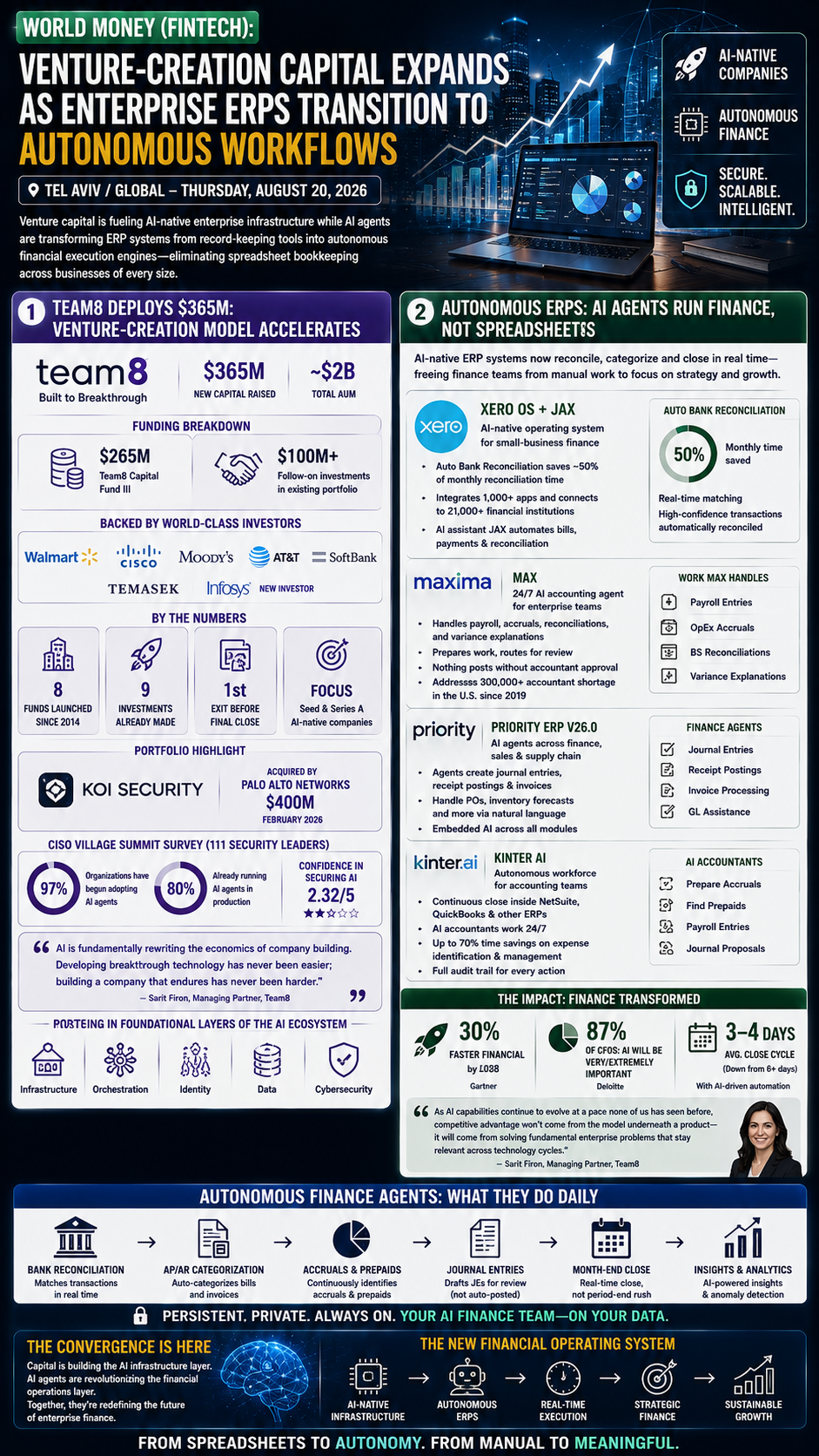
The financial technology landscape is being reshaped by two parallel forces: the expansion of venture-creation capital targeting AI-native enterprise infrastructure, and the accelerating transition of enterprise resource planning (ERP) systems from passive record-keeping to autonomous financial execution. Israeli venture group Team8 has secured $365 million in new capital, bringing its total assets under management to nearly $2 billion, while a wave of AI-native accounting agents and autonomous ERP platforms is eliminating traditional spreadsheet bookkeeping across small businesses and corporate finance desks alike.
TEAM8 DEPLOYS $365M: Venture-Creation Model Targets AI-Native Enterprise
Team8, the global venture group that develops and spins out technology companies, announced it has raised $365 million in fresh capital, comprising $265 million for Team8 Capital's third fund and more than $100 million earmarked for follow-on investments in existing portfolio companies. The new fund, managed by managing partners Sarit Firon and Liran Grinberg alongside partners Ori Barzilay and Hadar Siterman, will focus primarily on Seed and Series A companies building AI-native technologies across cybersecurity, software infrastructure, fintech and digital health.
The fundraising brings Team8's total assets under management to nearly $2 billion across eight funds launched since the firm was founded in 2014. Backers include Walmart, Cisco, Moody's, AT&T, SoftBank, Temasek, and new investor Infosys. The fund has already made nine investments and recorded its first exit before final close: Palo Alto Networks acquired Israeli cybersecurity startup Koi Security for a reported $400 million in February 2026.
The timing reflects a critical inflection point in enterprise AI adoption. According to a survey presented at Team8's CISO Village Summit, 97% of 111 security leaders surveyed said their organizations had already begun adopting AI agents, and 80% were already running them in production. Yet respondents rated their confidence in securing AI at just 2.32 out of five. "Agentic AI has become one of the most urgent operational and security challenges facing enterprises," the firm said.
Team8 Managing Partner Sarit Firon framed the opportunity in terms of enduring value: "AI is fundamentally rewriting the economics of company building. Developing breakthrough technology has never been easier; building a company that endures has never been harder". The firm plans to invest in what it views as foundational layers of the AI ecosystem—infrastructure, orchestration, identity, data, and cybersecurity—as AI agents are embedded in workflows faster than businesses can safely absorb the change.
DAILY ROUTINE IMPACT: Autonomous ERPs Eliminate Spreadsheet Bookkeeping
While venture capital flows to AI-native infrastructure, the financial operations of both small businesses and global enterprises are undergoing a quiet revolution. Traditional spreadsheet bookkeeping is being rapidly displaced by AI-native ERP systems that autonomously execute bank reconciliation, accounts payable and receivable categorization, and monthly ledger closes in real time.
For small and medium businesses, Xero has launched Xero OS, an AI-native operating system for small-business finance that marks a shift from a "system of record" to a "system of action". The platform underpins JAX, an AI finance assistant that automates bill analysis, payment setup, and bank reconciliation, drawing on data from more than 1,000 connected apps and real-time links to over 21,000 financial institutions worldwide. JAX's Auto Bank Reconciliation automates one of the most time-consuming manual tasks in bookkeeping, saving accountants and bookkeepers around 50% of their monthly bank reconciliation time, matching high-confidence transactions to bank feeds automatically in real time.
For enterprise accounting teams, Maxima has launched Max, a 24/7 AI agent that handles the manual and recurring preparation work consuming accounting departments—from payroll entries and operating expense accruals to balance sheet reconciliations and variance explanations. Max prepares the work and routes it to accountants for review, but nothing posts to the general ledger without their approval. The launch addresses a critical structural labour shortage: more than 300,000 accountants and auditors have left the U.S. workforce since 2019, with a record low of students entering the field.
Priority Software has embedded autonomous AI agents across finance, sales and supply chain modules in its Priority ERP V26.0 release, handling tasks such as journal entries, purchase orders, and inventory forecasts through natural language. In finance, agents create journal entries and receipt postings and assist with invoice processing.
Kinter.ai has launched what it describes as the first autonomous workforce for accounting teams, enabling continuous closes inside existing ERPs like NetSuite and QuickBooks. Kinter's AI accountants operate continuously—preparing accruals throughout the month, identifying prepaid expenses, automating payroll entries, and drafting journal entry proposals for review, while maintaining a complete audit trail for every action. Customers are realizing up to 70% time savings on identifying and managing expenses.
Gartner projects that finance organisations using cloud ERP systems with embedded AI assistants could achieve a 30% faster financial close by 2028, and Deloitte reports that 87% of CFOs expect AI to become very or extremely important to finance operations. Companies implementing AI-driven close automation are already compressing close cycles from six or more days to three to four days.
The convergence of venture-creation capital and autonomous ERP platforms signals a structural shift in how financial operations are built and executed. The era of spreadsheet-dependent bookkeeping is giving way to persistent, AI-native financial agents that reconcile, categorise, and close in real time—freeing finance professionals from manual execution to focus on analysis, strategy, and growth. As Team8's Sarit Firon observed: "As AI capabilities continue to evolve at a pace none of us has seen before, competitive advantage won't come from the model underneath a product—it will come from solving fundamental enterprise problems that stay relevant across technology cycles".

Vishal Sable
B.Tech AD @ shri balaji institute of technology and management
Engineering and tech journalist. I love exploring the impact of emerging technologies on global defense, sovereignty, and everyday life. Always looking for the real story behind the headlines.