Back to News
News AlertWorld Money
Visa & CaixaBank Execute First Real-World Agentic Payment; CNBC Names Top Fintechs
V
Author
Vishal Sable
Published
July 31, 2026
Reading Time
4 MIN READ
Spread the Word
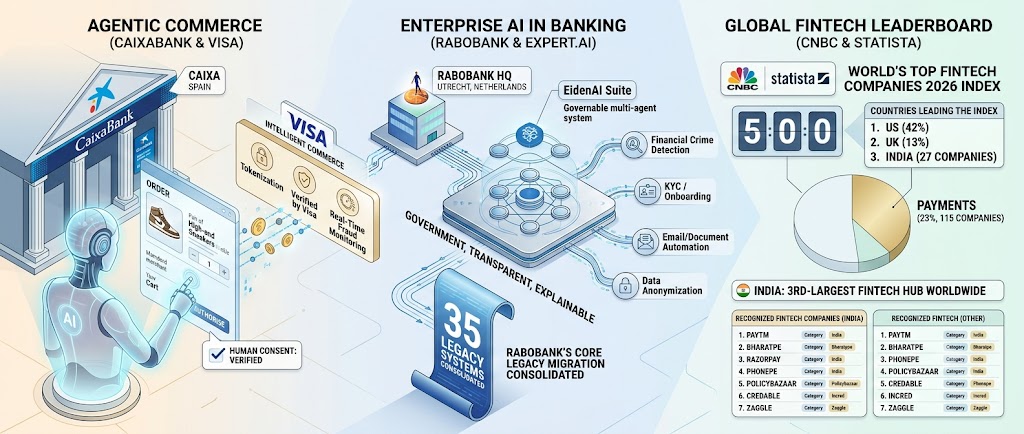
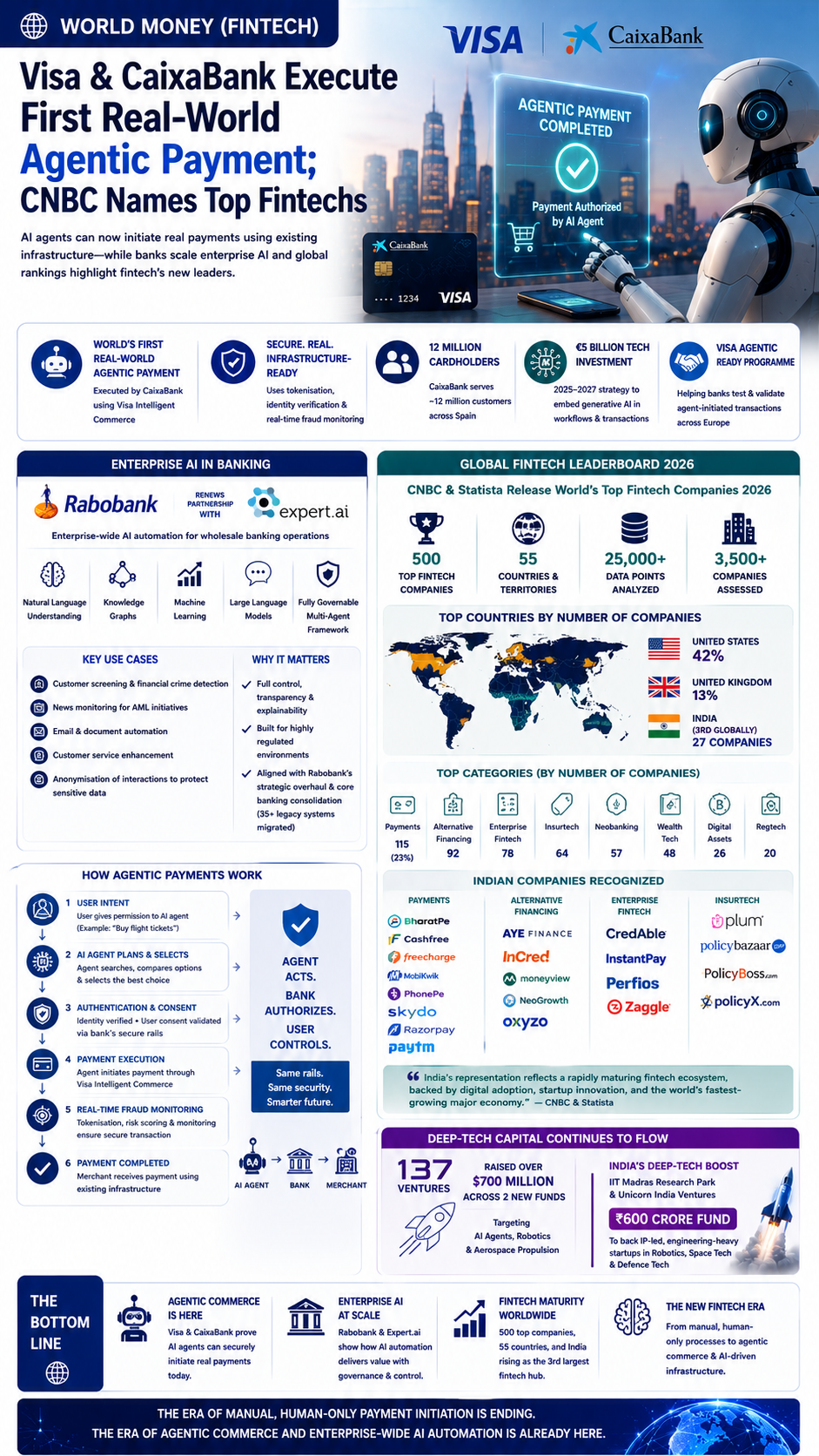
CaixaBank in Spain, working with Visa's Intelligent Commerce framework, has successfully executed a real-world payment initiated autonomously by an AI agent acting on behalf of a human user. The transaction, conducted using real card credentials and standard merchant systems, demonstrated that AI agents can securely initiate purchases within today's existing payments infrastructure. The payment was processed through Visa Intelligent Commerce, leveraging technologies already deployed across digital payments—including tokenisation, identity verification, and real-time fraud monitoring—without requiring changes to merchant infrastructure.
The initiative formed part of Visa's Agentic Ready programme in Europe, which was launched in March to help banks test and validate agent-initiated transactions. The identity and authorisation layer is central to the model, since a payment made by software on a person's behalf still has to be tied back to a verified human who authorised it. CaixaBank, headquartered in Valencia and serving around 12 million cardholders, is investing €5 billion through a 2025-to-2027 technology strategy focused on integrating generative AI into its workflows and transaction processing. The bank set up an internal AI office late last year and has begun rolling out conversational AI agents across its digital channels. The milestone reflects growing momentum behind agentic commerce as financial institutions explore using AI to automate purchasing decisions while retaining customer consent and control.
Enterprise AI in Banking
Rabobank renewed and extended its multi-year partnership with Expert.ai to deploy enterprise-wide automation across its wholesale banking operations. An Expert.ai customer since 2018, Rabobank will continue to leverage the company's AI solutions through the EidenAI Suite, built on a hybrid AI approach that combines natural language understanding, knowledge graphs, machine learning, and large language models within a fully governable, multi-agent framework. This approach enables advanced AI capabilities while maintaining full control, transparency, and explainability—critical requirements in highly regulated banking environments. EidenAI solutions support a wide range of priorities, from customer screening and financial crime detection during onboarding, to news monitoring for anti-money laundering initiatives, email and document automation, customer service enhancement, and the anonymisation of customer interactions to protect sensitive data. The partnership aligns with Rabobank's strategic overhaul to streamline and improve efficiency across business operations, following the bank's recent completion of a core banking migration that consolidated thousands of portfolios, facilities, loans, trades, and accounts from more than 35 legacy systems onto a single platform.
Global Leaderboards
CNBC and Statista released the World's Top Fintech Companies 2026 index, recognising 500 fintech companies across eight segments—payments, alternative financing, enterprise fintech, insurtech, neobanking, wealth technology, digital assets, and regtech. Statista assessed around 3,500 fintech companies and analysed more than 25,000 data points before selecting companies headquartered across 55 countries and territories. The United States led with 42% of recognised companies, followed by the United Kingdom at 13%, while India ranked third globally with 27 companies featured.
Payments remained the largest category globally, accounting for 115 companies (23% of the list). Indian companies recognised in the payments category include BharatPe, Cashfree, Freecharge, MobiKwik, PhonePe, Skydo, Razorpay, and Paytm. India also secured a significant presence in alternative financing (Aye Finance, InCred, Moneyview, NeoGrowth, Oxyzo), enterprise fintech (CredAble, InstantPay, Perfios, Zaggle), and insurtech (Plum, PolicyBazaar, PolicyBoss, PolicyX.com). CNBC noted that India's representation reflects a rapidly maturing fintech ecosystem, backed by widespread digital adoption, a thriving startup ecosystem, and the country's position as the world's fastest-growing major economy.
The Bottom Line
July 2026 confirms that agentic commerce is moving from theory to production—CaixaBank and Visa have proven that AI agents can securely execute card payments within existing infrastructure while maintaining issuer oversight and customer consent. Rabobank's renewed partnership with Expert.ai demonstrates that enterprise AI in banking is shifting from experimentation to scaled, governable deployment across wholesale operations. And CNBC and Statista's global ranking confirms that fintech is entering a maturity phase where scale, profitability, and AI-driven infrastructure define global success, with India emerging as the third-largest hub of recognised fintech companies worldwide. The era of manual, human-only payment initiation is ending. The era of agentic commerce and enterprise-wide AI automation is already here.

Vishal Sable
B.Tech AD @ shri balaji institute of technology and management
Engineering and tech journalist. I love exploring the impact of emerging technologies on global defense, sovereignty, and everyday life. Always looking for the real story behind the headlines.